




P-V diagram of an ideal gas is given in the figure
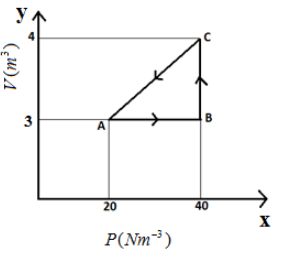
Work done on the gas in process CA is
A. $60J$
B. $70J$
C. $30J$
D. $20J$
Answer
 Verified
651.3k+ views
Hint:In a cyclic process, the total work done is equal to the area enclosed by the graph. The work done will be positive if the cycle is going in clockwise direction and negative if the cycle is going in an anti-clockwise direction.
Formula used:
$W = \dfrac{{({P_f} + {P_i})}}{2}\Delta V$
Where $W$ is the total work done, ${P_i}$ is the initial pressure, ${P_f}$ is the final pressure and $\Delta V$ is the change in volume.
Complete step by step solution:
In the above cyclic process, while going from C to A, we can notice that it is a straight line that is both the volume and pressure are changing. We can obtain the total work done in this in a similar way we find the work done for an adiabatic process which is $P\Delta V$ where $P$ is the pressure and $\Delta V$ is the change in volume of the gas. But instead of constant pressure $P$, we consider the average pressure $\dfrac{{({P_f} + {P_i})}}{2}$ .
Thus we obtain the formula $W = \dfrac{{({P_f} + {P_i})}}{2}\Delta V$ .
It the above figure, it is given the value of initial pressure ${P_i}$ as $20N{m^{ - 3}}$ , final pressure ${P_f}$ as $40N{m^{ - 3}}$ and we can obtain the change in volume $\Delta V$ as $1{m^3}$ .
By substituting these values in the above formula, we get
$W = \left( {\dfrac{{20 + 40}}{2}} \right) \times 1 = 30J$
So,the correct option is C.
Note:For a cyclic process that is going in anti-clockwise direction, the total work is negative. The total work done can be found by summing up all the works done in A to B, B to C and C to A or by finding the area enclosed by the graph.
Formula used:
$W = \dfrac{{({P_f} + {P_i})}}{2}\Delta V$
Where $W$ is the total work done, ${P_i}$ is the initial pressure, ${P_f}$ is the final pressure and $\Delta V$ is the change in volume.
Complete step by step solution:
In the above cyclic process, while going from C to A, we can notice that it is a straight line that is both the volume and pressure are changing. We can obtain the total work done in this in a similar way we find the work done for an adiabatic process which is $P\Delta V$ where $P$ is the pressure and $\Delta V$ is the change in volume of the gas. But instead of constant pressure $P$, we consider the average pressure $\dfrac{{({P_f} + {P_i})}}{2}$ .
Thus we obtain the formula $W = \dfrac{{({P_f} + {P_i})}}{2}\Delta V$ .
It the above figure, it is given the value of initial pressure ${P_i}$ as $20N{m^{ - 3}}$ , final pressure ${P_f}$ as $40N{m^{ - 3}}$ and we can obtain the change in volume $\Delta V$ as $1{m^3}$ .
By substituting these values in the above formula, we get
$W = \left( {\dfrac{{20 + 40}}{2}} \right) \times 1 = 30J$
So,the correct option is C.
Note:For a cyclic process that is going in anti-clockwise direction, the total work is negative. The total work done can be found by summing up all the works done in A to B, B to C and C to A or by finding the area enclosed by the graph.
Recently Updated Pages
Which will be the least stable resonating structure class 11 chemistry CBSE

How many 5 digit telephone numbers can be construc-class-11-maths-CBSE
How do you find the angle of the resultant vector class 11 physics CBSE
Draw labelled diagram of the following i Gram seed class 11 biology CBSE
1 Quintal is equal to a 110 kg b 10 kg c 100kg d 1000 class 11 physics CBSE
What is the need and importance of classification class 11 biology CBSE
Trending doubts
Find the value of the expression given below sin 30circ class 11 maths CBSE
One Metric ton is equal to kg A 10000 B 1000 C 100 class 11 physics CBSE
10 examples of friction in our daily life
Draw a diagram of a plant cell and label at least eight class 11 biology CBSE
Difference between physical and chemical change class 11 chemistry CBSE
Proton was discovered by A Thomson B Rutherford C Chadwick class 11 chemistry CBSE