




Prove the given inverse trigonometric expression: $\tan \left( \dfrac{1}{2}{{\sin }^{-1}}\left( \dfrac{3}{4} \right) \right)=\dfrac{4-\sqrt{7}}{3}$.
Answer
 Verified
608.7k+ views
Hint: Assume, ${{\sin }^{-1}}\left( \dfrac{3}{4} \right)=\theta $. Convert this sine inverse function into tan inverse function. In the given sine inverse function, assume the numerator as perpendicular and denominator as hypotenuse. Find the base using Pythagoras theorem given by: $\text{(hypotenuse)}^{2}=\text{(base)}^{2}+\text{(perpendicular)}^{2}$. So, now we have to find the value of $\tan \left( \dfrac{\theta }{2} \right)$. Use the half angle formula: $\tan \theta =\dfrac{2\tan \left( \dfrac{\theta }{2} \right)}{1-{{\tan }^{2}}\left( \dfrac{\theta }{2} \right)}$, to form a quadratic equation in $\tan \left( \dfrac{\theta }{2} \right)$ by substituting the value of $\tan \theta $. Now, solve this quadratic equation to get the answer.
Complete step-by-step solution -
Let us assume: ${{\sin }^{-1}}\left( \dfrac{3}{4} \right)=\theta $.
We know that, $\sin \theta =\dfrac{\text{Perpendicular}}{\text{Hypotenuse}}$, therefore, $\theta ={{\sin }^{-1}}\left( \dfrac{\text{Perpendicular}}{\text{Hypotenuse}} \right)$. On comparing we get that, in ${{\sin }^{-1}}\left( \dfrac{3}{4} \right)$, 3 is the perpendicular and 4 is the hypotenuse.
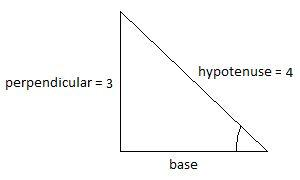
Using Pythagoras theorem given by: $\text{(hypotenuse)}^{2}=\text{(base)}^{2}+\text{(perpendicular)}^{2}$, we have,
$\begin{align}
& \text{(base)}^{2}=\text{(hypotenuse)}^{2}-\text{(perpendicular)}^{2} \\
& \Rightarrow \text{base}=\sqrt{\text{(hypotenuse)}^{2}-\text{(perpendicular)}^{2}} \\
& \Rightarrow \text{base}=\sqrt{{{4}^{\text{2}}}-{{3}^{\text{2}}}} \\
& \Rightarrow \text{base}=\sqrt{16-9} \\
& \Rightarrow \text{base}=\sqrt{7} \\
\end{align}$
Now, we know that, $\tan \theta =\dfrac{\text{Perpendicular}}{\text{Base}}$, therefore, $\theta ={{\tan }^{-1}}\left( \dfrac{\text{Perpendicular}}{\text{Base}} \right)$.
$\Rightarrow {{\sin }^{-1}}\left( \dfrac{3}{4} \right)={{\tan }^{-1}}\left( \dfrac{3}{\sqrt{7}} \right)$
Since, we have assumed, ${{\sin }^{-1}}\left( \dfrac{3}{4} \right)=\theta $.
$\begin{align}
& \Rightarrow {{\tan }^{-1}}\left( \dfrac{3}{\sqrt{7}} \right)=\theta \\
& \Rightarrow \tan \theta =\dfrac{3}{\sqrt{7}}..................(i) \\
\end{align}$
Now, the expression: $\tan \left( \dfrac{1}{2}{{\sin }^{-1}}\left( \dfrac{3}{4} \right) \right)$ becomes $\tan \left( \dfrac{\theta }{2} \right)$.
Now, applying the half angle formula: $\tan \theta =\dfrac{2\tan \left( \dfrac{\theta }{2} \right)}{1-{{\tan }^{2}}\left( \dfrac{\theta }{2} \right)}$, and substituting the value of $\tan \theta $ from equation (i), we get,
$\dfrac{3}{\sqrt{7}}=\dfrac{2\tan \left( \dfrac{\theta }{2} \right)}{1-{{\tan }^{2}}\left( \dfrac{\theta }{2} \right)}$
By cross-multiplication we get,
$\begin{align}
& 3-3{{\tan }^{2}}\left( \dfrac{\theta }{2} \right)=2\sqrt{7}\tan \left( \dfrac{\theta }{2} \right) \\
& \Rightarrow 3{{\tan }^{2}}\left( \dfrac{\theta }{2} \right)+2\sqrt{7}\tan \left( \dfrac{\theta }{2} \right)-3=0 \\
\end{align}$
Solving this quadratic equation by discriminant method, we get,
\[\begin{align}
& \tan \left( \dfrac{\theta }{2} \right)=\dfrac{-2\sqrt{7}\pm \sqrt{{{\left( 2\sqrt{7} \right)}^{2}}-4\times 3\times (-3)}}{2\times 3} \\
& \Rightarrow \tan \left( \dfrac{\theta }{2} \right)=\dfrac{-2\sqrt{7}\pm \sqrt{28+36}}{6} \\
& \Rightarrow \tan \left( \dfrac{\theta }{2} \right)=\dfrac{-2\sqrt{7}\pm \sqrt{64}}{6} \\
& \Rightarrow \tan \left( \dfrac{\theta }{2} \right)=\dfrac{-2\sqrt{7}\pm 8}{6} \\
& \Rightarrow \tan \left( \dfrac{\theta }{2} \right)=\dfrac{-\sqrt{7}\pm 4}{3} \\
& \text{either }\tan \left( \dfrac{\theta }{2} \right)=\dfrac{-\sqrt{7}+4}{3}\text{ or }\tan \left( \dfrac{\theta }{2} \right)=\dfrac{-\sqrt{7}-4}{3} \\
\end{align}\]
Since, $\sin \theta $ is positive, therefore, $\theta $ must be lying in the first quadrant. Hence, $\left( \dfrac{\theta }{2} \right)$ must lie in the first quadrant. So, $\tan \left( \dfrac{\theta }{2} \right)$ must be positive.
Hence, the only value of \[\tan \left( \dfrac{\theta }{2} \right)=\dfrac{4-\sqrt{7}}{3}\].
Note: There are many alternate ways to solve this question. We can convert the given sine inverse functions, in the L.H.S, to any of the desired inverse functions and then use the Pythagoras theorem to get the answer. Here, we have changed it in tan inverse function. You may change it in cosine inverse function by taking the ratio of base and hypotenuse and then apply the formula: \[{{\tan }^{2}}\left( \dfrac{\theta }{2} \right)=\dfrac{1-\cos \theta }{1+\cos \theta }\], to get the answer.
Complete step-by-step solution -
Let us assume: ${{\sin }^{-1}}\left( \dfrac{3}{4} \right)=\theta $.
We know that, $\sin \theta =\dfrac{\text{Perpendicular}}{\text{Hypotenuse}}$, therefore, $\theta ={{\sin }^{-1}}\left( \dfrac{\text{Perpendicular}}{\text{Hypotenuse}} \right)$. On comparing we get that, in ${{\sin }^{-1}}\left( \dfrac{3}{4} \right)$, 3 is the perpendicular and 4 is the hypotenuse.
Using Pythagoras theorem given by: $\text{(hypotenuse)}^{2}=\text{(base)}^{2}+\text{(perpendicular)}^{2}$, we have,
$\begin{align}
& \text{(base)}^{2}=\text{(hypotenuse)}^{2}-\text{(perpendicular)}^{2} \\
& \Rightarrow \text{base}=\sqrt{\text{(hypotenuse)}^{2}-\text{(perpendicular)}^{2}} \\
& \Rightarrow \text{base}=\sqrt{{{4}^{\text{2}}}-{{3}^{\text{2}}}} \\
& \Rightarrow \text{base}=\sqrt{16-9} \\
& \Rightarrow \text{base}=\sqrt{7} \\
\end{align}$
Now, we know that, $\tan \theta =\dfrac{\text{Perpendicular}}{\text{Base}}$, therefore, $\theta ={{\tan }^{-1}}\left( \dfrac{\text{Perpendicular}}{\text{Base}} \right)$.
$\Rightarrow {{\sin }^{-1}}\left( \dfrac{3}{4} \right)={{\tan }^{-1}}\left( \dfrac{3}{\sqrt{7}} \right)$
Since, we have assumed, ${{\sin }^{-1}}\left( \dfrac{3}{4} \right)=\theta $.
$\begin{align}
& \Rightarrow {{\tan }^{-1}}\left( \dfrac{3}{\sqrt{7}} \right)=\theta \\
& \Rightarrow \tan \theta =\dfrac{3}{\sqrt{7}}..................(i) \\
\end{align}$
Now, the expression: $\tan \left( \dfrac{1}{2}{{\sin }^{-1}}\left( \dfrac{3}{4} \right) \right)$ becomes $\tan \left( \dfrac{\theta }{2} \right)$.
Now, applying the half angle formula: $\tan \theta =\dfrac{2\tan \left( \dfrac{\theta }{2} \right)}{1-{{\tan }^{2}}\left( \dfrac{\theta }{2} \right)}$, and substituting the value of $\tan \theta $ from equation (i), we get,
$\dfrac{3}{\sqrt{7}}=\dfrac{2\tan \left( \dfrac{\theta }{2} \right)}{1-{{\tan }^{2}}\left( \dfrac{\theta }{2} \right)}$
By cross-multiplication we get,
$\begin{align}
& 3-3{{\tan }^{2}}\left( \dfrac{\theta }{2} \right)=2\sqrt{7}\tan \left( \dfrac{\theta }{2} \right) \\
& \Rightarrow 3{{\tan }^{2}}\left( \dfrac{\theta }{2} \right)+2\sqrt{7}\tan \left( \dfrac{\theta }{2} \right)-3=0 \\
\end{align}$
Solving this quadratic equation by discriminant method, we get,
\[\begin{align}
& \tan \left( \dfrac{\theta }{2} \right)=\dfrac{-2\sqrt{7}\pm \sqrt{{{\left( 2\sqrt{7} \right)}^{2}}-4\times 3\times (-3)}}{2\times 3} \\
& \Rightarrow \tan \left( \dfrac{\theta }{2} \right)=\dfrac{-2\sqrt{7}\pm \sqrt{28+36}}{6} \\
& \Rightarrow \tan \left( \dfrac{\theta }{2} \right)=\dfrac{-2\sqrt{7}\pm \sqrt{64}}{6} \\
& \Rightarrow \tan \left( \dfrac{\theta }{2} \right)=\dfrac{-2\sqrt{7}\pm 8}{6} \\
& \Rightarrow \tan \left( \dfrac{\theta }{2} \right)=\dfrac{-\sqrt{7}\pm 4}{3} \\
& \text{either }\tan \left( \dfrac{\theta }{2} \right)=\dfrac{-\sqrt{7}+4}{3}\text{ or }\tan \left( \dfrac{\theta }{2} \right)=\dfrac{-\sqrt{7}-4}{3} \\
\end{align}\]
Since, $\sin \theta $ is positive, therefore, $\theta $ must be lying in the first quadrant. Hence, $\left( \dfrac{\theta }{2} \right)$ must lie in the first quadrant. So, $\tan \left( \dfrac{\theta }{2} \right)$ must be positive.
Hence, the only value of \[\tan \left( \dfrac{\theta }{2} \right)=\dfrac{4-\sqrt{7}}{3}\].
Note: There are many alternate ways to solve this question. We can convert the given sine inverse functions, in the L.H.S, to any of the desired inverse functions and then use the Pythagoras theorem to get the answer. Here, we have changed it in tan inverse function. You may change it in cosine inverse function by taking the ratio of base and hypotenuse and then apply the formula: \[{{\tan }^{2}}\left( \dfrac{\theta }{2} \right)=\dfrac{1-\cos \theta }{1+\cos \theta }\], to get the answer.
Recently Updated Pages
Master Class 12 Economics: Engaging Questions & Answers for Success

Master Class 12 Physics: Engaging Questions & Answers for Success
Master Class 12 English: Engaging Questions & Answers for Success
Master Class 12 Social Science: Engaging Questions & Answers for Success
Master Class 12 Maths: Engaging Questions & Answers for Success
Master Class 12 Business Studies: Engaging Questions & Answers for Success
Trending doubts
Which are the Top 10 Largest Countries of the World?
What are the major means of transport Explain each class 12 social science CBSE
Draw a labelled sketch of the human eye class 12 physics CBSE
Why cannot DNA pass through cell membranes class 12 biology CBSE
Differentiate between insitu conservation and exsitu class 12 biology CBSE
Draw a neat and well labeled diagram of TS of ovary class 12 biology CBSE