




Prove that the trigonometric expression $2{\tan ^{ - 1}}x = {\sin ^{ - 1}}\left( {\dfrac{{2x}}{{1 + {x^2}}}} \right)$ holds true.
Answer
 Verified
639k+ views
Hint – In this question consider the L.H.S part and break $2{\tan ^{ - 1}}x$ into ${\tan ^{ - 1}}x + {\tan ^{ - 1}}x$, then apply the formula${\tan ^{ - 1}}A + {\tan ^{ - 1}}B = {\tan ^{ - 1}}\left( {\dfrac{{A + B}}{{1 - AB}}} \right)$. Then convert trigonometric identity of ${\tan ^{ - 1}}x{\text{ into si}}{{\text{n}}^{ - 1}}x$ to get the proof.
Complete step-by-step solution -
Proof –
Consider L.H.S
$ \Rightarrow 2{\tan ^{ - 1}}x$
This is written as
$ \Rightarrow {\tan ^{ - 1}}x + {\tan ^{ - 1}}x$
Now as we know that ${\tan ^{ - 1}}A + {\tan ^{ - 1}}B = {\tan ^{ - 1}}\left( {\dfrac{{A + B}}{{1 - AB}}} \right)$ so use this property in above equation we have,
$ \Rightarrow {\tan ^{ - 1}}x + {\tan ^{ - 1}}x = {\tan ^{ - 1}}\left( {\dfrac{{x + x}}{{1 - {x^2}}}} \right) = {\tan ^{ - 1}}\left( {\dfrac{{2x}}{{1 - {x^2}}}} \right)$
Now let
y = ${\tan ^{ - 1}}\left( {\dfrac{{2x}}{{1 - {x^2}}}} \right)$................. (1)
$ \Rightarrow \tan y = \left( {\dfrac{{2x}}{{1 - {x^2}}}} \right)$
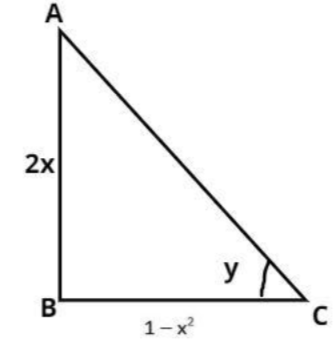
Now as we know tan is ratio of perpendicular to base
Therefore perpendicular = 2x
And base = $(1 – {x^2})$.
Now apply Pythagoras theorem in right triangle ABC as shown above we have,
\[ \Rightarrow {\left( {{\text{Hypotenuse}}} \right)^2} = {\left( {{\text{perpendicular}}} \right)^2} + {\left( {{\text{base}}} \right)^2}\]
\[ \Rightarrow {\left( {{\text{Hypotenuse}}} \right)^2} = {\left( {2x} \right)^2} + {\left( {1 - {x^2}} \right)^2}\]
Now simplify this we have,
\[ \Rightarrow {\left( {{\text{Hypotenuse}}} \right)^2} = 4{x^2} + 1 + {x^4} - 2{x^2} = 1 + 2{x^2} + {x^4} = {\left( {1 + {x^2}} \right)^2}\]
Therefore, \[\left( {{\text{Hypotenuse}}} \right) = \left( {1 + {x^2}} \right)\]
Now as we know sin is the ratio of perpendicular to hypotenuse so we have,
$ \Rightarrow \sin y = \dfrac{{2x}}{{1 + {x^2}}}$
$ \Rightarrow y = {\sin ^{ - 1}}\left( {\dfrac{{2x}}{{1 + {x^2}}}} \right)$
So from equation (1) we have,
$ \Rightarrow {\tan ^{ - 1}}\left( {\dfrac{{2x}}{{1 - {x^2}}}} \right) = {\sin ^{ - 1}}\left( {\dfrac{{2x}}{{1 + {x^2}}}} \right)$
= L.H.S
Hence proved.
Note – The conversion of one inverse trigonometric identity into another is based upon the same concept as that of conversion of a normal trigonometric ratio into another. A right angled triangle depicting sides of perpendicular, base and hypotenuse, helps establish relations.
Complete step-by-step solution -
Proof –
Consider L.H.S
$ \Rightarrow 2{\tan ^{ - 1}}x$
This is written as
$ \Rightarrow {\tan ^{ - 1}}x + {\tan ^{ - 1}}x$
Now as we know that ${\tan ^{ - 1}}A + {\tan ^{ - 1}}B = {\tan ^{ - 1}}\left( {\dfrac{{A + B}}{{1 - AB}}} \right)$ so use this property in above equation we have,
$ \Rightarrow {\tan ^{ - 1}}x + {\tan ^{ - 1}}x = {\tan ^{ - 1}}\left( {\dfrac{{x + x}}{{1 - {x^2}}}} \right) = {\tan ^{ - 1}}\left( {\dfrac{{2x}}{{1 - {x^2}}}} \right)$
Now let
y = ${\tan ^{ - 1}}\left( {\dfrac{{2x}}{{1 - {x^2}}}} \right)$................. (1)
$ \Rightarrow \tan y = \left( {\dfrac{{2x}}{{1 - {x^2}}}} \right)$
Now as we know tan is ratio of perpendicular to base
Therefore perpendicular = 2x
And base = $(1 – {x^2})$.
Now apply Pythagoras theorem in right triangle ABC as shown above we have,
\[ \Rightarrow {\left( {{\text{Hypotenuse}}} \right)^2} = {\left( {{\text{perpendicular}}} \right)^2} + {\left( {{\text{base}}} \right)^2}\]
\[ \Rightarrow {\left( {{\text{Hypotenuse}}} \right)^2} = {\left( {2x} \right)^2} + {\left( {1 - {x^2}} \right)^2}\]
Now simplify this we have,
\[ \Rightarrow {\left( {{\text{Hypotenuse}}} \right)^2} = 4{x^2} + 1 + {x^4} - 2{x^2} = 1 + 2{x^2} + {x^4} = {\left( {1 + {x^2}} \right)^2}\]
Therefore, \[\left( {{\text{Hypotenuse}}} \right) = \left( {1 + {x^2}} \right)\]
Now as we know sin is the ratio of perpendicular to hypotenuse so we have,
$ \Rightarrow \sin y = \dfrac{{2x}}{{1 + {x^2}}}$
$ \Rightarrow y = {\sin ^{ - 1}}\left( {\dfrac{{2x}}{{1 + {x^2}}}} \right)$
So from equation (1) we have,
$ \Rightarrow {\tan ^{ - 1}}\left( {\dfrac{{2x}}{{1 - {x^2}}}} \right) = {\sin ^{ - 1}}\left( {\dfrac{{2x}}{{1 + {x^2}}}} \right)$
= L.H.S
Hence proved.
Note – The conversion of one inverse trigonometric identity into another is based upon the same concept as that of conversion of a normal trigonometric ratio into another. A right angled triangle depicting sides of perpendicular, base and hypotenuse, helps establish relations.
Recently Updated Pages
Master Class 12 Business Studies: Engaging Questions & Answers for Success

Master Class 12 Biology: Engaging Questions & Answers for Success
Master Class 12 Chemistry: Engaging Questions & Answers for Success
Class 12 Question and Answer - Your Ultimate Solutions Guide
Master Class 11 Social Science: Engaging Questions & Answers for Success
Master Class 11 English: Engaging Questions & Answers for Success
Trending doubts
Which is more stable and why class 12 chemistry CBSE
What are the major means of transport Explain each class 12 social science CBSE
Give 10 examples of unisexual and bisexual flowers
Which one is the sweetest sugar a Glucose b Fructose class 12 biology CBSE
The first microscope was invented by A Leeuwenhoek class 12 biology CBSE
What is the Full Form of 1.DPT 2.DDT 3.BCG