



Prove that the sum of any two sides of a triangle is greater than the third side.
Answer
 Verified
611.7k+ views
Hint: Consider a triangle $ABC$. Extend $AB$ to $D$ such that $AD = AC$.Then apply the theorem that in a triangle , the side opposite to the larger angle is longer.
Complete step-by-step answer:
Given: A triangle $ABC$.
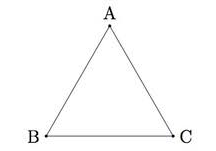
To prove: $AB + AC > BC$
$AB + BC > AC$
$BC + AC > AB$
Construction: Extend $AB$ to $D$ such that $AD = AC$.
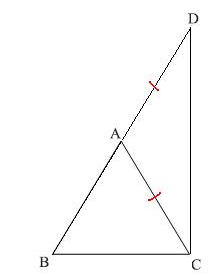
Proof: In $\Delta ACD$,
$AC = CD$ (By Construction)
$\therefore \angle ADC = \angle ACD$ (In a triangle, angles opposite to equal sides are equal)
Now, $\angle BCD = \angle BCA + \angle ACD$
$\angle BCD = \angle BCA + \angle ADC$ $\left( {\because \angle ADC = \angle ACD} \right)$
$ \Rightarrow $$\angle BCD > \angle BDC$
$ \Rightarrow BD > BC$ (In a triangle , side opposite to the larger angle is longer)
$ \Rightarrow AB + AD > BC$ $\left( {\because BD = AB + AD} \right)$
$ \Rightarrow AB + AC > BC$ ($\because AD = AC$ by construction)
Therefore the sum of any two sides of a triangle is greater than the third side.
Note: The two other statements i.e., $AB + BC > AC$ and $BC + AC > AB$ can also be proved in the same manner as we proved $AB + AC > BC$.
Complete step-by-step answer:
Given: A triangle $ABC$.
To prove: $AB + AC > BC$
$AB + BC > AC$
$BC + AC > AB$
Construction: Extend $AB$ to $D$ such that $AD = AC$.
Proof: In $\Delta ACD$,
$AC = CD$ (By Construction)
$\therefore \angle ADC = \angle ACD$ (In a triangle, angles opposite to equal sides are equal)
Now, $\angle BCD = \angle BCA + \angle ACD$
$\angle BCD = \angle BCA + \angle ADC$ $\left( {\because \angle ADC = \angle ACD} \right)$
$ \Rightarrow $$\angle BCD > \angle BDC$
$ \Rightarrow BD > BC$ (In a triangle , side opposite to the larger angle is longer)
$ \Rightarrow AB + AD > BC$ $\left( {\because BD = AB + AD} \right)$
$ \Rightarrow AB + AC > BC$ ($\because AD = AC$ by construction)
Therefore the sum of any two sides of a triangle is greater than the third side.
Note: The two other statements i.e., $AB + BC > AC$ and $BC + AC > AB$ can also be proved in the same manner as we proved $AB + AC > BC$.

Recently Updated Pages
Master Class 9 General Knowledge: Engaging Questions & Answers for Success

Master Class 9 Maths: Engaging Questions & Answers for Success
Master Class 9 Science: Engaging Questions & Answers for Success
Master Class 9 English: Engaging Questions & Answers for Success
Master Class 9 Social Science: Engaging Questions & Answers for Success
Class 9 Question and Answer - Your Ultimate Solutions Guide
Trending doubts
What is the situation called when no party gets the class 9 social science CBSE
Find the sum of series 1 + 2 + 3 + 4 + 5 + + 100 class 9 maths CBSE
Difference Between Plant Cell and Animal Cell
Fill the blanks with the suitable prepositions 1 The class 9 english CBSE
What is pollution? How many types of pollution? Define it
What is the Full Form of ICSE / ISC ?