




Prove that the radius of the right circular cylinder of greatest curved surface area which can be inscribed in a given cone is half of that of the cone.
Answer
 Verified
627.9k+ views
Hint: First of all, draw the diagram for the problem with the given data which will give us a clear idea of what we have to find. Then find the curved surface area of the cylinder and then prove the problem by using a second derivative test.
Complete step-by-step answer:
Let \[{\text{OC}} = r\] be the radius of the cone
\[{\text{OA}} = h\] be the height of the cone
\[\angle {\text{OAQ}} = \alpha \] be the semi vertical angle of the cone
Let \[{\text{OE}} = x\] be the radius of the cylinder
\[{\text{OO'}} = \] height of the cylinder
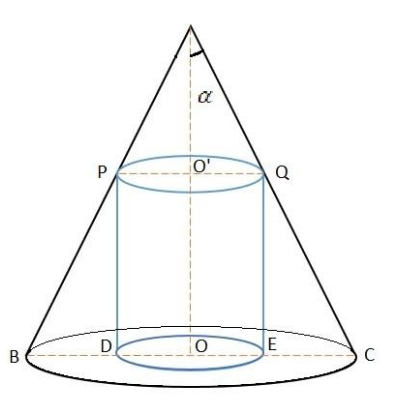
From the diagram,
In \[\Delta {\text{AO'Q}}\]
\[
\tan \alpha = \dfrac{{{\text{O'Q}}}}{{{\text{AO'}}}} \\
\tan \alpha = \dfrac{{{\text{OE}}}}{{{\text{OA - O'O}}}} \\
\tan \alpha = \dfrac{x}{{h - {\text{O'O}}}}...........................................\left( 1 \right) \\
\]
In \[\Delta {\text{AOC}}\]
\[
\tan \alpha = \dfrac{{{\text{OC}}}}{{{\text{OA}}}} \\
\tan \alpha = \dfrac{r}{h}...........................................\left( 2 \right) \\
\]
From equations (1) and (2), we have
\[
\dfrac{x}{{h - {\text{O'O}}}} = \dfrac{r}{h} \\
\dfrac{{hx}}{r} = h - {\text{O'O}} \\
{\text{O'O}} = \dfrac{{hr - hx}}{r} \\
{\text{O'O}} = \dfrac{{h\left( {r - x} \right)}}{r} \\
\]
We know that the curved surface of cylinder \[ = 2\pi \times {\text{Radius}} \times {\text{Height}}\]
So, curved surface area of cylinder is given by
\[
S = 2\pi \times x \times {\text{O'O}} \\
S = 2\pi xh\dfrac{{\left( {r - x} \right)}}{r} \\
S = \dfrac{{2\pi h}}{r}\left( {rx - {x^2}} \right){\text{ }}\left( {{\text{where k}} = \dfrac{{2\pi h}}{r}{\text{ is a constant}}} \right) \\
\]
Now, differentiating S w.r.t \[x\] i.e., \[S'\left( x \right)\]
\[
S' = \dfrac{d}{{dx}}\left( {k\left( {rx - {x^2}} \right)} \right) \\
S' = k\dfrac{d}{{dx}}\left( {rx - {x^2}} \right) \\
\therefore S' = k\left( {r - 2x} \right) \\
\]
Now, differentiating \[S'\left( x \right)\] w.r.t again \[x\] i.e., \[S''\left( x \right)\]
\[
S'' = \dfrac{d}{{dx}}\left( {k\left( {r - 2x} \right)} \right) \\
S'' = k\dfrac{d}{{dx}}\left( {r - 2x} \right) \\
S'' = k\left( {0 - 2} \right) \\
\therefore S'' = - 2k \\
\]
We know that the minimum or maximum value of S occurs at \[S'\left( x \right) = 0\]
So, put \[S'\left( x \right) = 0\]
\[
k\left( {r - 2x} \right) = 0 \\
\therefore x = \dfrac{r}{2} \\
\]
Now, finding \[S''\left( x \right)\] at \[x = \dfrac{r}{2}\], we have
\[
{{S''}_{x = \dfrac{r}{2}}} = - 2k < 0 \\
\therefore {{S''}_{x = \dfrac{r}{2}}} < 0 \\
\]
Therefore, \[x = \dfrac{r}{2}\] is maxima of S.
As the second derivative of the curved surface area of the cylinder is less than zero, the radius of cylinder with greatest curved surface area which can be inscribed in a given cone is half of that cone.
Note: The curved surface area of the cylinder with radius \[r\] and height \[h\] is given by \[S = 2\pi rh\]. The second derivative test is used to determine whether a stationary point is a local maximum or a local minimum.
Complete step-by-step answer:
Let \[{\text{OC}} = r\] be the radius of the cone
\[{\text{OA}} = h\] be the height of the cone
\[\angle {\text{OAQ}} = \alpha \] be the semi vertical angle of the cone
Let \[{\text{OE}} = x\] be the radius of the cylinder
\[{\text{OO'}} = \] height of the cylinder
From the diagram,
In \[\Delta {\text{AO'Q}}\]
\[
\tan \alpha = \dfrac{{{\text{O'Q}}}}{{{\text{AO'}}}} \\
\tan \alpha = \dfrac{{{\text{OE}}}}{{{\text{OA - O'O}}}} \\
\tan \alpha = \dfrac{x}{{h - {\text{O'O}}}}...........................................\left( 1 \right) \\
\]
In \[\Delta {\text{AOC}}\]
\[
\tan \alpha = \dfrac{{{\text{OC}}}}{{{\text{OA}}}} \\
\tan \alpha = \dfrac{r}{h}...........................................\left( 2 \right) \\
\]
From equations (1) and (2), we have
\[
\dfrac{x}{{h - {\text{O'O}}}} = \dfrac{r}{h} \\
\dfrac{{hx}}{r} = h - {\text{O'O}} \\
{\text{O'O}} = \dfrac{{hr - hx}}{r} \\
{\text{O'O}} = \dfrac{{h\left( {r - x} \right)}}{r} \\
\]
We know that the curved surface of cylinder \[ = 2\pi \times {\text{Radius}} \times {\text{Height}}\]
So, curved surface area of cylinder is given by
\[
S = 2\pi \times x \times {\text{O'O}} \\
S = 2\pi xh\dfrac{{\left( {r - x} \right)}}{r} \\
S = \dfrac{{2\pi h}}{r}\left( {rx - {x^2}} \right){\text{ }}\left( {{\text{where k}} = \dfrac{{2\pi h}}{r}{\text{ is a constant}}} \right) \\
\]
Now, differentiating S w.r.t \[x\] i.e., \[S'\left( x \right)\]
\[
S' = \dfrac{d}{{dx}}\left( {k\left( {rx - {x^2}} \right)} \right) \\
S' = k\dfrac{d}{{dx}}\left( {rx - {x^2}} \right) \\
\therefore S' = k\left( {r - 2x} \right) \\
\]
Now, differentiating \[S'\left( x \right)\] w.r.t again \[x\] i.e., \[S''\left( x \right)\]
\[
S'' = \dfrac{d}{{dx}}\left( {k\left( {r - 2x} \right)} \right) \\
S'' = k\dfrac{d}{{dx}}\left( {r - 2x} \right) \\
S'' = k\left( {0 - 2} \right) \\
\therefore S'' = - 2k \\
\]
We know that the minimum or maximum value of S occurs at \[S'\left( x \right) = 0\]
So, put \[S'\left( x \right) = 0\]
\[
k\left( {r - 2x} \right) = 0 \\
\therefore x = \dfrac{r}{2} \\
\]
Now, finding \[S''\left( x \right)\] at \[x = \dfrac{r}{2}\], we have
\[
{{S''}_{x = \dfrac{r}{2}}} = - 2k < 0 \\
\therefore {{S''}_{x = \dfrac{r}{2}}} < 0 \\
\]
Therefore, \[x = \dfrac{r}{2}\] is maxima of S.
As the second derivative of the curved surface area of the cylinder is less than zero, the radius of cylinder with greatest curved surface area which can be inscribed in a given cone is half of that cone.
Note: The curved surface area of the cylinder with radius \[r\] and height \[h\] is given by \[S = 2\pi rh\]. The second derivative test is used to determine whether a stationary point is a local maximum or a local minimum.
Recently Updated Pages
Master Class 12 Social Science: Engaging Questions & Answers for Success

Master Class 12 Physics: Engaging Questions & Answers for Success
Master Class 12 Maths: Engaging Questions & Answers for Success
Master Class 12 Economics: Engaging Questions & Answers for Success
Master Class 12 Chemistry: Engaging Questions & Answers for Success
Master Class 12 Business Studies: Engaging Questions & Answers for Success
Trending doubts
Which are the Top 10 Largest Countries of the World?
Draw a labelled sketch of the human eye class 12 physics CBSE
Explain the structure of megasporangium class 12 biology CBSE
What are the major means of transport Explain each class 12 social science CBSE
How many chromosomes are found in human ovum a 46 b class 12 biology CBSE
The diagram of the section of a maize grain is given class 12 biology CBSE