




Prove that the locus of intersection of normal at the ends of conjugate diameter is the curve \[2{{\left( {{a}^{2}}{{x}^{2}}+{{b}^{2}}{{y}^{2}} \right)}^{3}}={{\left( {{a}^{2}}-{{b}^{2}} \right)}^{2}}{{\left( {{a}^{2}}{{x}^{2}}-{{b}^{2}}{{y}^{2}} \right)}^{2}}\].
Answer
 Verified
586.2k+ views
Hint: Use the concept of conjugate diameters i.e. \[\theta -\varphi =\pm \dfrac{\pi }{2}\]where \[\theta \And \varphi \]are eccentric angles of points of conjugate diameter. Write down the equations of normal and eliminate (\[\theta \And \varphi \]) parametric angles.
Complete answer: Let us first suppose CP and CD are two conjugate diameters.
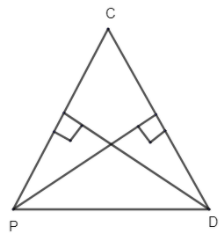
Here we can see that tangent through P is parallel to CD and tangent through D is parallel to PC. Hence, normal to P point is perpendicular to CD and normal to D is perpendicular to PC. Hence, in other words we need to find the orthocentre of \[\vartriangle CPD\]or intersections of normal.
We have given ellipse; \[\dfrac{{{x}^{2}}}{{{a}^{2}}}+\dfrac{{{y}^{2}}}{{{b}^{2}}}=1-(1)\]
Here, we need to assume points of conjugate diameters.
Let \[\varphi \]is the eccentric angle of point P, then coordinates of \[P=\left( a\cos \varphi ,b\sin \varphi \right)\].
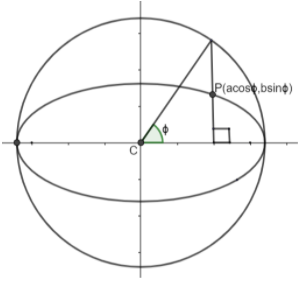
Eccentric angle is the angle between the major axis and line joining the circle at a point where perpendicular from any point to the major axis ellipse is extended to the circle as shown in diagram.
Since CP and CD are conjugate diameters. Hence, tangent at P is parallel to CD as per the definition of conjugate diameter.
Imp point: -
1. We need to know the relation between the two conjugate diameters i.e. If \[\left( a\cos \theta ,b\sin \theta \right)\]be the coordinates of the extremity of a diameter then \[\left( -a\sin \theta ,b\cos \theta \right)\]will be the coordinates of the extremity of its conjugate.
It means \[\theta -\varphi =\pm \dfrac{\pi }{2}\].
If \[\theta \] is an eccentric angle for extremity of a diameter and \[\varphi \] is eccentric angle of extremity of other diameter.
Hence, \[\vartriangle CPD\] can be represented as
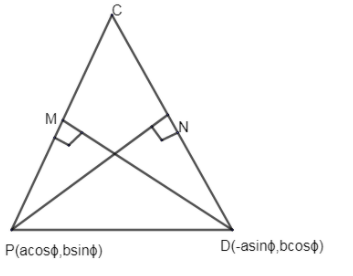
Since, C, P, D are on a circle and \[PM\bot CD\], where CD is parallel to the tangent at point P; Hence PM is normal at point P.
Similarly, DN is normal at point D.
Hence, equations of both normal PM & DN respectively are: -
\[ax\sec \varphi -by\cos ec\varphi ={{a}^{2}}-{{b}^{2}}-(2)\]
(Standard formula for normal through \[a\sin \varphi ,b\cos \varphi \])
\[-ax\cos ec-by\sec \varphi ={{a}^{2}}-{{b}^{2}}-(3)\]
The locus of the orthocentre of \[\vartriangle CPD\]is obtained by eliminating \[\varphi \]between (2) and (3)
Apply cross multiplication in following manner: -
\[\dfrac{\sec \varphi }{\left( by-ax \right)\left( {{a}^{2}}-{{b}^{2}} \right)}=\dfrac{\cos ec\varphi }{\left( by+ax \right)\left( {{a}^{2}}-{{b}^{2}} \right)}=\dfrac{-1}{\left( {{b}^{2}}{{y}^{2}}+{{a}^{2}}{{x}^{2}} \right)}\]
From the above equation we can write
\[\begin{align}
& \sec \varphi =\dfrac{\left( by-ax \right)\left( {{a}^{2}}-{{b}^{2}} \right)}{-\left( {{b}^{2}}{{y}^{2}}+{{a}^{2}}{{x}^{2}} \right)} \\
& \cos ec\varphi =\dfrac{\left( by+ax \right)\left( {{a}^{2}}-{{b}^{2}} \right)}{-\left( {{b}^{2}}{{y}^{2}}+{{a}^{2}}{{x}^{2}} \right)} \\
\end{align}\]
As we know the relation \[{{\sin }^{2}}\varphi +{{\cos }^{2}}\varphi =1\]
\[\begin{align}
& 1=\dfrac{{{\left( {{b}^{2}}{{y}^{2}}+{{a}^{2}}{{x}^{2}} \right)}^{2}}}{{{\left( by-ax \right)}^{2}}{{\left( {{a}^{2}}-{{b}^{2}} \right)}^{2}}}+\dfrac{{{\left( {{b}^{2}}{{y}^{2}}+{{a}^{2}}{{x}^{2}} \right)}^{2}}}{{{\left( by+ax \right)}^{2}}{{\left( {{a}^{2}}-{{b}^{2}} \right)}^{2}}} \\
& \dfrac{{{\left( {{b}^{2}}{{y}^{2}}+{{a}^{2}}{{x}^{2}} \right)}^{2}}}{{{\left( {{a}^{2}}-{{b}^{2}} \right)}^{2}}}\left( \dfrac{1}{{{\left( by-ax \right)}^{2}}}+\dfrac{1}{{{\left( by+ax \right)}^{2}}} \right)=1 \\
& \dfrac{{{\left( {{b}^{2}}{{y}^{2}}+{{a}^{2}}{{x}^{2}} \right)}^{2}}}{{{\left( {{a}^{2}}-{{b}^{2}} \right)}^{2}}}\times \dfrac{{{\left( by-ax \right)}^{2}}+{{\left( by+ax \right)}^{2}}}{{{\left( {{b}^{2}}{{y}^{2}}-{{a}^{2}}{{x}^{2}} \right)}^{2}}}=1 \\
& 2{{\left( {{b}^{2}}{{y}^{2}}+{{a}^{2}}{{x}^{2}} \right)}^{3}}={{\left( {{a}^{2}}-{{b}^{2}} \right)}^{2}}{{\left( {{b}^{2}}{{y}^{2}}-{{a}^{2}}{{x}^{2}} \right)}^{2}} \\
\end{align}\]
Hence proved.
Note:
Terms like auxiliary circle, eccentric angle, orthocentre, conjugate diameters & relation between conjugate diameters should be clearly known otherwise it may take a very long time to solve.
Calculation part is also an important one.
Complete answer: Let us first suppose CP and CD are two conjugate diameters.
Here we can see that tangent through P is parallel to CD and tangent through D is parallel to PC. Hence, normal to P point is perpendicular to CD and normal to D is perpendicular to PC. Hence, in other words we need to find the orthocentre of \[\vartriangle CPD\]or intersections of normal.
We have given ellipse; \[\dfrac{{{x}^{2}}}{{{a}^{2}}}+\dfrac{{{y}^{2}}}{{{b}^{2}}}=1-(1)\]
Here, we need to assume points of conjugate diameters.
Let \[\varphi \]is the eccentric angle of point P, then coordinates of \[P=\left( a\cos \varphi ,b\sin \varphi \right)\].
Eccentric angle is the angle between the major axis and line joining the circle at a point where perpendicular from any point to the major axis ellipse is extended to the circle as shown in diagram.
Since CP and CD are conjugate diameters. Hence, tangent at P is parallel to CD as per the definition of conjugate diameter.
Imp point: -
1. We need to know the relation between the two conjugate diameters i.e. If \[\left( a\cos \theta ,b\sin \theta \right)\]be the coordinates of the extremity of a diameter then \[\left( -a\sin \theta ,b\cos \theta \right)\]will be the coordinates of the extremity of its conjugate.
It means \[\theta -\varphi =\pm \dfrac{\pi }{2}\].
If \[\theta \] is an eccentric angle for extremity of a diameter and \[\varphi \] is eccentric angle of extremity of other diameter.
Hence, \[\vartriangle CPD\] can be represented as
Since, C, P, D are on a circle and \[PM\bot CD\], where CD is parallel to the tangent at point P; Hence PM is normal at point P.
Similarly, DN is normal at point D.
Hence, equations of both normal PM & DN respectively are: -
\[ax\sec \varphi -by\cos ec\varphi ={{a}^{2}}-{{b}^{2}}-(2)\]
(Standard formula for normal through \[a\sin \varphi ,b\cos \varphi \])
\[-ax\cos ec-by\sec \varphi ={{a}^{2}}-{{b}^{2}}-(3)\]
The locus of the orthocentre of \[\vartriangle CPD\]is obtained by eliminating \[\varphi \]between (2) and (3)
Apply cross multiplication in following manner: -
\[\dfrac{\sec \varphi }{\left( by-ax \right)\left( {{a}^{2}}-{{b}^{2}} \right)}=\dfrac{\cos ec\varphi }{\left( by+ax \right)\left( {{a}^{2}}-{{b}^{2}} \right)}=\dfrac{-1}{\left( {{b}^{2}}{{y}^{2}}+{{a}^{2}}{{x}^{2}} \right)}\]
From the above equation we can write
\[\begin{align}
& \sec \varphi =\dfrac{\left( by-ax \right)\left( {{a}^{2}}-{{b}^{2}} \right)}{-\left( {{b}^{2}}{{y}^{2}}+{{a}^{2}}{{x}^{2}} \right)} \\
& \cos ec\varphi =\dfrac{\left( by+ax \right)\left( {{a}^{2}}-{{b}^{2}} \right)}{-\left( {{b}^{2}}{{y}^{2}}+{{a}^{2}}{{x}^{2}} \right)} \\
\end{align}\]
As we know the relation \[{{\sin }^{2}}\varphi +{{\cos }^{2}}\varphi =1\]
\[\begin{align}
& 1=\dfrac{{{\left( {{b}^{2}}{{y}^{2}}+{{a}^{2}}{{x}^{2}} \right)}^{2}}}{{{\left( by-ax \right)}^{2}}{{\left( {{a}^{2}}-{{b}^{2}} \right)}^{2}}}+\dfrac{{{\left( {{b}^{2}}{{y}^{2}}+{{a}^{2}}{{x}^{2}} \right)}^{2}}}{{{\left( by+ax \right)}^{2}}{{\left( {{a}^{2}}-{{b}^{2}} \right)}^{2}}} \\
& \dfrac{{{\left( {{b}^{2}}{{y}^{2}}+{{a}^{2}}{{x}^{2}} \right)}^{2}}}{{{\left( {{a}^{2}}-{{b}^{2}} \right)}^{2}}}\left( \dfrac{1}{{{\left( by-ax \right)}^{2}}}+\dfrac{1}{{{\left( by+ax \right)}^{2}}} \right)=1 \\
& \dfrac{{{\left( {{b}^{2}}{{y}^{2}}+{{a}^{2}}{{x}^{2}} \right)}^{2}}}{{{\left( {{a}^{2}}-{{b}^{2}} \right)}^{2}}}\times \dfrac{{{\left( by-ax \right)}^{2}}+{{\left( by+ax \right)}^{2}}}{{{\left( {{b}^{2}}{{y}^{2}}-{{a}^{2}}{{x}^{2}} \right)}^{2}}}=1 \\
& 2{{\left( {{b}^{2}}{{y}^{2}}+{{a}^{2}}{{x}^{2}} \right)}^{3}}={{\left( {{a}^{2}}-{{b}^{2}} \right)}^{2}}{{\left( {{b}^{2}}{{y}^{2}}-{{a}^{2}}{{x}^{2}} \right)}^{2}} \\
\end{align}\]
Hence proved.
Note:
Terms like auxiliary circle, eccentric angle, orthocentre, conjugate diameters & relation between conjugate diameters should be clearly known otherwise it may take a very long time to solve.
Calculation part is also an important one.
Recently Updated Pages
Master Class 12 Economics: Engaging Questions & Answers for Success

Master Class 12 Physics: Engaging Questions & Answers for Success
Master Class 12 English: Engaging Questions & Answers for Success
Master Class 12 Social Science: Engaging Questions & Answers for Success
Master Class 12 Maths: Engaging Questions & Answers for Success
Master Class 12 Business Studies: Engaging Questions & Answers for Success
Trending doubts
Which are the Top 10 Largest Countries of the World?
What are the major means of transport Explain each class 12 social science CBSE
Draw a labelled sketch of the human eye class 12 physics CBSE
Why cannot DNA pass through cell membranes class 12 biology CBSE
Differentiate between insitu conservation and exsitu class 12 biology CBSE
Draw a neat and well labeled diagram of TS of ovary class 12 biology CBSE