




Prove that the height of the cylinder of maximum volume that can be inscribed in a sphere of radius R is \[\dfrac{{2R}}{{\sqrt 3 }}\]. Also find the maximum volume.
Answer
 Verified
631.2k+ views
Hint – In this question let the diameter of the base of the cylinder be x units, then apply Pythagoras theorem in triangle DBC to find the relation between x, h and R. Use the direct formula for volume of cylinder and substitute the relationship obtained. Differentiate the volume with respect to height and put it equal to 0, to get the value of h in terms of R.
Complete step-by-step answer:
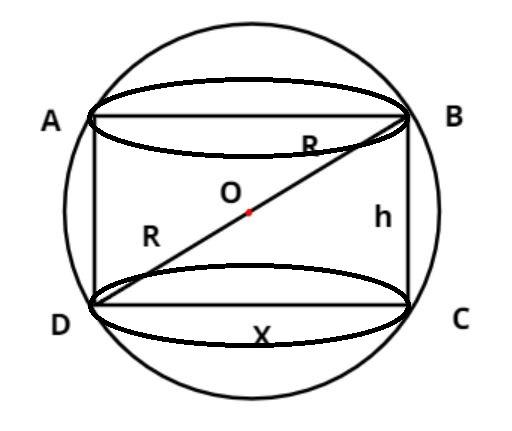
Sphere having the cylinder inscribed is shown in the above figure.
Let the diameter of the base of the cylinder = X unit.
It is given that the radius of the cylinder is = R unit.
So the diameter of the cylinder = twice the radius = 2R unit.
Let the height of the cylinder = h unit.
So applying Pythagoras theorem in triangle DBC we have,
$ \Rightarrow {\left( {{\text{hypotenuse}}} \right)^2} = {\left( {{\text{perpendicular}}} \right)^2} + {\left( {{\text{base}}} \right)^2}$
Now from figure, hypotenuse = 2R, perpendicular = h and base = X.
Now substitute the values we have,
$ \Rightarrow {\left( {2R} \right)^2} = {\left( h \right)^2} + {\left( X \right)^2}$
$ \Rightarrow {X^2} = 4{R^2} - {h^2}$........................ (1)
Now as we know that the volume (V) of the cylinder having base X and height h is given as $V = \pi \times radiu{s^2} \times h$
$ \Rightarrow V = \pi {\left( {\dfrac{X}{2}} \right)^2}h$, [as the radius of the cylinder is half of the base of the cylinder].
Now from equation (1) substitute the value of ${X^2}$ in above equation we have,
$ \Rightarrow V = \pi \left( {\dfrac{{4{R^2} - {h^2}}}{4}} \right)h$
$ \Rightarrow V = \pi {R^2}h - \dfrac{1}{4}\pi {h^3}$........... (2)
Now we have to maximize the volume of the cylinder w.r.t. the height of the cylinder.
So differentiate the above equation w.r.t. h and equate to zero we have,
$ \Rightarrow \dfrac{d}{{dh}}V = \dfrac{d}{{dh}}\left( {\pi {R^2}h - \dfrac{1}{4}\pi {h^3}} \right) = 0$
Now differentiate it according to the property $\dfrac{d}{{dx}}{x^n} = n{x^{n - 1}}$ we have,
$ \Rightarrow \left( {\pi {R^2} - \dfrac{1}{4}\pi \times 3{h^2}} \right) = 0$
$ \Rightarrow 3\pi {h^2} = 4\pi {R^2}$
$ \Rightarrow {h^2} = \dfrac{4}{3}{R^2}$
Now take square root on both sides we have,
$ \Rightarrow h = \sqrt {\dfrac{4}{3}{R^2}} = \dfrac{{2R}}{{\sqrt 3 }}$
Now double differentiate the equation (2) so that we can conclude whether at this height the volume is maximum or minimum, is $\dfrac{{{d^2}}}{{d{h^2}}}V$= negative than the volume is maximum and if positive then the volume is minimum.
$ \Rightarrow \dfrac{{{d^2}}}{{d{h^2}}}V = \dfrac{{{d^2}}}{{d{h^2}}}\left( {\pi {R^2}h - \dfrac{1}{4}\pi {h^3}} \right) = \dfrac{d}{{dh}}\left( {\pi {R^2} - \dfrac{1}{4}\pi \times 3{h^2}} \right) = - \dfrac{1}{4}\pi \times 6h = \dfrac{{ - 3}}{2}\pi h$
So as we see that h is positive so the double differentiation of the volume is negative so the volume of the cylinder inscribed in the sphere is maximum.
Hence, \[h = \dfrac{{2R}}{{\sqrt 3 }}\] units.
Hence proved.
Now in equation (2) substitute the value of h we have,
$ \Rightarrow V = \pi {R^2}\dfrac{{2R}}{{\sqrt 3 }} - \dfrac{1}{4}\pi {\left( {\dfrac{{2R}}{{\sqrt 3 }}} \right)^3}$
Now simplify this we have,
$ \Rightarrow V = \dfrac{{2\pi {R^3}}}{{\sqrt 3 }} - \dfrac{{2\pi {R^3}}}{{3\sqrt 3 }} = \dfrac{{4\pi {R^3}}}{{3\sqrt 3 }}$ Cubic units.
So this is the required volume.
Note – After putting the first derivative equal to zero, always check the second derivative, if the second derivative with the substitution the value obtained before comes out to be negative that we can say that the value corresponds to the maxima and if it is negative then the value obtained corresponds to minima.
Complete step-by-step answer:
Sphere having the cylinder inscribed is shown in the above figure.
Let the diameter of the base of the cylinder = X unit.
It is given that the radius of the cylinder is = R unit.
So the diameter of the cylinder = twice the radius = 2R unit.
Let the height of the cylinder = h unit.
So applying Pythagoras theorem in triangle DBC we have,
$ \Rightarrow {\left( {{\text{hypotenuse}}} \right)^2} = {\left( {{\text{perpendicular}}} \right)^2} + {\left( {{\text{base}}} \right)^2}$
Now from figure, hypotenuse = 2R, perpendicular = h and base = X.
Now substitute the values we have,
$ \Rightarrow {\left( {2R} \right)^2} = {\left( h \right)^2} + {\left( X \right)^2}$
$ \Rightarrow {X^2} = 4{R^2} - {h^2}$........................ (1)
Now as we know that the volume (V) of the cylinder having base X and height h is given as $V = \pi \times radiu{s^2} \times h$
$ \Rightarrow V = \pi {\left( {\dfrac{X}{2}} \right)^2}h$, [as the radius of the cylinder is half of the base of the cylinder].
Now from equation (1) substitute the value of ${X^2}$ in above equation we have,
$ \Rightarrow V = \pi \left( {\dfrac{{4{R^2} - {h^2}}}{4}} \right)h$
$ \Rightarrow V = \pi {R^2}h - \dfrac{1}{4}\pi {h^3}$........... (2)
Now we have to maximize the volume of the cylinder w.r.t. the height of the cylinder.
So differentiate the above equation w.r.t. h and equate to zero we have,
$ \Rightarrow \dfrac{d}{{dh}}V = \dfrac{d}{{dh}}\left( {\pi {R^2}h - \dfrac{1}{4}\pi {h^3}} \right) = 0$
Now differentiate it according to the property $\dfrac{d}{{dx}}{x^n} = n{x^{n - 1}}$ we have,
$ \Rightarrow \left( {\pi {R^2} - \dfrac{1}{4}\pi \times 3{h^2}} \right) = 0$
$ \Rightarrow 3\pi {h^2} = 4\pi {R^2}$
$ \Rightarrow {h^2} = \dfrac{4}{3}{R^2}$
Now take square root on both sides we have,
$ \Rightarrow h = \sqrt {\dfrac{4}{3}{R^2}} = \dfrac{{2R}}{{\sqrt 3 }}$
Now double differentiate the equation (2) so that we can conclude whether at this height the volume is maximum or minimum, is $\dfrac{{{d^2}}}{{d{h^2}}}V$= negative than the volume is maximum and if positive then the volume is minimum.
$ \Rightarrow \dfrac{{{d^2}}}{{d{h^2}}}V = \dfrac{{{d^2}}}{{d{h^2}}}\left( {\pi {R^2}h - \dfrac{1}{4}\pi {h^3}} \right) = \dfrac{d}{{dh}}\left( {\pi {R^2} - \dfrac{1}{4}\pi \times 3{h^2}} \right) = - \dfrac{1}{4}\pi \times 6h = \dfrac{{ - 3}}{2}\pi h$
So as we see that h is positive so the double differentiation of the volume is negative so the volume of the cylinder inscribed in the sphere is maximum.
Hence, \[h = \dfrac{{2R}}{{\sqrt 3 }}\] units.
Hence proved.
Now in equation (2) substitute the value of h we have,
$ \Rightarrow V = \pi {R^2}\dfrac{{2R}}{{\sqrt 3 }} - \dfrac{1}{4}\pi {\left( {\dfrac{{2R}}{{\sqrt 3 }}} \right)^3}$
Now simplify this we have,
$ \Rightarrow V = \dfrac{{2\pi {R^3}}}{{\sqrt 3 }} - \dfrac{{2\pi {R^3}}}{{3\sqrt 3 }} = \dfrac{{4\pi {R^3}}}{{3\sqrt 3 }}$ Cubic units.
So this is the required volume.
Note – After putting the first derivative equal to zero, always check the second derivative, if the second derivative with the substitution the value obtained before comes out to be negative that we can say that the value corresponds to the maxima and if it is negative then the value obtained corresponds to minima.
Recently Updated Pages
Master Class 12 Business Studies: Engaging Questions & Answers for Success

Master Class 12 Biology: Engaging Questions & Answers for Success
Master Class 12 Chemistry: Engaging Questions & Answers for Success
Class 12 Question and Answer - Your Ultimate Solutions Guide
Master Class 11 Social Science: Engaging Questions & Answers for Success
Master Class 11 English: Engaging Questions & Answers for Success
Trending doubts
Which is more stable and why class 12 chemistry CBSE
Which are the Top 10 Largest Countries of the World?
Draw a labelled sketch of the human eye class 12 physics CBSE
Differentiate between homogeneous and heterogeneous class 12 chemistry CBSE
What are the major means of transport Explain each class 12 social science CBSE
Sulphuric acid is known as the king of acids State class 12 chemistry CBSE