




Prove that the equal chords of two congruent circles subtend equal angles at their respective centres.
Answer
 Verified
600.6k+ views
Hint: Use the fact that the radii of two congruent circles are equal and hence prove that OA = O’A’ and OB = O’B’. Use the fact that since the chords are equal AB = A’B’ and hence prove that the triangle ABC and A’B’C’ are congruent and hence prove that $\angle AOC=\angle A'O'C'$. Hence prove that the equal chords of congruent circles subtend equal angles at the centres of their corresponding circles.
Complete step by step answer:
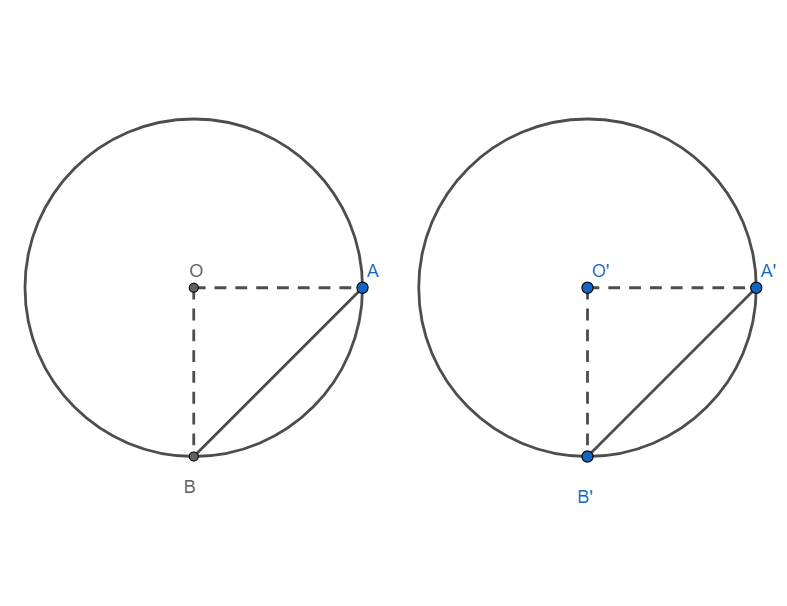
Given: Two circles with centre O and O’ have equal radii. AB is the chord of the circle with centre O and A’B’ is a chord of the circle with centre O’.
To prove $\angle AOB=\angle A'O'B'$
Proof:
Since the circle have equal radii, we have
OA = O’A’ and OB = O’B’
Now, in triangle AOB and A’O’B’, we have
AO = A’O’ (proved above)
OB = O’B’ (Proved above)
AB = A’B’ (Given).
Hence by S.S.S congruence criterion, we have
$\Delta AOB\cong \Delta A'O'B'$
Hence, we have
$\angle AOB=\angle A'O'B'$ (Corresponding parts of congruent triangles)
Hence, equal chords of two congruent circles subtend equal angles at their respective centres.
Hence, proved.
Note: Alternative Solution: Using Sine rule.
We know that if R is the radius of circumcentre of a triangle ABC, then $\dfrac{a}{\sin A}=\dfrac{b}{\sin B}=\dfrac{c}{\sin C}=2R$
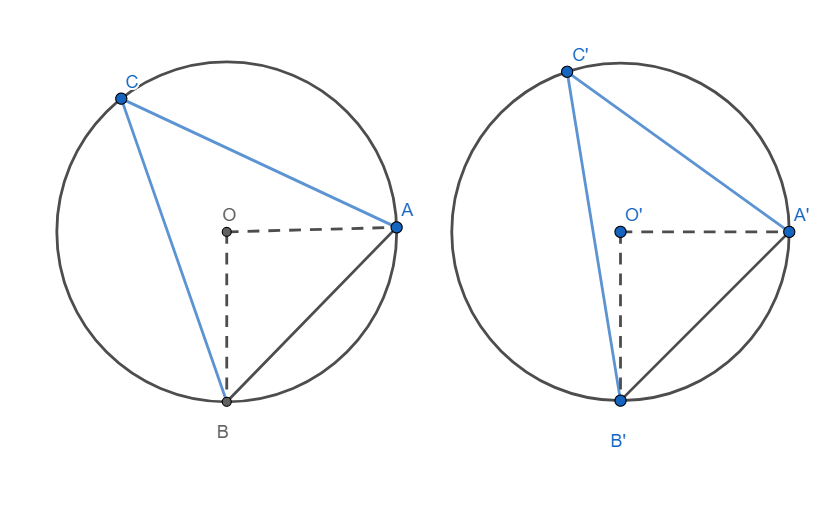
Consider two points C and C’ on the alternate segments as shown in the diagram above.
By sine rule, we have
$\begin{align}
& \dfrac{AB}{\sin C}=2R \\
& \Rightarrow AB=2R\sin C \\
\end{align}$
Similarly, we have
$A'B'=2R\sin C'$
Since AB = A’B’, we have
$\begin{align}
& 2R\sin C=2R\sin C' \\
& \Rightarrow \sin C=\sin C' \\
& \Rightarrow C=C' \\
\end{align}$
We know that the angle subtended in the alternate segment is half the angle subtended at the centre.
Hence, we have
$\angle AOB=2\angle C$ and $\angle A'O'B'=2\angle C'$
Since $\angle C=\angle C'$, we have
$\angle AOB=\angle A'O'B'$
Q.E.D
Complete step by step answer:
Given: Two circles with centre O and O’ have equal radii. AB is the chord of the circle with centre O and A’B’ is a chord of the circle with centre O’.
To prove $\angle AOB=\angle A'O'B'$
Proof:
Since the circle have equal radii, we have
OA = O’A’ and OB = O’B’
Now, in triangle AOB and A’O’B’, we have
AO = A’O’ (proved above)
OB = O’B’ (Proved above)
AB = A’B’ (Given).
Hence by S.S.S congruence criterion, we have
$\Delta AOB\cong \Delta A'O'B'$
Hence, we have
$\angle AOB=\angle A'O'B'$ (Corresponding parts of congruent triangles)
Hence, equal chords of two congruent circles subtend equal angles at their respective centres.
Hence, proved.
Note: Alternative Solution: Using Sine rule.
We know that if R is the radius of circumcentre of a triangle ABC, then $\dfrac{a}{\sin A}=\dfrac{b}{\sin B}=\dfrac{c}{\sin C}=2R$
Consider two points C and C’ on the alternate segments as shown in the diagram above.
By sine rule, we have
$\begin{align}
& \dfrac{AB}{\sin C}=2R \\
& \Rightarrow AB=2R\sin C \\
\end{align}$
Similarly, we have
$A'B'=2R\sin C'$
Since AB = A’B’, we have
$\begin{align}
& 2R\sin C=2R\sin C' \\
& \Rightarrow \sin C=\sin C' \\
& \Rightarrow C=C' \\
\end{align}$
We know that the angle subtended in the alternate segment is half the angle subtended at the centre.
Hence, we have
$\angle AOB=2\angle C$ and $\angle A'O'B'=2\angle C'$
Since $\angle C=\angle C'$, we have
$\angle AOB=\angle A'O'B'$
Q.E.D
Recently Updated Pages
Which will be the least stable resonating structure class 11 chemistry CBSE

How many 5 digit telephone numbers can be construc-class-11-maths-CBSE
How do you find the angle of the resultant vector class 11 physics CBSE
Draw labelled diagram of the following i Gram seed class 11 biology CBSE
1 Quintal is equal to a 110 kg b 10 kg c 100kg d 1000 class 11 physics CBSE
What is the need and importance of classification class 11 biology CBSE
Trending doubts
Find the value of the expression given below sin 30circ class 11 maths CBSE
One Metric ton is equal to kg A 10000 B 1000 C 100 class 11 physics CBSE
10 examples of friction in our daily life
Draw a diagram of a plant cell and label at least eight class 11 biology CBSE
Difference between physical and chemical change class 11 chemistry CBSE
Proton was discovered by A Thomson B Rutherford C Chadwick class 11 chemistry CBSE