




Prove that ${\sin ^6}\theta + {\cos ^6}\theta + 3{\sin ^2}\theta {\cos ^2}\theta = 1$.
Answer
 Verified
664.2k+ views
Hint: First of all, we will write the formula of cube of sum of two variables which we will require in this formula and then just consider those two quantities to be ${\sin ^2}\theta $ and ${\cos ^2}\theta $ and after simplification, we will get the required answer.
Complete step-by-step answer:
We know that: ${(a + b)^3} = {a^3} + {b^3} + 3ab(a + b)$.
Now, let $a = {\sin ^2}\theta $ and $b = {\cos ^2}\theta $. Putting this in the formula stated above, we will get:-
${({\sin ^2}\theta + {\cos ^2}\theta )^3} = {\left( {{{\sin }^2}\theta } \right)^3} + {\left( {{{\cos }^2}\theta } \right)^3} + 3{\sin ^2}\theta {\cos ^2}\theta ({\sin ^2}\theta + {\cos ^2}\theta )$
We also know that \[{\sin ^2}\theta + {\cos ^2}\theta = 1\].
On putting this, we will get:-
$ \Rightarrow {(1)^3} = {\left( {{{\sin }^2}\theta } \right)^3} + {\left( {{{\cos }^2}\theta } \right)^3} + 3{\sin ^2}\theta {\cos ^2}\theta (1)$
On simplifying it, we will get:-
\[ \Rightarrow 1 = {\sin ^6}\theta + {\cos ^6}\theta + 3{\sin ^2}\theta {\cos ^2}\theta \].
We can see that this is the required result.
Hence, proved.
Note: The students must note the fact we used in this which is: \[{\sin ^2}\theta + {\cos ^2}\theta = 1\]. We can easily prove it as well.
Consider the triangle given below where we have a triangle ABC right angled at A and without loss of generality, we have considered the angle C to be equal to $\theta $.
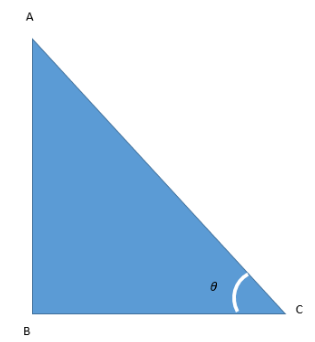
So, here we see that $\sin \theta = \dfrac{P}{H} = \dfrac{{AB}}{{AC}}$ ………(1)
And $\cos \theta = \dfrac{B}{H} = \dfrac{{BC}}{{AC}}$ ………..(2)
Squaring (1), we will get: ${\sin ^2}\theta = {\left( {\dfrac{{AB}}{{AC}}} \right)^2}$ ………(3)
Squaring (2), we will get: ${\cos ^2}\theta = {\left( {\dfrac{{BC}}{{AC}}} \right)^2}$ ………….(4)
Now, adding (3) and (4), we will get:- ${\sin ^2}\theta + {\cos ^2}\theta = {\left( {\dfrac{{AB}}{{AC}}} \right)^2} + {\left( {\dfrac{{BC}}{{AC}}} \right)^2}$.
We can rewrite it as: ${\sin ^2}\theta + {\cos ^2}\theta = \dfrac{{A{B^2}}}{{A{C^2}}} + \dfrac{{B{C^2}}}{{A{C^2}}}$.
Since, the denominator on the RHS is same for both the quantities, we can add the numerator directly.
Hence, we get: ${\sin ^2}\theta + {\cos ^2}\theta = \dfrac{{A{B^2} + B{C^2}}}{{A{C^2}}}$ …………..(5)
Now, we know that the Pythagorean Theorem states that in a right angled triangle, the square of the hypotenuse is equal to the sum of squares of another two sides.
Hence, in this triangle ABC, we will get: $A{B^2} + B{C^2} = A{C^2}$.
Putting this in (5), we will get as follows:-
${\sin ^2}\theta + {\cos ^2}\theta = \dfrac{{A{C^2}}}{{A{C^2}}}$
On simplifying the RHS, we will get: ${\sin ^2}\theta + {\cos ^2}\theta = 1$
Hence, proved.
Complete step-by-step answer:
We know that: ${(a + b)^3} = {a^3} + {b^3} + 3ab(a + b)$.
Now, let $a = {\sin ^2}\theta $ and $b = {\cos ^2}\theta $. Putting this in the formula stated above, we will get:-
${({\sin ^2}\theta + {\cos ^2}\theta )^3} = {\left( {{{\sin }^2}\theta } \right)^3} + {\left( {{{\cos }^2}\theta } \right)^3} + 3{\sin ^2}\theta {\cos ^2}\theta ({\sin ^2}\theta + {\cos ^2}\theta )$
We also know that \[{\sin ^2}\theta + {\cos ^2}\theta = 1\].
On putting this, we will get:-
$ \Rightarrow {(1)^3} = {\left( {{{\sin }^2}\theta } \right)^3} + {\left( {{{\cos }^2}\theta } \right)^3} + 3{\sin ^2}\theta {\cos ^2}\theta (1)$
On simplifying it, we will get:-
\[ \Rightarrow 1 = {\sin ^6}\theta + {\cos ^6}\theta + 3{\sin ^2}\theta {\cos ^2}\theta \].
We can see that this is the required result.
Hence, proved.
Note: The students must note the fact we used in this which is: \[{\sin ^2}\theta + {\cos ^2}\theta = 1\]. We can easily prove it as well.
Consider the triangle given below where we have a triangle ABC right angled at A and without loss of generality, we have considered the angle C to be equal to $\theta $.
So, here we see that $\sin \theta = \dfrac{P}{H} = \dfrac{{AB}}{{AC}}$ ………(1)
And $\cos \theta = \dfrac{B}{H} = \dfrac{{BC}}{{AC}}$ ………..(2)
Squaring (1), we will get: ${\sin ^2}\theta = {\left( {\dfrac{{AB}}{{AC}}} \right)^2}$ ………(3)
Squaring (2), we will get: ${\cos ^2}\theta = {\left( {\dfrac{{BC}}{{AC}}} \right)^2}$ ………….(4)
Now, adding (3) and (4), we will get:- ${\sin ^2}\theta + {\cos ^2}\theta = {\left( {\dfrac{{AB}}{{AC}}} \right)^2} + {\left( {\dfrac{{BC}}{{AC}}} \right)^2}$.
We can rewrite it as: ${\sin ^2}\theta + {\cos ^2}\theta = \dfrac{{A{B^2}}}{{A{C^2}}} + \dfrac{{B{C^2}}}{{A{C^2}}}$.
Since, the denominator on the RHS is same for both the quantities, we can add the numerator directly.
Hence, we get: ${\sin ^2}\theta + {\cos ^2}\theta = \dfrac{{A{B^2} + B{C^2}}}{{A{C^2}}}$ …………..(5)
Now, we know that the Pythagorean Theorem states that in a right angled triangle, the square of the hypotenuse is equal to the sum of squares of another two sides.
Hence, in this triangle ABC, we will get: $A{B^2} + B{C^2} = A{C^2}$.
Putting this in (5), we will get as follows:-
${\sin ^2}\theta + {\cos ^2}\theta = \dfrac{{A{C^2}}}{{A{C^2}}}$
On simplifying the RHS, we will get: ${\sin ^2}\theta + {\cos ^2}\theta = 1$
Hence, proved.
Recently Updated Pages
Explain the structure of megasporangium class 12 biology CBSE

Why is chloroform kept in dark coloured bottles class 12 chemistry CBSE
Derive the balancing condition of a Wheatstone bri class 12 physics CBSE
Draw VI characteristics of a pn junction diode Explain class 12 physics CBSE
Is it possible to carry pride in ones language too class 12 english CBSE
In a population at Hardy Weinberg equilibrium the allele class 12 biology CBSE
Trending doubts
Draw a labelled sketch of the human eye class 12 physics CBSE
Which are the Top 10 Largest Countries of the World?
Draw ray diagrams each showing i myopic eye and ii class 12 physics CBSE
One megawatt is equal to how many units of electri class 12 physics CBSE
Which is the correct genotypic ratio of mendel dihybrid class 12 biology CBSE
Give 10 examples of unisexual and bisexual flowers