




Prove that foci of conjugate hyperbolas are concyclic.
Answer
 Verified
563.4k+ views
Hint: To solve this question, we first need to understand what a conjugate of a hyperbola means , its equations and then find the eccentricities if the two by the knowledge of hyperbolas and the formulae, then the length of foci is calculated, if it is same for the two, they are concyclic.
Equation of the conjugate hyperbolas are $ \dfrac{{{x^2}}}{{{a^2}}} - \dfrac{{{y^2}}}{{{b^2}}} = 1 $ and $ \dfrac{{{x^2}}}{{{a^2}}} - \dfrac{{{y^2}}}{{{b^2}}} = - 1 $
The standard hyperbola’s eccentricity is given by $ e = \sqrt {1 + \dfrac{{{b^2}}}{{{a^2}}}} $
Length of the foci from the origin for standard hyperbola is $ c = ae $
Complete step by step solution:
The hyperbola equation is given by the equation $ \dfrac{{{x^2}}}{{{a^2}}} - \dfrac{{{y^2}}}{{{b^2}}} = 1 $ and that for its conjugate hyperbola is simply given as $ \dfrac{{{x^2}}}{{{a^2}}} - \dfrac{{{y^2}}}{{{b^2}}} = - 1 $
The different equations indicate that the eccentricities and the foci of the conjugate hyperbolas might be different. Now, if we find the eccentricities of the two hyperbolas
The standard hyperbola’s eccentricity is given by $ e = \sqrt {1 + \dfrac{{{b^2}}}{{{a^2}}}} $
The eccentricity of the conjugate hyperbola is given by the relation
$ \dfrac{1}{{{e_1}^2}} + \dfrac{1}{{{e_2}^2}} = 1 $
Where $ {e_1} $ and $ {e_2} $ are eccentricities of the original hyperbola and its conjugate
Therefore, on solving, we get, $ {e_2} $ as
$ {e_2} = \sqrt {1 + \dfrac{{{a^2}}}{{{b^2}}}} $
Now, if we calculate the length of the foci from the origin for the two hyperbolas, then,
$ c = ae $ for standard hyperbola
$ c = a\sqrt {1 + \dfrac{{{b^2}}}{{{a^2}}}} = \sqrt {{a^2} + {b^2}} $
And $ c = be $ for the conjugate
$ c = b\sqrt {1 + \dfrac{{{a^2}}}{{{b^2}}}} = \sqrt {{b^2} + {a^2}} $
Hence, we see that the lengths of the foci are the same for the standard hyperbola and its conjugate, thus, we can say the foci of conjugate hyperbolas are concyclic.
Note:
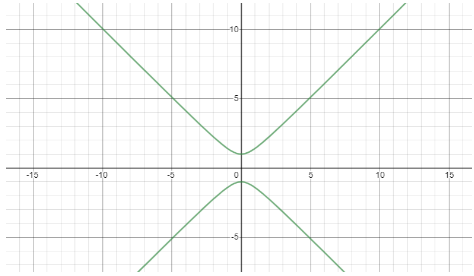
In the graph, we can see there are two hyperbolas, the second one looks like just the inverted image of the first, this is what we mean by the conjugate hyperbolas, they have different equations but the nature is similar just a difference of the coordinates, that’s why the values of eccentricity and foci are same.
Equation of the conjugate hyperbolas are $ \dfrac{{{x^2}}}{{{a^2}}} - \dfrac{{{y^2}}}{{{b^2}}} = 1 $ and $ \dfrac{{{x^2}}}{{{a^2}}} - \dfrac{{{y^2}}}{{{b^2}}} = - 1 $
The standard hyperbola’s eccentricity is given by $ e = \sqrt {1 + \dfrac{{{b^2}}}{{{a^2}}}} $
Length of the foci from the origin for standard hyperbola is $ c = ae $
Complete step by step solution:
The hyperbola equation is given by the equation $ \dfrac{{{x^2}}}{{{a^2}}} - \dfrac{{{y^2}}}{{{b^2}}} = 1 $ and that for its conjugate hyperbola is simply given as $ \dfrac{{{x^2}}}{{{a^2}}} - \dfrac{{{y^2}}}{{{b^2}}} = - 1 $
The different equations indicate that the eccentricities and the foci of the conjugate hyperbolas might be different. Now, if we find the eccentricities of the two hyperbolas
The standard hyperbola’s eccentricity is given by $ e = \sqrt {1 + \dfrac{{{b^2}}}{{{a^2}}}} $
The eccentricity of the conjugate hyperbola is given by the relation
$ \dfrac{1}{{{e_1}^2}} + \dfrac{1}{{{e_2}^2}} = 1 $
Where $ {e_1} $ and $ {e_2} $ are eccentricities of the original hyperbola and its conjugate
Therefore, on solving, we get, $ {e_2} $ as
$ {e_2} = \sqrt {1 + \dfrac{{{a^2}}}{{{b^2}}}} $
Now, if we calculate the length of the foci from the origin for the two hyperbolas, then,
$ c = ae $ for standard hyperbola
$ c = a\sqrt {1 + \dfrac{{{b^2}}}{{{a^2}}}} = \sqrt {{a^2} + {b^2}} $
And $ c = be $ for the conjugate
$ c = b\sqrt {1 + \dfrac{{{a^2}}}{{{b^2}}}} = \sqrt {{b^2} + {a^2}} $
Hence, we see that the lengths of the foci are the same for the standard hyperbola and its conjugate, thus, we can say the foci of conjugate hyperbolas are concyclic.
Note:
In the graph, we can see there are two hyperbolas, the second one looks like just the inverted image of the first, this is what we mean by the conjugate hyperbolas, they have different equations but the nature is similar just a difference of the coordinates, that’s why the values of eccentricity and foci are same.
Recently Updated Pages
Master Class 11 English: Engaging Questions & Answers for Success

Master Class 11 Maths: Engaging Questions & Answers for Success
Class 11 Question and Answer - Your Ultimate Solutions Guide
Master Class 11 Biology: Engaging Questions & Answers for Success
Master Class 11 Physics: Engaging Questions & Answers for Success
Master Class 11 Accountancy: Engaging Questions & Answers for Success
Trending doubts
Differentiate between an exothermic and an endothermic class 11 chemistry CBSE
One Metric ton is equal to kg A 10000 B 1000 C 100 class 11 physics CBSE
Difference Between Prokaryotic Cells and Eukaryotic Cells
There are 720 permutations of the digits 1 2 3 4 5 class 11 maths CBSE
Draw a diagram of a plant cell and label at least eight class 11 biology CBSE
1 Quintal is equal to a 110 kg b 10 kg c 100kg d 1000 class 11 physics CBSE