




Prove that $\cos \left( { - x} \right) = \cos x{\text{ }}{\text{.}}$
Answer
 Verified
561.6k+ views
Hint: In this question, a trigonometric identity has been given and we are asked to prove it. One way is that we can apply the difference formula for cosine function by putting the appropriate values and solving it. The other method is to analyze the behavior of the cosine function by plotting it’s graph and find out whether it is an odd function or even function and then by the definition of even or odd function we can prove the given identity. $\left( 1 \right)$ Even functions: cosine and secant are even functions i.e. $\cos \left( { - x} \right) = \cos x$ and $\sec \left( { - x} \right) = \sec x$ . $\left( 2 \right)$ Odd functions: sine, tangent, cosecant, cotangent all are odd functions i.e. $\sin \left( { - x} \right) = - \sin x,{\text{ }}\tan \left( { - x} \right) = - \tan x,{\text{ }}\cos ec\left( { - x} \right) = - \cos ecx,{\text{ }}\cot \left( { - x} \right) = - \cot x$.
Complete step-by-step solution:
To prove: $\cos \left( { - x} \right) = \cos x$
Method $1{\text{ :}}$
By the difference of angle formula for cosine function, we know that;
$ \Rightarrow \cos \left( {A - B} \right) = \cos A\cos B + \sin A\sin B{\text{ }}......\left( 1 \right)$
Put $A = 0{\text{ , }}B = x$ in the above formula, we get the L.H.S. ;
L.H.S. $ \Rightarrow \cos \left( {0 - x} \right) = \cos {0^0} \times \cos x + \sin {0^0} \times \sin x$
We know that;
$\because \sin {0^0} = 0$ and
$\because \cos {0^0} = 1$
The above equation can be further simplified as;
L.H.S. $ \Rightarrow \cos \left( { - x} \right) = 1 \times \cos x + 0 \times \sin x$
On further simplification;
L.H.S. $ \Rightarrow \cos \left( { - x} \right) = \cos x$
L.H.S. = R.H.S.
Hence proved.
Method $2{\text{ :}}$
By using the property of even and odd function:
$\left( {\text{i}} \right)$ Odd function:
Definition: A function $y = f\left( x \right)$ is called an odd function if $f\left( { - x} \right) = - f\left( x \right)$ for every $x$ in the function’s domain. In simple words we can say that if we replace $x$ with $ - x$ , the value of the function becomes negative.
Example: $\sin \left( { - x} \right) = - \sin x$ ( sine is a odd function )
Important point: The graph of an odd function is symmetrical about the origin ( by ${180^0}$ rotation ) . The graph for sine function is shown below:-
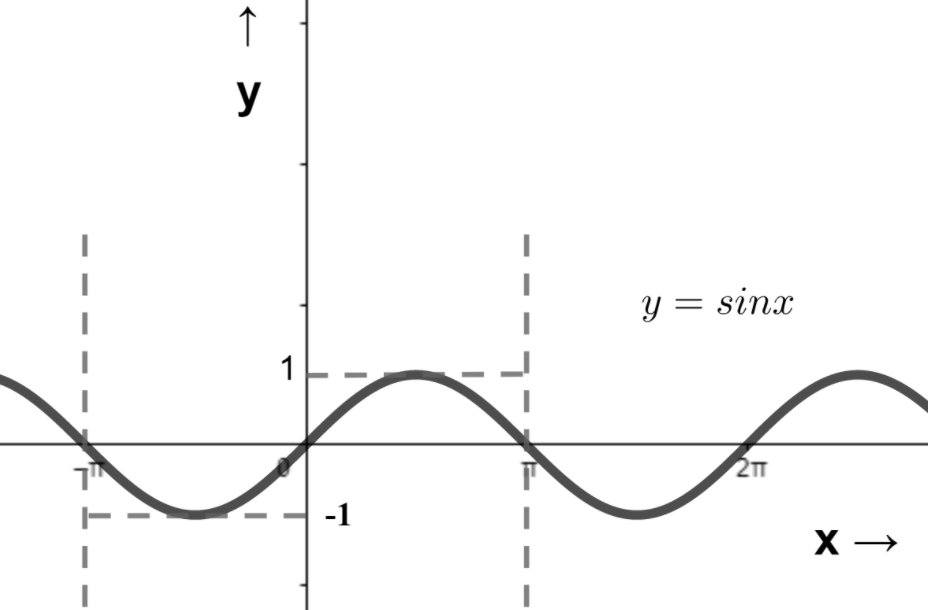
Figure $1$ : Graph of sine function ( time period $ = 2\pi $ )
From the graph we can see that the value of $\sin \left( {\dfrac{\pi }{2}} \right) = 1$ but the value of $\sin \left( { - \dfrac{\pi }{2}} \right) = - 1$ , hence our definition holds true i.e. $f\left( { - x} \right) = - f\left( x \right)$ .
$\left( {{\text{ii}}} \right)$ Even function:
Definition: A function $y = f\left( x \right)$ is called an even function if $f\left( { - x} \right) = f\left( x \right)$ for every $x$ in the function’s domain. In simple words we can say that if we replace $x$ with $ - x$ , the value of the function does not change.
Example: $\cos \left( { - x} \right) = \cos x$ ( cosine is an even function )
Important point: The graph of an even function is symmetrical about the vertical axis or y-axis. The graph for cosine function is shown below:-
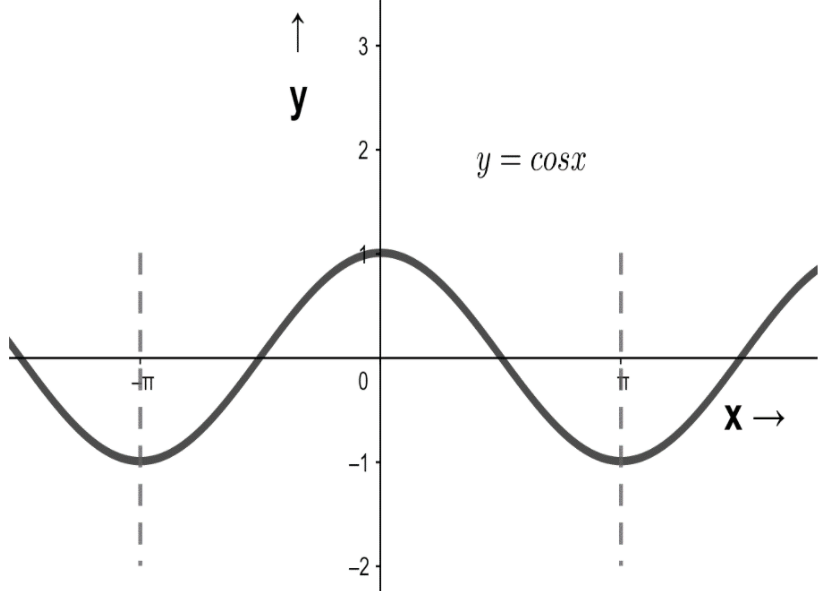
Figure $2$ : Graph of cosine function ( time period $ = 2\pi $ )
From the graph we can see that the value of $\cos \pi = - 1$ and also the value of $\cos \left( { - \pi } \right) = - 1$ , hence our definition holds true i.e. $f\left( { - x} \right) = f\left( x \right)$ .
So, from the above figure we can directly state that;
$ \Rightarrow \cos \left( { - x} \right) = \cos x$
Hence proved.
Note: The even and odd properties of functions can be really useful while solving this type of questions. The functions can be of three types: $\left( {\text{i}} \right)$ Even function: As we have already seen cosine is an even function. $\left( {{\text{ii}}} \right)$ Odd function: We have discussed that the sine function is an odd function. $\left( {{\text{iii}}} \right)$ Neither even nor odd function: It is a possibility that a function is neither even nor odd. For example: Check if the given function is even or odd; $y \Rightarrow f\left( x \right) = \tan x + \sec x$ . Put $x = - x$ , we get $f\left( { - x} \right) = \tan \left( { - x} \right) + \sec \left( { - x} \right)$ . We know that tangent is a odd function i.e. $\tan \left( { - x} \right) = - \tan x$ and secant is an even function i.e. $\sec \left( { - x} \right) = \sec x$ . Therefore, $f\left( { - x} \right) = - \tan x + \sec x$ . So, in this case $f\left( { - x} \right) \ne f\left( x \right)$ or $f\left( { - x} \right) \ne - f\left( x \right)$ ; hence this function is neither even nor odd.
Complete step-by-step solution:
To prove: $\cos \left( { - x} \right) = \cos x$
Method $1{\text{ :}}$
By the difference of angle formula for cosine function, we know that;
$ \Rightarrow \cos \left( {A - B} \right) = \cos A\cos B + \sin A\sin B{\text{ }}......\left( 1 \right)$
Put $A = 0{\text{ , }}B = x$ in the above formula, we get the L.H.S. ;
L.H.S. $ \Rightarrow \cos \left( {0 - x} \right) = \cos {0^0} \times \cos x + \sin {0^0} \times \sin x$
We know that;
$\because \sin {0^0} = 0$ and
$\because \cos {0^0} = 1$
The above equation can be further simplified as;
L.H.S. $ \Rightarrow \cos \left( { - x} \right) = 1 \times \cos x + 0 \times \sin x$
On further simplification;
L.H.S. $ \Rightarrow \cos \left( { - x} \right) = \cos x$
L.H.S. = R.H.S.
Hence proved.
Method $2{\text{ :}}$
By using the property of even and odd function:
$\left( {\text{i}} \right)$ Odd function:
Definition: A function $y = f\left( x \right)$ is called an odd function if $f\left( { - x} \right) = - f\left( x \right)$ for every $x$ in the function’s domain. In simple words we can say that if we replace $x$ with $ - x$ , the value of the function becomes negative.
Example: $\sin \left( { - x} \right) = - \sin x$ ( sine is a odd function )
Important point: The graph of an odd function is symmetrical about the origin ( by ${180^0}$ rotation ) . The graph for sine function is shown below:-
Figure $1$ : Graph of sine function ( time period $ = 2\pi $ )
From the graph we can see that the value of $\sin \left( {\dfrac{\pi }{2}} \right) = 1$ but the value of $\sin \left( { - \dfrac{\pi }{2}} \right) = - 1$ , hence our definition holds true i.e. $f\left( { - x} \right) = - f\left( x \right)$ .
$\left( {{\text{ii}}} \right)$ Even function:
Definition: A function $y = f\left( x \right)$ is called an even function if $f\left( { - x} \right) = f\left( x \right)$ for every $x$ in the function’s domain. In simple words we can say that if we replace $x$ with $ - x$ , the value of the function does not change.
Example: $\cos \left( { - x} \right) = \cos x$ ( cosine is an even function )
Important point: The graph of an even function is symmetrical about the vertical axis or y-axis. The graph for cosine function is shown below:-
Figure $2$ : Graph of cosine function ( time period $ = 2\pi $ )
From the graph we can see that the value of $\cos \pi = - 1$ and also the value of $\cos \left( { - \pi } \right) = - 1$ , hence our definition holds true i.e. $f\left( { - x} \right) = f\left( x \right)$ .
So, from the above figure we can directly state that;
$ \Rightarrow \cos \left( { - x} \right) = \cos x$
Hence proved.
Note: The even and odd properties of functions can be really useful while solving this type of questions. The functions can be of three types: $\left( {\text{i}} \right)$ Even function: As we have already seen cosine is an even function. $\left( {{\text{ii}}} \right)$ Odd function: We have discussed that the sine function is an odd function. $\left( {{\text{iii}}} \right)$ Neither even nor odd function: It is a possibility that a function is neither even nor odd. For example: Check if the given function is even or odd; $y \Rightarrow f\left( x \right) = \tan x + \sec x$ . Put $x = - x$ , we get $f\left( { - x} \right) = \tan \left( { - x} \right) + \sec \left( { - x} \right)$ . We know that tangent is a odd function i.e. $\tan \left( { - x} \right) = - \tan x$ and secant is an even function i.e. $\sec \left( { - x} \right) = \sec x$ . Therefore, $f\left( { - x} \right) = - \tan x + \sec x$ . So, in this case $f\left( { - x} \right) \ne f\left( x \right)$ or $f\left( { - x} \right) \ne - f\left( x \right)$ ; hence this function is neither even nor odd.
Recently Updated Pages
Which of the following graphs shows the variation of class 12 physics CBSE

Draw a labelled diagram of the human male reproductive class 12 biology CBSE
Describe the experiment to compare the emf of two cells class 12 physics CBSE
What is standard hydrogen electrode
What is conventional current and electric current class 12 physics CBSE
2Bromopentane is treated with an alcoholic KOH solution class 12 chemistry CBSE
Trending doubts
Draw a labelled sketch of the human eye class 12 physics CBSE
Which are the Top 10 Largest Countries of the World?
Differentiate between homogeneous and heterogeneous class 12 chemistry CBSE
Draw ray diagrams each showing i myopic eye and ii class 12 physics CBSE
Which is the correct genotypic ratio of mendel dihybrid class 12 biology CBSE
What is the Full Form of PVC, PET, HDPE, LDPE, PP and PS ?