




Protonema is found in lifecycle of
A. Spirogyra
B. Rhizopus
C. Funaria
D. Dryopteris
Answer
 Verified
669.3k+ views
Hint: A protonema is a thread-like chain of cells that forms the earliest stage of the life cycle of mosses.
Complete answer:
Protonema can be seen in Funaria as it is a type of moss.
Funaria are primitive multicellular, autotrophic, shade loving, amphibious moss. They reproduce by spore formation. They have no vascular system. Root like structures called rhizoids are present. They show alternation of generation i.e. the gametophytic stage alternates with the sporophyte stage. When it grows from the spore, it starts as a germinate tube that lengthens and branches off to form filamentous form called protonema. The protonema starts as a colourless tube filled with the chlorophyll containing cells called chloronemata which later mature into cells called caulonemata which have reddish brown pigmented cell walls. The protonema then develops into a leafy gametophore, the adult form of Funaria, which is its more common form. The protonema stage takes part in the haploid phase of the moss.
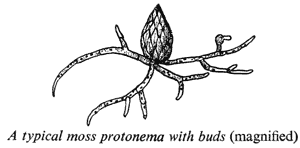
So, The correct option is C ‘Funaria’.
Note: In most mosses the protonema is filamentous but in a few genera, it is thalloid. In some, there is a short, filamentous chloronemata but it soon develops into a thallose form. The thallose area, through composed of many cells, is only one cell thick. And in others, the spores of moss have thick walls and the spore divides within the spore wall leading to the existence of two cells within the stretched spore wall which ruptures after growing and leads to the development of a protonemal component consisting of between 20 and 25 globose cells. This is called a massive protonema.
Complete answer:
Protonema can be seen in Funaria as it is a type of moss.
Funaria are primitive multicellular, autotrophic, shade loving, amphibious moss. They reproduce by spore formation. They have no vascular system. Root like structures called rhizoids are present. They show alternation of generation i.e. the gametophytic stage alternates with the sporophyte stage. When it grows from the spore, it starts as a germinate tube that lengthens and branches off to form filamentous form called protonema. The protonema starts as a colourless tube filled with the chlorophyll containing cells called chloronemata which later mature into cells called caulonemata which have reddish brown pigmented cell walls. The protonema then develops into a leafy gametophore, the adult form of Funaria, which is its more common form. The protonema stage takes part in the haploid phase of the moss.
So, The correct option is C ‘Funaria’.
Note: In most mosses the protonema is filamentous but in a few genera, it is thalloid. In some, there is a short, filamentous chloronemata but it soon develops into a thallose form. The thallose area, through composed of many cells, is only one cell thick. And in others, the spores of moss have thick walls and the spore divides within the spore wall leading to the existence of two cells within the stretched spore wall which ruptures after growing and leads to the development of a protonemal component consisting of between 20 and 25 globose cells. This is called a massive protonema.
Recently Updated Pages
Which will be the least stable resonating structure class 11 chemistry CBSE

How many 5 digit telephone numbers can be construc-class-11-maths-CBSE
How do you find the angle of the resultant vector class 11 physics CBSE
Draw labelled diagram of the following i Gram seed class 11 biology CBSE
1 Quintal is equal to a 110 kg b 10 kg c 100kg d 1000 class 11 physics CBSE
What is the need and importance of classification class 11 biology CBSE
Trending doubts
Find the value of the expression given below sin 30circ class 11 maths CBSE
One Metric ton is equal to kg A 10000 B 1000 C 100 class 11 physics CBSE
10 examples of friction in our daily life
Draw a diagram of a plant cell and label at least eight class 11 biology CBSE
Difference between physical and chemical change class 11 chemistry CBSE
Proton was discovered by A Thomson B Rutherford C Chadwick class 11 chemistry CBSE