




How is propyne prepared from an:
(i) alkylene dihalide
(ii) alkylidene dihalide
(iii) tetra haloalkane
Answer
 Verified
634.8k+ views
Hint: Propyne is an alkyne who can be prepared from the alkane derivatives by substitution reaction. We need to have general information and understanding about the reactions that would take place to prepare propyne.
Complete step by step solution:
Let us firstly understand about the reagents given for the preparation of propyne;
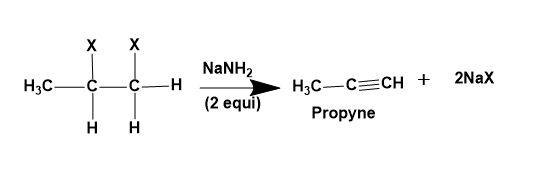
1. Alkylene dihalide- It is a di-halogen derivative of an alkane in which the two halogens are attached to the adjacent carbon atoms of the chain. Since, the position of halogens are on adjacent carbon atoms; alkylene dihalides are also known as vicinal dihalides.
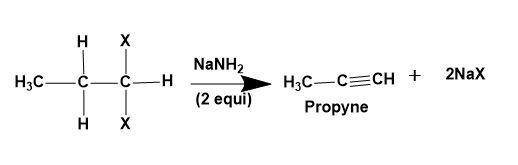
2. Alkylidene dihalide-It is a di-halogen derivative of an alkane in which the two halogens are attached to the same carbon atom of the chain. Since, the position of halogens are on the same carbon atom; alkylidene dihalides are also known as geminal dihalides.
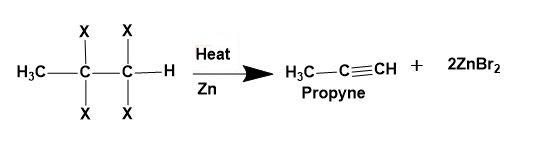
3. Tetra haloalkane-The general formula of tetra haloalkane is ${{C}_{n}}{{H}_{2n-2}}{{X}_{4}}$ where, n = 1, 2, 3, 4…
The position of the halogen atom is indicated by the ‘n’ on the carbon chain.
Now, let us move towards the reaction giving propyne as the product from;
(i) Alkylene dihalide -Dehydrohalogenation of vicinal dihalides takes place to give alkyne as a product.
(ii) Alkylidene dihalide-Dehydrohalogenation of geminal dihalides takes place to give alkyne as a product.
(iii) Tetra-haloalkane-Dehalogenation of vicinal tetra-haloalkane takes place to give alkyne as a product.
Note: These are the laboratory methods for the preparation of alkynes. Also, they have their own drawbacks too; as the halogen compounds are themselves prepared by halogen addition to alkynes.
Complete step by step solution:
Let us firstly understand about the reagents given for the preparation of propyne;
1. Alkylene dihalide- It is a di-halogen derivative of an alkane in which the two halogens are attached to the adjacent carbon atoms of the chain. Since, the position of halogens are on adjacent carbon atoms; alkylene dihalides are also known as vicinal dihalides.
2. Alkylidene dihalide-It is a di-halogen derivative of an alkane in which the two halogens are attached to the same carbon atom of the chain. Since, the position of halogens are on the same carbon atom; alkylidene dihalides are also known as geminal dihalides.
3. Tetra haloalkane-The general formula of tetra haloalkane is ${{C}_{n}}{{H}_{2n-2}}{{X}_{4}}$ where, n = 1, 2, 3, 4…
The position of the halogen atom is indicated by the ‘n’ on the carbon chain.
Now, let us move towards the reaction giving propyne as the product from;
(i) Alkylene dihalide -Dehydrohalogenation of vicinal dihalides takes place to give alkyne as a product.
(ii) Alkylidene dihalide-Dehydrohalogenation of geminal dihalides takes place to give alkyne as a product.
(iii) Tetra-haloalkane-Dehalogenation of vicinal tetra-haloalkane takes place to give alkyne as a product.
Note: These are the laboratory methods for the preparation of alkynes. Also, they have their own drawbacks too; as the halogen compounds are themselves prepared by halogen addition to alkynes.
Recently Updated Pages
Which of the following graphs shows the variation of class 12 physics CBSE

Draw a labelled diagram of the human male reproductive class 12 biology CBSE
Describe the experiment to compare the emf of two cells class 12 physics CBSE
What is standard hydrogen electrode
What is conventional current and electric current class 12 physics CBSE
2Bromopentane is treated with an alcoholic KOH solution class 12 chemistry CBSE
Trending doubts
Draw a labelled sketch of the human eye class 12 physics CBSE
Which are the Top 10 Largest Countries of the World?
Differentiate between homogeneous and heterogeneous class 12 chemistry CBSE
Draw ray diagrams each showing i myopic eye and ii class 12 physics CBSE
Which is the correct genotypic ratio of mendel dihybrid class 12 biology CBSE
What is the Full Form of PVC, PET, HDPE, LDPE, PP and PS ?