




Propan-2-ol on reacting with $C{{l}_{2}}$ produces:
A. Trichloroethanol
B. Trichloroacetone
C. Acetone
D. None of these
Answer
 Verified
628.5k+ views
Hint: Think about which functional group among halogens and hydroxides is a better leaving group. Reason about what kind of reaction may occur as a consequence of the previous deduction.
Complete step by step solution:
This kind of reaction is known as the Haloform reaction, it forms compounds like chloroform, iodoform, etc.
Here, a displacement reaction substituting the $O{{H}^{-}}$ group with the $C{{l}^{-}}$ group cannot occur as $C{{l}^{-}}$ is a better leaving group than $O{{H}^{-}}$ and cannot be substituted. But chlorine is a very electronegative group and causes an elimination reaction. It oxidizes the secondary carbon by dehydrogenation and forms a ketone and $HCl$. The reaction occurs as follows:
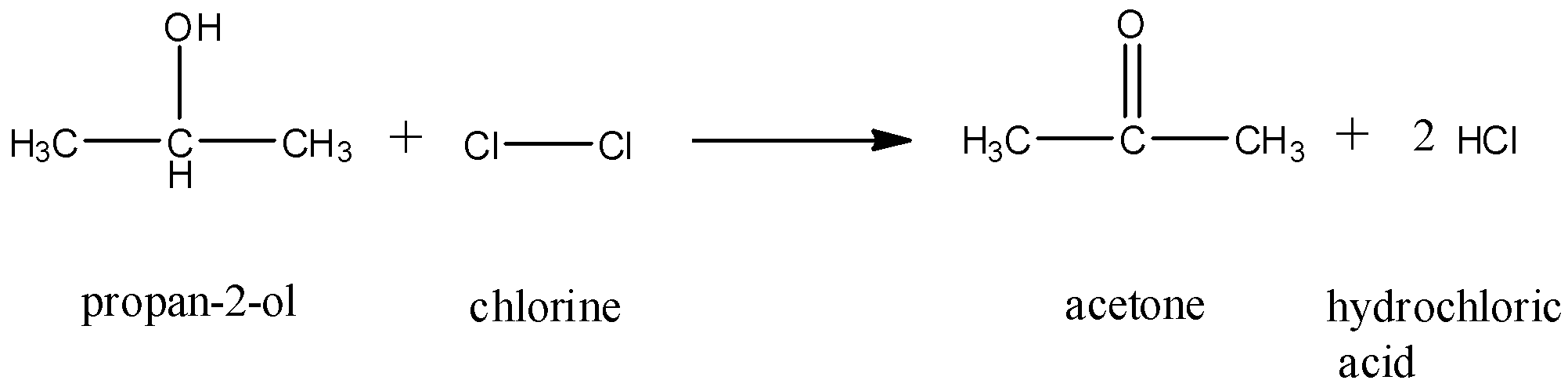
Acetone is the intermediate formed in this reaction.
Now, the excess of chlorine immediately reacts with the formed acetone to form a haloform compound. The chlorine replaces the hydrogen atoms on one of the carbon atoms and turns acetone into trichloroacetone. The reaction goes as follows:
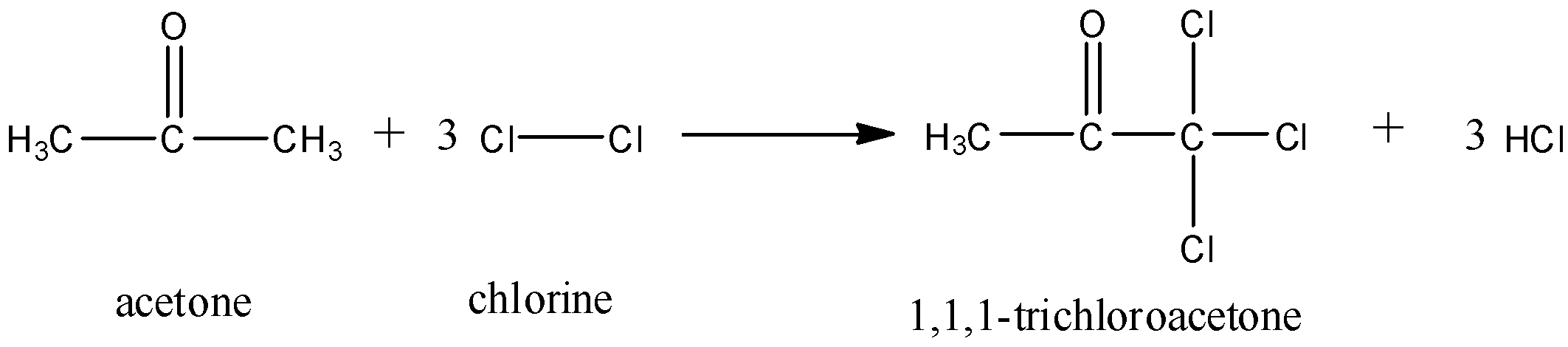
This reaction will go on till all the chlorine is depleted.
Hence, the answer is ‘B. Trichloroacetone’.
Note: The intermediate formed in this reaction is acetone. If chlorine is not available in excess then most of the product found will be acetone, but some of the product will still be trichloroacetone and some of the reactant will remain unreacted. This happens as some molecules may react and form products faster than others on the basis of pure chance. Do not get confused and mark your answer as ‘C. Acetone’ since the final product formed will always be trichloroacetone.
Complete step by step solution:
This kind of reaction is known as the Haloform reaction, it forms compounds like chloroform, iodoform, etc.
Here, a displacement reaction substituting the $O{{H}^{-}}$ group with the $C{{l}^{-}}$ group cannot occur as $C{{l}^{-}}$ is a better leaving group than $O{{H}^{-}}$ and cannot be substituted. But chlorine is a very electronegative group and causes an elimination reaction. It oxidizes the secondary carbon by dehydrogenation and forms a ketone and $HCl$. The reaction occurs as follows:
Acetone is the intermediate formed in this reaction.
Now, the excess of chlorine immediately reacts with the formed acetone to form a haloform compound. The chlorine replaces the hydrogen atoms on one of the carbon atoms and turns acetone into trichloroacetone. The reaction goes as follows:
This reaction will go on till all the chlorine is depleted.
Hence, the answer is ‘B. Trichloroacetone’.
Note: The intermediate formed in this reaction is acetone. If chlorine is not available in excess then most of the product found will be acetone, but some of the product will still be trichloroacetone and some of the reactant will remain unreacted. This happens as some molecules may react and form products faster than others on the basis of pure chance. Do not get confused and mark your answer as ‘C. Acetone’ since the final product formed will always be trichloroacetone.
Recently Updated Pages
Master Class 12 Economics: Engaging Questions & Answers for Success

Master Class 12 English: Engaging Questions & Answers for Success
Master Class 12 Social Science: Engaging Questions & Answers for Success
Master Class 12 Maths: Engaging Questions & Answers for Success
Master Class 12 Physics: Engaging Questions & Answers for Success
Master Class 12 Business Studies: Engaging Questions & Answers for Success
Trending doubts
Which are the Top 10 Largest Countries of the World?
Draw a labelled sketch of the human eye class 12 physics CBSE
Differentiate between homogeneous and heterogeneous class 12 chemistry CBSE
Why is the cell called the structural and functional class 12 biology CBSE
Draw ray diagrams each showing i myopic eye and ii class 12 physics CBSE
Which is the correct genotypic ratio of mendel dihybrid class 12 biology CBSE