




Principle of reversibility can applied to
A. Lens system
B. Mirror system
C. Lens and mirror system
D. None of these
Answer
 Verified
606.6k+ views
Hint: In this solution, Principle of reversibility of light can be applied to both lens and mirror
because light reversibility states that if the direction of light's travel is reversed, light follows the
same path.
Complete step-by-step answer:
Principle of reversibility: The principle of light reversibility states that if the direction of light's
travel is reversed, light follows the same path. It presumes that a reversal of the direction of the
ray does not affect the attenuation of a light ray during its passage through an optical medium
due to reflection, refraction and absorption. In its simplest explanation, the reversibility principle
is a deduction of the refraction of light from Snell's law. The reversibility principle presumes that
the attenuation of a light ray during its entry through an optical medium due to reflection,
refraction, and absorption is not altered by a reversal of the ray direction.
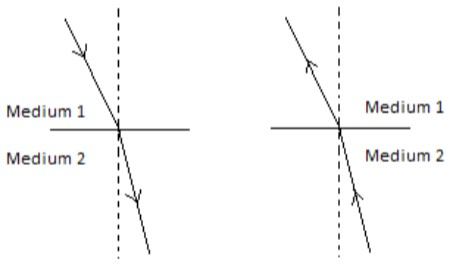
According to the theory of reversibility of light, if after suffering from a number of reflections
and refractions, the direction of the light is reversed, then it retraces its direction. This means that
if a light ray passes from medium 1 to medium 2 and has the angle of incidence and the angle of
refraction as I and r respectively, then the angle of refraction in medium 1 would be I if the light
is incident from medium 2 at an angle r.
So we can observe that principle of reversibility will apply to both lens and mirror system,
Since the theory is followed by both, path of light ray is reversible or light trace back its path
while traveling in reverse direction or a ray of light will move in either direction along the same
track.
Hence the required answer is C.
Note: The rule specifies that if the direction of a light beam is reversed, it must follow the same
path regardless the number of times the beam is mirrored or refracted.
because light reversibility states that if the direction of light's travel is reversed, light follows the
same path.
Complete step-by-step answer:
Principle of reversibility: The principle of light reversibility states that if the direction of light's
travel is reversed, light follows the same path. It presumes that a reversal of the direction of the
ray does not affect the attenuation of a light ray during its passage through an optical medium
due to reflection, refraction and absorption. In its simplest explanation, the reversibility principle
is a deduction of the refraction of light from Snell's law. The reversibility principle presumes that
the attenuation of a light ray during its entry through an optical medium due to reflection,
refraction, and absorption is not altered by a reversal of the ray direction.
According to the theory of reversibility of light, if after suffering from a number of reflections
and refractions, the direction of the light is reversed, then it retraces its direction. This means that
if a light ray passes from medium 1 to medium 2 and has the angle of incidence and the angle of
refraction as I and r respectively, then the angle of refraction in medium 1 would be I if the light
is incident from medium 2 at an angle r.
So we can observe that principle of reversibility will apply to both lens and mirror system,
Since the theory is followed by both, path of light ray is reversible or light trace back its path
while traveling in reverse direction or a ray of light will move in either direction along the same
track.
Hence the required answer is C.
Note: The rule specifies that if the direction of a light beam is reversed, it must follow the same
path regardless the number of times the beam is mirrored or refracted.
Recently Updated Pages
Master Class 10 Computer Science: Engaging Questions & Answers for Success

Master Class 10 General Knowledge: Engaging Questions & Answers for Success
Master Class 10 English: Engaging Questions & Answers for Success
Master Class 10 Social Science: Engaging Questions & Answers for Success
Master Class 10 Maths: Engaging Questions & Answers for Success
Master Class 10 Science: Engaging Questions & Answers for Success
Trending doubts
Find the sum of series 1 + 2 + 3 + 4 + 5 + + 100 class 9 maths CBSE
Fill the blanks with the suitable prepositions 1 The class 9 english CBSE
Difference Between Plant Cell and Animal Cell
What is the Full Form of ICSE / ISC ?
What is pollution? How many types of pollution? Define it
Name 10 Living and Non living things class 9 biology CBSE