




Why do primary alkyl halides generally undergo the $S{N_2}$ mechanism?
Answer
 Verified
493.8k+ views
Hint: A class of organic reaction in which an electron rich species i.e., a nucleophile attacks an electron deficient species i.e., electrophile to replace a leaving group is known as nucleophilic substitution reaction. It can be of two types i.e., unimolecular nucleophilic substitution $\left( {S{N_1}} \right)$ reaction and bimolecular nucleophilic substitution $\left( {S{N_2}} \right)$ reaction.
Complete answer:
In bimolecular nucleophilic substitution reaction i.e., $S{N_2}$ reaction, two molecules are involved in the rate determining step i.e., the rate of the reaction depends on both reactant as well as nucleophile. The mechanism of $S{N_2}$ reaction is a concerted single step mechanism, that means the attack of nucleophile and the removal of the leaving group takes place simultaneously. The mechanism can be explained as follows:
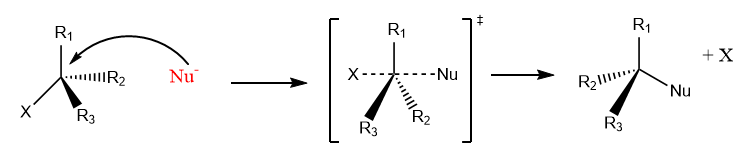
It is clearly observed from the mechanism that the attack of nucleophile takes place from the back side of alkyl halide. If each of the three substituents in the alkyl halide are hydrogen atoms i.e., if we consider primary alkyl halide, there would be little steric hindrance for incoming nucleophile and thus, the nucleophilic substitution can occur with ease at electrophilic centre. As the number of alkyl groups increases on the electrophilic centre, the rate of reaction will be affected by two factors which are as follows:
1. Increase in steric hindrance:
The bulky group attached to the electrophilic centre will work as a shield and will prevent the nucleophile from attacking the electrophilic centre.
2. Decrease in electrophilicity of carbon atom:
Because the alkyl groups are electron donating groups, which will donate electrons to the electrophilic centre and thus, the electrophilicity of the molecule will be decreased.
Hence, on increasing the number of alkyl groups on the electrophilic centre, the rate of $S{N_2}$ reaction decreases. The order of reactivity of alkyl halides can be generalized as follows:
${\text{methyl}} > {1^o} > {2^o} > {3^o}$
Thus, we can conclude that primary alkyl halides generally undergo the $S{N_2}$ mechanism.
Note:
It is important to note that primary alkyl halides do not undergo $S{N_1}$ mechanism because it is the two-step mechanism and the reaction intermediate involved in $S{N_1}$ mechanism is carbocation which is stable as the number of alkyl group on the carbon increases. So, tertiary alkyl halides generally undergo the $S{N_1}$ mechanism.
Complete answer:
In bimolecular nucleophilic substitution reaction i.e., $S{N_2}$ reaction, two molecules are involved in the rate determining step i.e., the rate of the reaction depends on both reactant as well as nucleophile. The mechanism of $S{N_2}$ reaction is a concerted single step mechanism, that means the attack of nucleophile and the removal of the leaving group takes place simultaneously. The mechanism can be explained as follows:
It is clearly observed from the mechanism that the attack of nucleophile takes place from the back side of alkyl halide. If each of the three substituents in the alkyl halide are hydrogen atoms i.e., if we consider primary alkyl halide, there would be little steric hindrance for incoming nucleophile and thus, the nucleophilic substitution can occur with ease at electrophilic centre. As the number of alkyl groups increases on the electrophilic centre, the rate of reaction will be affected by two factors which are as follows:
1. Increase in steric hindrance:
The bulky group attached to the electrophilic centre will work as a shield and will prevent the nucleophile from attacking the electrophilic centre.
2. Decrease in electrophilicity of carbon atom:
Because the alkyl groups are electron donating groups, which will donate electrons to the electrophilic centre and thus, the electrophilicity of the molecule will be decreased.
Hence, on increasing the number of alkyl groups on the electrophilic centre, the rate of $S{N_2}$ reaction decreases. The order of reactivity of alkyl halides can be generalized as follows:
${\text{methyl}} > {1^o} > {2^o} > {3^o}$
Thus, we can conclude that primary alkyl halides generally undergo the $S{N_2}$ mechanism.
Note:
It is important to note that primary alkyl halides do not undergo $S{N_1}$ mechanism because it is the two-step mechanism and the reaction intermediate involved in $S{N_1}$ mechanism is carbocation which is stable as the number of alkyl group on the carbon increases. So, tertiary alkyl halides generally undergo the $S{N_1}$ mechanism.
Recently Updated Pages
Master Class 12 Economics: Engaging Questions & Answers for Success

Master Class 12 Physics: Engaging Questions & Answers for Success
Master Class 12 English: Engaging Questions & Answers for Success
Master Class 12 Social Science: Engaging Questions & Answers for Success
Master Class 12 Maths: Engaging Questions & Answers for Success
Master Class 12 Business Studies: Engaging Questions & Answers for Success
Trending doubts
Which are the Top 10 Largest Countries of the World?
What are the major means of transport Explain each class 12 social science CBSE
Draw a labelled sketch of the human eye class 12 physics CBSE
Why cannot DNA pass through cell membranes class 12 biology CBSE
Differentiate between insitu conservation and exsitu class 12 biology CBSE
Draw a neat and well labeled diagram of TS of ovary class 12 biology CBSE