



Primary alcohols are obtained by the reaction of Grignard reagent with:
A. ${\text{C}}{{\text{H}}_{\text{3}}}{\text{COC}}{{\text{H}}_{\text{3}}}$
B. ${\text{HCOOH}}$
C. ${\text{HCHO}}$
D .${\text{C}}{{\text{H}}_{\text{3}}}{\text{CHO}}$
Answer
 Verified
600.9k+ views
Hint: We should know what Grignard reagent is and how it works. The general formula of Grignard reagent is ${\text{RMgX}}$. It gives ${{\text{R}}^ - }$. ${{\text{R}}^ - }$ attacks on electrophilic centres. We will determine the electrophilic centre. We should also know what primary alcohol is. From all the products we will determine the primary alcohol.
Complete Solution :
The alkyl magnesium halide reagent having general formula ${\text{RMgX}}$ is known as a Grignard reagent. This reagent is used for the generation of alkyl nucleophiles. The alkyl nucleophile attack on carbonyl carbon generates negative change on carbonyl oxygen which gets protonated to give alcohol.
The reaction of prop $ - 2 - $ on ${\text{C}}{{\text{H}}_{\text{3}}}{\text{COC}}{{\text{H}}_{\text{3}}}$ with Grignard reagent is as follows:
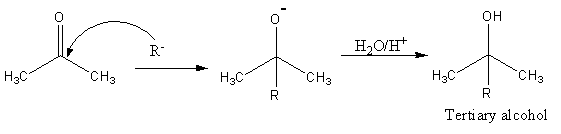
The reaction prop $ - 2 - $ on with Grignard reagent gives tertiary alcohol.
The reaction of formic acid with Grignard reagent is as follows:
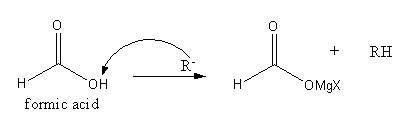
The hydrogen attached with oxygen is very acidic so the alkyl group generated from Grignard reagent abstracts this acidic hydrogen forming RH and magnesium salt of carboxylic acid as products.
The reaction of formaldehyde ${\text{HCHO}}$ with Grignard reagent is as follows:
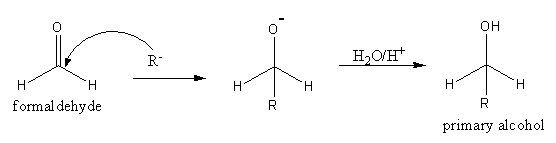
The reaction formaldehyde with Grignard reagent gives primary alcohol.
The reaction of acetaldehyde ${\text{C}}{{\text{H}}_{\text{3}}}{\text{CHO}}$ with Grignard reagent is as follows:
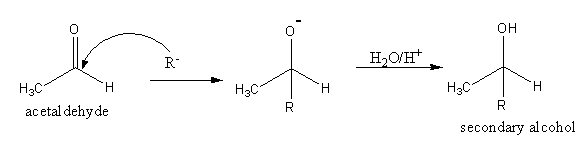
The reaction acetaldehyde with Grignard reagent gives secondary alcohol.
So, primary alcohols are obtained by the reaction of the Grignard reagent with formaldehyde ${\text{HCHO}}$.
Therefore, option (C) ${\text{HCHO}}$, is correct.
Note: Carbonyl carbon is the most electrophilic centre. Carbonyl is of two types; aldehydes and ketones. Only the formaldehyde gives primary alcohol. Remaining all aldehydes give secondary alcohol. Ketones do not give primary alcohol. Ketone gives secondary and tertiary alcohol. Prop on is a ketone and acetaldehyde is an aldehyde rather than formaldehyde, so both do not give primary alcohol. Acids react differently with the Grignard reagent. Acid gives alkanes.
Complete Solution :
The alkyl magnesium halide reagent having general formula ${\text{RMgX}}$ is known as a Grignard reagent. This reagent is used for the generation of alkyl nucleophiles. The alkyl nucleophile attack on carbonyl carbon generates negative change on carbonyl oxygen which gets protonated to give alcohol.
The reaction of prop $ - 2 - $ on ${\text{C}}{{\text{H}}_{\text{3}}}{\text{COC}}{{\text{H}}_{\text{3}}}$ with Grignard reagent is as follows:
The reaction prop $ - 2 - $ on with Grignard reagent gives tertiary alcohol.
The reaction of formic acid with Grignard reagent is as follows:
The hydrogen attached with oxygen is very acidic so the alkyl group generated from Grignard reagent abstracts this acidic hydrogen forming RH and magnesium salt of carboxylic acid as products.
The reaction of formaldehyde ${\text{HCHO}}$ with Grignard reagent is as follows:
The reaction formaldehyde with Grignard reagent gives primary alcohol.
The reaction of acetaldehyde ${\text{C}}{{\text{H}}_{\text{3}}}{\text{CHO}}$ with Grignard reagent is as follows:
The reaction acetaldehyde with Grignard reagent gives secondary alcohol.
So, primary alcohols are obtained by the reaction of the Grignard reagent with formaldehyde ${\text{HCHO}}$.
Therefore, option (C) ${\text{HCHO}}$, is correct.
Note: Carbonyl carbon is the most electrophilic centre. Carbonyl is of two types; aldehydes and ketones. Only the formaldehyde gives primary alcohol. Remaining all aldehydes give secondary alcohol. Ketones do not give primary alcohol. Ketone gives secondary and tertiary alcohol. Prop on is a ketone and acetaldehyde is an aldehyde rather than formaldehyde, so both do not give primary alcohol. Acids react differently with the Grignard reagent. Acid gives alkanes.
Recently Updated Pages
Master Class 12 Economics: Engaging Questions & Answers for Success

Master Class 12 English: Engaging Questions & Answers for Success
Master Class 12 Social Science: Engaging Questions & Answers for Success
Master Class 12 Maths: Engaging Questions & Answers for Success
Master Class 12 Physics: Engaging Questions & Answers for Success
Master Class 9 General Knowledge: Engaging Questions & Answers for Success
Trending doubts
Which are the Top 10 Largest Countries of the World?
Draw a labelled sketch of the human eye class 12 physics CBSE
Differentiate between homogeneous and heterogeneous class 12 chemistry CBSE
Why is the cell called the structural and functional class 12 biology CBSE
Draw ray diagrams each showing i myopic eye and ii class 12 physics CBSE
Which is the correct genotypic ratio of mendel dihybrid class 12 biology CBSE