




Primary acceptor of $C{ O }_{ 2 }$ in photosynthesis is
(a)Phosphoric acid
(b)Ribulose phosphate
(c)Glucose
(d)Ribulose-1,5- biphosphate
Answer
 Verified
661.5k+ views
Hint: The primary acceptor of carbon dioxide is an important five-carbon enzyme in the Calvin cycle and helps in carbon fixation. Magnesium ion is essential for its enzymatic activity.
Complete answer:
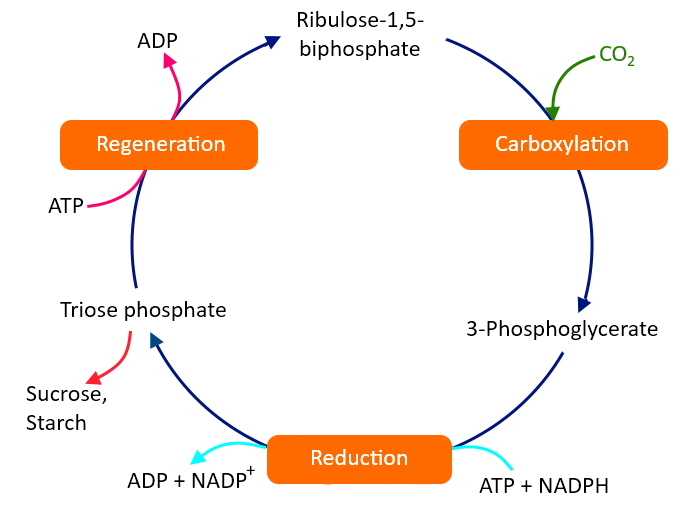
Ribulose-1,5- biphosphate is one of the enzymes used in the Calvin cycle. Ribulose-1,5- biphosphate helps in fixation of carbon dioxide where:
Carbon dioxide reacts with Ribulose-1,5- biphosphate to form two 3-phosphoglycerate. This reaction is highly exergonic. The reaction is catalyzed by the Ribulose-1,5- biphosphate carboxylase/ oxygenase (rubisco). Rubisco is a soluble enzyme located on the stromal surface of the thylakoid membrane of chloroplasts.
Additional Information:
-In the stroma, in addition to carbon dioxide, two other components are present to initiate the light-independent reactions: an enzyme called ribulose bisphosphate carboxylase (RUBISCO) and three molecules of ribulose bisphosphate (RUBP).
-Calvin cycle occurs in all photosynthetic plants during the dark phase of photosynthesis where it stores the ATP energy during the light reaction in the carbohydrate molecule as the food energy.
So, the correct answer is, ‘Ribulose-1,5- biphosphate.’
Note: -The Calvin cycle was first observed by Melvin Calvin in Chlorella and he was awarded a Nobel prize for this work.
-This cycle involves the main three stages: fixation, reduction, and regeneration.
-Calvin cycle is also known as the dark reaction or ${ C }_{ 3 }$ cycle or reductive pentose phosphate cycle and photosynthetic carbon reduction cycle (PCR).
Complete answer:
Ribulose-1,5- biphosphate is one of the enzymes used in the Calvin cycle. Ribulose-1,5- biphosphate helps in fixation of carbon dioxide where:
Carbon dioxide reacts with Ribulose-1,5- biphosphate to form two 3-phosphoglycerate. This reaction is highly exergonic. The reaction is catalyzed by the Ribulose-1,5- biphosphate carboxylase/ oxygenase (rubisco). Rubisco is a soluble enzyme located on the stromal surface of the thylakoid membrane of chloroplasts.
Additional Information:
-In the stroma, in addition to carbon dioxide, two other components are present to initiate the light-independent reactions: an enzyme called ribulose bisphosphate carboxylase (RUBISCO) and three molecules of ribulose bisphosphate (RUBP).
-Calvin cycle occurs in all photosynthetic plants during the dark phase of photosynthesis where it stores the ATP energy during the light reaction in the carbohydrate molecule as the food energy.
So, the correct answer is, ‘Ribulose-1,5- biphosphate.’
Note: -The Calvin cycle was first observed by Melvin Calvin in Chlorella and he was awarded a Nobel prize for this work.
-This cycle involves the main three stages: fixation, reduction, and regeneration.
-Calvin cycle is also known as the dark reaction or ${ C }_{ 3 }$ cycle or reductive pentose phosphate cycle and photosynthetic carbon reduction cycle (PCR).
Recently Updated Pages
If x a + bt + ct2 where x is in meters and t is in class 11 physics CBSE

A car covers the first half distance between two places class 11 physics CBSE
The resultant of two vectors overrightarrow P and overrightarrow class 11 physics CBSE
Find the value of cos 135 class 11 maths CBSE
A mass M is held in place by an applied force F and class 11 physics CBSE
A solution of glucose in water is labelled as 10 dfracwv class 11 chemistry CBSE
Trending doubts
One Metric ton is equal to kg A 10000 B 1000 C 100 class 11 physics CBSE
Find the value of the expression given below sin 30circ class 11 maths CBSE
What do you mean by retardation What is its SI uni class 11 physics CBSE
Draw a diagram of nephron and explain its structur class 11 biology CBSE
10 examples of friction in our daily life
Difference between physical and chemical change class 11 chemistry CBSE