




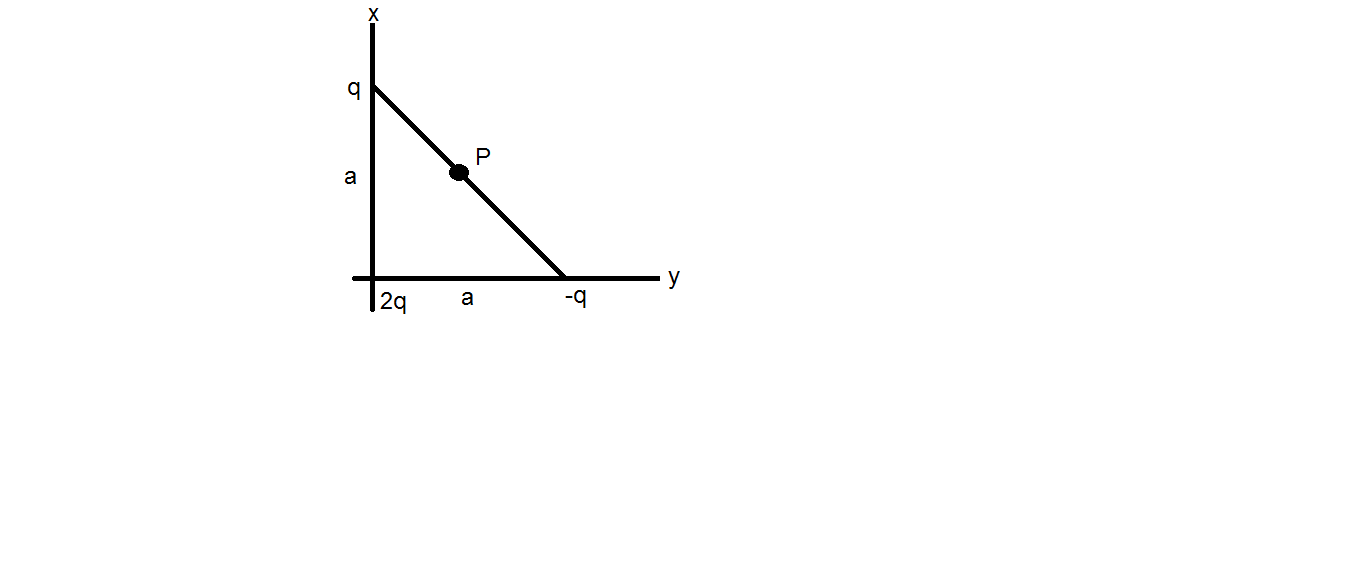
What is the potential energy of this configuration of three charges?
Answer
 Verified
510k+ views
Hint: In order to solve this question, we are going to firstly analyze the configuration of the three charges and we will find the potential energy of the charges taking two at a time, one by one, then, the total potential energy of the configuration is found by adding the three potential energies as calculated.
Formula used: The potential energy of the two charges is given as:
\[{U_3} = - \dfrac{1}{{4\pi {\varepsilon _0}}}\dfrac{{{q_1}{q_2}}}{r}\]
Where, \[r\]is the distance between the two charges \[{q_1}\]and\[{q_2}\].
Complete step-by-step solution:
It is given that the three charges are given in the configuration as above, if we find the potential energy taking two charges at a same time then, adding them can give the total potential energy of the configuration.
Let us first take the two charges, \[q\]and\[2q\], which are at a distance of \[a\]
Then, the potential energy is equal to:
\[{U_1} = \dfrac{1}{{4\pi {\varepsilon _0}}}\dfrac{{2{q^2}}}{a}\]
Now, taking the two charges \[2q\]and\[ - q\], which are at a distance of\[a\]
Then, the potential energy is equal to:
\[{U_2} = - \dfrac{1}{{4\pi {\varepsilon _0}}}\dfrac{{2{q^2}}}{a}\]
Taking the other two charges, \[q\]and\[ - q\], the distance between them is found by Pythagoras theorem,
\[s = \sqrt {{a^2} + {a^2}} = \sqrt 2 a\]
Thus, potential energy is given by
\[{U_3} = - \dfrac{1}{{4\pi {\varepsilon _0}}}\dfrac{{{q^2}}}{a}\]
Therefore, the total potential energy is equal to the sum of the three as given by:
\[U = {U_1} + {U_2} + {U_3} = \dfrac{1}{{4\pi {\varepsilon _0}}}\left( {\dfrac{{2{q^2}}}{a} - \dfrac{{2{q^2}}}{a} - \dfrac{{{q^2}}}{{\sqrt 2 a}}} \right)\]
Solving this equation, we get,
\[U = \dfrac{{ - {q^2}}}{{4\sqrt 2 \pi {\varepsilon _0}a}}\]
Note:It is important to note that the potential energy is the energy held by an object because of its position relative to other objects, stresses within itself, its electric charge, or other factors. It is taken for two charges at a time when more than the two charges are given, then the potential energies are found taking two charges each one by one.
Formula used: The potential energy of the two charges is given as:
\[{U_3} = - \dfrac{1}{{4\pi {\varepsilon _0}}}\dfrac{{{q_1}{q_2}}}{r}\]
Where, \[r\]is the distance between the two charges \[{q_1}\]and\[{q_2}\].
Complete step-by-step solution:
It is given that the three charges are given in the configuration as above, if we find the potential energy taking two charges at a same time then, adding them can give the total potential energy of the configuration.
Let us first take the two charges, \[q\]and\[2q\], which are at a distance of \[a\]
Then, the potential energy is equal to:
\[{U_1} = \dfrac{1}{{4\pi {\varepsilon _0}}}\dfrac{{2{q^2}}}{a}\]
Now, taking the two charges \[2q\]and\[ - q\], which are at a distance of\[a\]
Then, the potential energy is equal to:
\[{U_2} = - \dfrac{1}{{4\pi {\varepsilon _0}}}\dfrac{{2{q^2}}}{a}\]
Taking the other two charges, \[q\]and\[ - q\], the distance between them is found by Pythagoras theorem,
\[s = \sqrt {{a^2} + {a^2}} = \sqrt 2 a\]
Thus, potential energy is given by
\[{U_3} = - \dfrac{1}{{4\pi {\varepsilon _0}}}\dfrac{{{q^2}}}{a}\]
Therefore, the total potential energy is equal to the sum of the three as given by:
\[U = {U_1} + {U_2} + {U_3} = \dfrac{1}{{4\pi {\varepsilon _0}}}\left( {\dfrac{{2{q^2}}}{a} - \dfrac{{2{q^2}}}{a} - \dfrac{{{q^2}}}{{\sqrt 2 a}}} \right)\]
Solving this equation, we get,
\[U = \dfrac{{ - {q^2}}}{{4\sqrt 2 \pi {\varepsilon _0}a}}\]
Note:It is important to note that the potential energy is the energy held by an object because of its position relative to other objects, stresses within itself, its electric charge, or other factors. It is taken for two charges at a time when more than the two charges are given, then the potential energies are found taking two charges each one by one.
Recently Updated Pages
Master Class 12 Economics: Engaging Questions & Answers for Success

Master Class 12 Physics: Engaging Questions & Answers for Success
Master Class 12 English: Engaging Questions & Answers for Success
Master Class 12 Social Science: Engaging Questions & Answers for Success
Master Class 12 Maths: Engaging Questions & Answers for Success
Master Class 12 Business Studies: Engaging Questions & Answers for Success
Trending doubts
Which are the Top 10 Largest Countries of the World?
What are the major means of transport Explain each class 12 social science CBSE
Draw a labelled sketch of the human eye class 12 physics CBSE
Why cannot DNA pass through cell membranes class 12 biology CBSE
Differentiate between insitu conservation and exsitu class 12 biology CBSE
Draw a neat and well labeled diagram of TS of ovary class 12 biology CBSE