




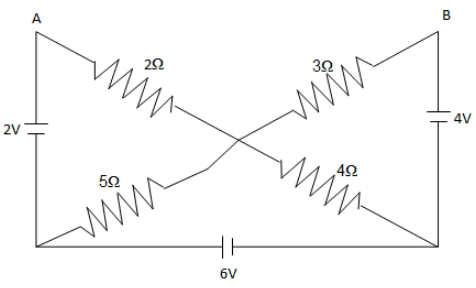
Potential difference between points A and B (i.e. \[{V_A}\]-\[{V_B}\] is ___________
Answer
 Verified
594.6k+ views
Hint:We are asked to find the potential difference between the points A and B. To find out the potential difference between points A and B, take a path of the circuit from point A to B and calculate the potential for the path to get the required potential difference.
Complete step by step answer:
Given a circuit and we are asked to find the potential difference between points A and B.Let us redraw the circuit.
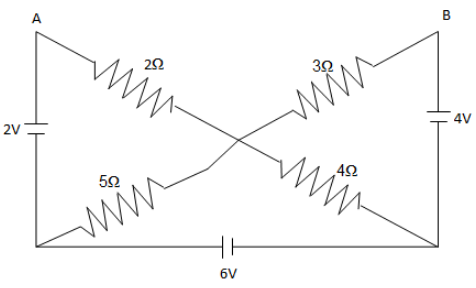
To find the potential difference between points A and B, we take the path ACDB.
Let \[{V_A}\] be the potential at point A and \[{V_B}\] be the potential at point B.
So, using the path ACDB the potential difference between point A and B is,
\[{V_A} - {V_B} = 2{\text{V}} + 6{\text{V}} - 4{\text{V}}\]
\[ \Rightarrow {V_A} - {V_B} = 8{\text{V}} - 4{\text{V}}\]
\[ \therefore {V_A} - {V_B} = 4{\text{V}}\]
Therefore, the potential difference between points A and B is \[4{\text{V}}\].
Note: Potential difference between two points A and B can be defined as the change in amount of potential energy of a charge while moving from point A to point B. Potential difference is also known as voltage drop. The SI unit of potential difference is volts. The relationship between voltage, current and resistance is given by Ohm’s law, which states that current passing through a conductor is directly proportional to the potential difference across the conductor. Mathematically, it is written as, \[V = IR\] where \[V\] is the potential difference or voltage drop, \[I\] is the current and \[R\] is the resistance of the conductor. If the voltage increases then there will be an increase in current flow too.
Complete step by step answer:
Given a circuit and we are asked to find the potential difference between points A and B.Let us redraw the circuit.
To find the potential difference between points A and B, we take the path ACDB.
Let \[{V_A}\] be the potential at point A and \[{V_B}\] be the potential at point B.
So, using the path ACDB the potential difference between point A and B is,
\[{V_A} - {V_B} = 2{\text{V}} + 6{\text{V}} - 4{\text{V}}\]
\[ \Rightarrow {V_A} - {V_B} = 8{\text{V}} - 4{\text{V}}\]
\[ \therefore {V_A} - {V_B} = 4{\text{V}}\]
Therefore, the potential difference between points A and B is \[4{\text{V}}\].
Note: Potential difference between two points A and B can be defined as the change in amount of potential energy of a charge while moving from point A to point B. Potential difference is also known as voltage drop. The SI unit of potential difference is volts. The relationship between voltage, current and resistance is given by Ohm’s law, which states that current passing through a conductor is directly proportional to the potential difference across the conductor. Mathematically, it is written as, \[V = IR\] where \[V\] is the potential difference or voltage drop, \[I\] is the current and \[R\] is the resistance of the conductor. If the voltage increases then there will be an increase in current flow too.
Recently Updated Pages
Master Class 12 Business Studies: Engaging Questions & Answers for Success

Master Class 12 Chemistry: Engaging Questions & Answers for Success
Master Class 12 Biology: Engaging Questions & Answers for Success
Class 12 Question and Answer - Your Ultimate Solutions Guide
Master Class 11 English: Engaging Questions & Answers for Success
Master Class 11 Social Science: Engaging Questions & Answers for Success
Trending doubts
Which are the Top 10 Largest Countries of the World?
Draw a labelled sketch of the human eye class 12 physics CBSE
The end of compass needle which points towards north class 12 physics CBSE
Differentiate between homogeneous and heterogeneous class 12 chemistry CBSE
In order to find out the different types of gametes class 12 biology NEET_UG
Why is the cell called the structural and functional class 12 biology CBSE