




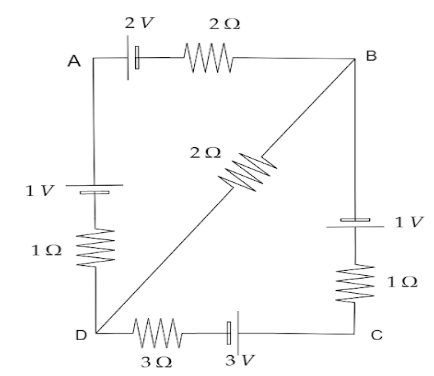
What is the potential difference between B and D
A. $\dfrac{1}{{13}}\;V$
B. $\dfrac{2}{{13}}\;V$
C. $\dfrac{7}{{13}}\;V$
D. $\dfrac{6}{{13}}\;V$
Answer
 Verified
568.2k+ views
Hint:In this question we have to find the potential difference between two pints. We have to consider two currents $i$ and $i'$ flowing into the circuit. Then by using Kirchhoff’s Voltage Law we will eventually form equations. By solving the equations, we will find the desired results.
Complete step by step answer:
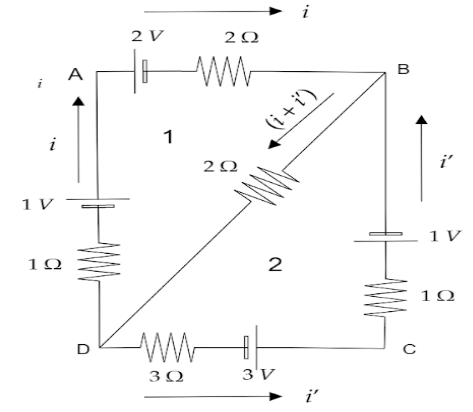
Let us consider two loops $1$ and $2$. The current flowing through loop $1$ is $i$ and the current flowing in loop $2$ be $i'$. The potential at B be ${V_b}$ and at D be ${V_d}$.
Now using Kirchhoff’s Voltage Law we will find out,
Considering loop $1$ we formulate the equation,
$ - (i \times 1) + 1 - 2 - \left( {2i} \right) - 2\left( {i + i'} \right) = 0$
Now, solving the equation we get,
$5i + 1 + 2i' = 0 - - - - - - \left( 1 \right)$
Considering loop $2$ we formulate the equation as,
$ - (i' \times 1) - 1 + 3 - \left( {3i'} \right) - 2\left( {i + i'} \right) = 0$
Solving the equation we get,
$ - 2i - 6i' + 2 = 0 - - - - - - \left( 2 \right)$
Multiplying equation $\left( 1 \right)$ by $3$ we get,
$15i + 3 + 6i' = 0 - - - - - \left( 3 \right)$
Adding equation $\left( 2 \right)$ and equation $\left( 3 \right)$ we get,
$13i + 5 = 0$
So, we get the value of $i = - \dfrac{5}{{13}}$.
Putting the value of $i$ in equation $\left( 1 \right)$ we get,
$5\left( { - \dfrac{5}{{13}}} \right) + 1 + 2i' = 0$
Therefore, the value of $i' = \dfrac{6}{{13}}$.
The current flowing along B and D is $ = \left( {i + i'} \right) = \dfrac{6}{{13}} - \dfrac{5}{{13}} = \dfrac{1}{{13}}$ $A$.
Now, with the help of Ohm’s Law we will find out the potential difference between B and D.
${V_b} - {V_d} = \left( {i + i'} \right) \times 2 \\
\therefore {V_b} - {V_d}= \dfrac{2}{{13}}{\text{ }}V$
Therefore, the potential difference between the two points is $\dfrac{2}{{13}}{\text{ }}V$.
Hence, the correct answer is option B.
Note: It must be noted that in this question we have used Kirchhoff's Voltage Law. The direction of current or the signs we use while formulating the equation follows the rule that if the current exists anything with a positive sign it is considered to be positive and vice-versa. The positive and negative potential of a battery is not decided by the current but by the battery itself.
Complete step by step answer:
Let us consider two loops $1$ and $2$. The current flowing through loop $1$ is $i$ and the current flowing in loop $2$ be $i'$. The potential at B be ${V_b}$ and at D be ${V_d}$.
Now using Kirchhoff’s Voltage Law we will find out,
Considering loop $1$ we formulate the equation,
$ - (i \times 1) + 1 - 2 - \left( {2i} \right) - 2\left( {i + i'} \right) = 0$
Now, solving the equation we get,
$5i + 1 + 2i' = 0 - - - - - - \left( 1 \right)$
Considering loop $2$ we formulate the equation as,
$ - (i' \times 1) - 1 + 3 - \left( {3i'} \right) - 2\left( {i + i'} \right) = 0$
Solving the equation we get,
$ - 2i - 6i' + 2 = 0 - - - - - - \left( 2 \right)$
Multiplying equation $\left( 1 \right)$ by $3$ we get,
$15i + 3 + 6i' = 0 - - - - - \left( 3 \right)$
Adding equation $\left( 2 \right)$ and equation $\left( 3 \right)$ we get,
$13i + 5 = 0$
So, we get the value of $i = - \dfrac{5}{{13}}$.
Putting the value of $i$ in equation $\left( 1 \right)$ we get,
$5\left( { - \dfrac{5}{{13}}} \right) + 1 + 2i' = 0$
Therefore, the value of $i' = \dfrac{6}{{13}}$.
The current flowing along B and D is $ = \left( {i + i'} \right) = \dfrac{6}{{13}} - \dfrac{5}{{13}} = \dfrac{1}{{13}}$ $A$.
Now, with the help of Ohm’s Law we will find out the potential difference between B and D.
${V_b} - {V_d} = \left( {i + i'} \right) \times 2 \\
\therefore {V_b} - {V_d}= \dfrac{2}{{13}}{\text{ }}V$
Therefore, the potential difference between the two points is $\dfrac{2}{{13}}{\text{ }}V$.
Hence, the correct answer is option B.
Note: It must be noted that in this question we have used Kirchhoff's Voltage Law. The direction of current or the signs we use while formulating the equation follows the rule that if the current exists anything with a positive sign it is considered to be positive and vice-versa. The positive and negative potential of a battery is not decided by the current but by the battery itself.
Recently Updated Pages
What is BLO What is the full form of BLO class 8 social science CBSE

Explain the Treaty of Vienna of 1815 class 10 social science CBSE
10 examples of friction in our daily life
Draw a diagram of nephron and explain its structur class 11 biology CBSE
Write structures of the following compounds i 2 Chloro3methylpentane class 11 chemistry CBSE
A Paragraph on Pollution in about 100-150 Words
Trending doubts
Draw a labelled sketch of the human eye class 12 physics CBSE
Which are the Top 10 Largest Countries of the World?
Differentiate between homogeneous and heterogeneous class 12 chemistry CBSE
Draw ray diagrams each showing i myopic eye and ii class 12 physics CBSE
Which is the correct genotypic ratio of mendel dihybrid class 12 biology CBSE
What is the Full Form of PVC, PET, HDPE, LDPE, PP and PS ?