




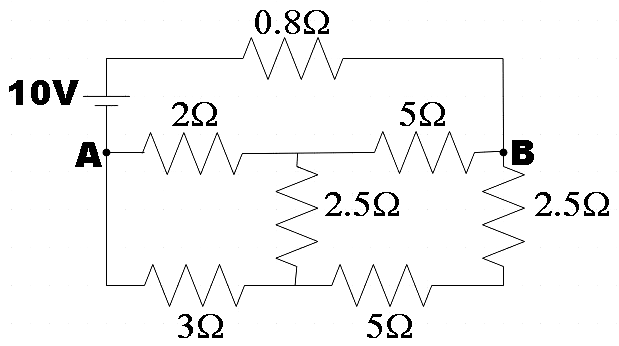
What is the potential difference between A and B?
A. 8.4V
B. 2.4V
C. 4.2V
D. 7.2V
Answer
 Verified
589.2k+ views
Hint: As a first step, we could find the effective resistance of all the resistors in the circuit. Then you could find the net current in the circuit using the Ohm’s law. After that you could apply Kirchoff’s voltage law in the loop including AB and the voltage source and thus find the potential difference across AB.
Complete Step by step solution:
In the question, we are given a circuit consisting of few resistors and a cell of voltage 10V and are asked to find the potential difference between A and B.
In order to answer this question, the very first step that we have to follow is to find the net current flowing through the circuit. For finding that, we have to find the equivalent resistance of the circuit.
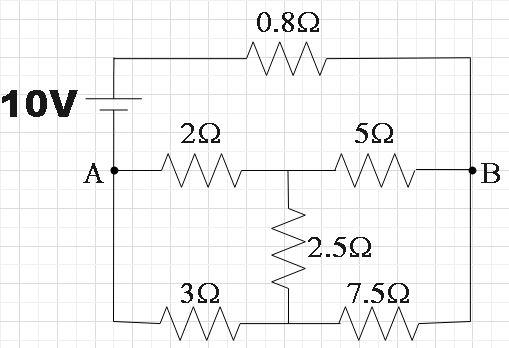
From the figure we see that the $5\Omega $ resistor and the$2.5\Omega $ are in series, we could redraw the circuit as,
Now we see that,
$\dfrac{2}{5}=\dfrac{3}{7.5}$
Which we know is the Wheatstone bridge condition, so, we find that no current will pass through the$2.5\Omega $. Now, we see that $2\Omega $ resistor and $5\Omega $ resistors are in series with each other, so are the $3\Omega $ and $7.5\Omega $ resistors. So, the circuit can now be reduced as,
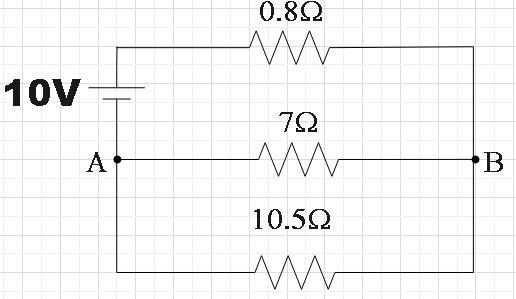
Now we see that $10.5\Omega $ and $7\Omega $ are parallel to each other and $0.8\Omega $ is connected in series with them. So, their equivalent resistance will be,
$R=\dfrac{10.5\times 7}{10.5+7}+0.8$
$\Rightarrow R=\left( 4.2+0.8 \right)\Omega $
$\therefore R=5\Omega $
So we found the net resistance of the given circuit to be$5\Omega $. Net current would then be,
$I=\dfrac{V}{R}$
$\Rightarrow I=\dfrac{10}{5}$
$\therefore I=2A$
Now, from Kirchoff’s voltage rule, we have,
$10-I\left( 0.8\Omega \right)-{{V}_{AB}}=0$
$\Rightarrow 10-2\left( 0.8\Omega \right)={{V}_{AB}}$
$\Rightarrow {{V}_{AB}}=10-1.6$
$\therefore {{V}_{AB}}=8.4V$
Therefore, we found the voltage across the terminals A and B to be $8.4V$.
Hence, option A is found to be the correct answer.
Note:
You may have noted that we have used the Wheatstone bridge principle while finding the effective resistance. On keeping a galvanometer in place of the $2.5\Omega $ resistor, you may observe null deflection. Then we have used the Kirchoff’s voltage rule which states that the net voltage in a loop is zero.
Complete Step by step solution:
In the question, we are given a circuit consisting of few resistors and a cell of voltage 10V and are asked to find the potential difference between A and B.
In order to answer this question, the very first step that we have to follow is to find the net current flowing through the circuit. For finding that, we have to find the equivalent resistance of the circuit.
From the figure we see that the $5\Omega $ resistor and the$2.5\Omega $ are in series, we could redraw the circuit as,
Now we see that,
$\dfrac{2}{5}=\dfrac{3}{7.5}$
Which we know is the Wheatstone bridge condition, so, we find that no current will pass through the$2.5\Omega $. Now, we see that $2\Omega $ resistor and $5\Omega $ resistors are in series with each other, so are the $3\Omega $ and $7.5\Omega $ resistors. So, the circuit can now be reduced as,
Now we see that $10.5\Omega $ and $7\Omega $ are parallel to each other and $0.8\Omega $ is connected in series with them. So, their equivalent resistance will be,
$R=\dfrac{10.5\times 7}{10.5+7}+0.8$
$\Rightarrow R=\left( 4.2+0.8 \right)\Omega $
$\therefore R=5\Omega $
So we found the net resistance of the given circuit to be$5\Omega $. Net current would then be,
$I=\dfrac{V}{R}$
$\Rightarrow I=\dfrac{10}{5}$
$\therefore I=2A$
Now, from Kirchoff’s voltage rule, we have,
$10-I\left( 0.8\Omega \right)-{{V}_{AB}}=0$
$\Rightarrow 10-2\left( 0.8\Omega \right)={{V}_{AB}}$
$\Rightarrow {{V}_{AB}}=10-1.6$
$\therefore {{V}_{AB}}=8.4V$
Therefore, we found the voltage across the terminals A and B to be $8.4V$.
Hence, option A is found to be the correct answer.
Note:
You may have noted that we have used the Wheatstone bridge principle while finding the effective resistance. On keeping a galvanometer in place of the $2.5\Omega $ resistor, you may observe null deflection. Then we have used the Kirchoff’s voltage rule which states that the net voltage in a loop is zero.
Recently Updated Pages
Master Class 12 Business Studies: Engaging Questions & Answers for Success

Master Class 12 Biology: Engaging Questions & Answers for Success
Master Class 12 Chemistry: Engaging Questions & Answers for Success
Class 12 Question and Answer - Your Ultimate Solutions Guide
Master Class 11 Social Science: Engaging Questions & Answers for Success
Master Class 11 English: Engaging Questions & Answers for Success
Trending doubts
Which is more stable and why class 12 chemistry CBSE
What are the major means of transport Explain each class 12 social science CBSE
Name the part of the flower which the tassels of the class 12 biology CBSE
The value of constant k in coulombs law is beginalign class 12 physics CBSE
Suicide bags of cells are aEndoplasmic reticulum bLysosome class 12 biology CBSE
Quantisation of charge implies a Charge does not exist class 12 physics CBSE