




Potato is (underground) stem because it
A. Possesses axillary buds (eyes).
B. Lacks chlorophyll.
C. Does not bear roots.
D. Contains reserve food.
Answer
 Verified
648.3k+ views
Hint: Potato is a tuber plant that is a starchy and a very important food crop. It is a root vegetable. The tuber is a special part of the plant that is used to store the food. The tuber is a regenerative organ that is used for vegetative propagation in potatoes. The tubers consist of many adventitious buds that grow to form potatoes.
Complete answer:
The potato is an economically important food crop. It is made by the modification of the stem called a tuber. Tubers are swollen type stems that have all the parts of a normal stem. It consists of vascular tissue, nodes, and internodes. The nodes are called eyes or axillary buds. These are adventitious buds that grow at places where they usually do not form. They generally arise from latent buds located in the leaf axils formed by internodes in potatoes. The tubers originate from the swollen ends of stolons.
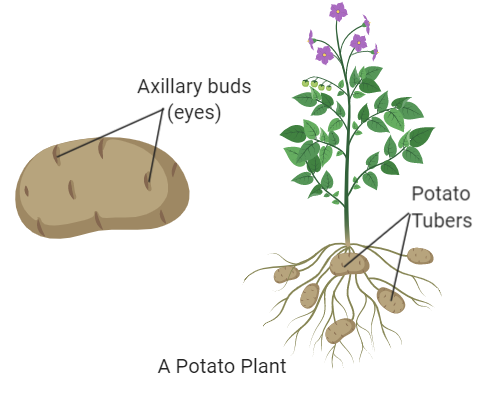
At the farthest point away from stolon attachment and tuber, the terminal bud is produced. The bud shows apical dominance as a normal stem. The tuber is the vegetative propagation part of the potato. The tubers survive in winters till spring. On arrival of appropriate conditions, the tubers propagate. The stored food in tubers is used to grow stems. Therefore, the potato is an underground stem because it possesses axillary buds called eyes. They are underground stems not because they lack chlorophyll. Also, they do bear roots and contain reserved food.
Thus, the right answer is option A.
Note: On propagation, the main shoot develops from the tuber. The base of the shoot near the tuber produces adventitious roots. The buds are produced on the lateral side of the shoot. The shoot develops to form stolons. The stolons elongate in presence of auxins that prevent root growth from the stolons. The stolon should attain a certain age before the production of a new tuber.
Complete answer:
The potato is an economically important food crop. It is made by the modification of the stem called a tuber. Tubers are swollen type stems that have all the parts of a normal stem. It consists of vascular tissue, nodes, and internodes. The nodes are called eyes or axillary buds. These are adventitious buds that grow at places where they usually do not form. They generally arise from latent buds located in the leaf axils formed by internodes in potatoes. The tubers originate from the swollen ends of stolons.
At the farthest point away from stolon attachment and tuber, the terminal bud is produced. The bud shows apical dominance as a normal stem. The tuber is the vegetative propagation part of the potato. The tubers survive in winters till spring. On arrival of appropriate conditions, the tubers propagate. The stored food in tubers is used to grow stems. Therefore, the potato is an underground stem because it possesses axillary buds called eyes. They are underground stems not because they lack chlorophyll. Also, they do bear roots and contain reserved food.
Thus, the right answer is option A.
Note: On propagation, the main shoot develops from the tuber. The base of the shoot near the tuber produces adventitious roots. The buds are produced on the lateral side of the shoot. The shoot develops to form stolons. The stolons elongate in presence of auxins that prevent root growth from the stolons. The stolon should attain a certain age before the production of a new tuber.
Recently Updated Pages
Which will be the least stable resonating structure class 11 chemistry CBSE

How many 5 digit telephone numbers can be construc-class-11-maths-CBSE
How do you find the angle of the resultant vector class 11 physics CBSE
Draw labelled diagram of the following i Gram seed class 11 biology CBSE
1 Quintal is equal to a 110 kg b 10 kg c 100kg d 1000 class 11 physics CBSE
What is the need and importance of classification class 11 biology CBSE
Trending doubts
Find the value of the expression given below sin 30circ class 11 maths CBSE
One Metric ton is equal to kg A 10000 B 1000 C 100 class 11 physics CBSE
10 examples of friction in our daily life
Draw a diagram of a plant cell and label at least eight class 11 biology CBSE
Difference between physical and chemical change class 11 chemistry CBSE
Proton was discovered by A Thomson B Rutherford C Chadwick class 11 chemistry CBSE