




What is population inversion and optical pumping? Explain.
Answer
 Verified
676.2k+ views
Hint: In the band diagram of semiconductors, the population of charge carriers is always more in the valence band as compared to the conduction band in normal conditions. We can invert the population of charge carriers by a procedure called optical pumping.
Detailed step by step solution:
In an intrinsic semiconductor, there are two energy bands which the charge carriers can occupy. The lower energy band called valence band is completely filled with charge carriers while the upper energy band called conduction band is empty which can be occupied by charge carriers. They are separated from each other by an energy gap called band gap which is forbidden and no charge carrier can occupy any state of energy in this gap.
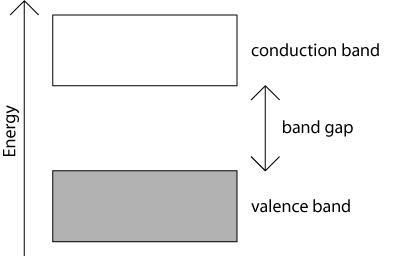
In normal conditions, the conduction band of the semiconductor is empty while the valence band is filled with the charge carriers. The phenomenon in which we invert this configuration is known as population inversion. When population inversion takes place, the conduction band gets filled with charge carriers while the valence band becomes empty.
The population inversion is attained by a process called optical pumping where external energy supplied to the semiconductor through photons. The charge carriers in the valence band absorb the incident photon energy crossing the band gap to occupy the conduction band.
Note: This phenomenon of population inversion and optical pumping to obtain population inversion is very important in constructing lasers. When the population inversion happens, the charge carriers eventually jump back to the valence band releasing energy in the form of photons of light which is how a laser operates.
Detailed step by step solution:
In an intrinsic semiconductor, there are two energy bands which the charge carriers can occupy. The lower energy band called valence band is completely filled with charge carriers while the upper energy band called conduction band is empty which can be occupied by charge carriers. They are separated from each other by an energy gap called band gap which is forbidden and no charge carrier can occupy any state of energy in this gap.
In normal conditions, the conduction band of the semiconductor is empty while the valence band is filled with the charge carriers. The phenomenon in which we invert this configuration is known as population inversion. When population inversion takes place, the conduction band gets filled with charge carriers while the valence band becomes empty.
The population inversion is attained by a process called optical pumping where external energy supplied to the semiconductor through photons. The charge carriers in the valence band absorb the incident photon energy crossing the band gap to occupy the conduction band.
Note: This phenomenon of population inversion and optical pumping to obtain population inversion is very important in constructing lasers. When the population inversion happens, the charge carriers eventually jump back to the valence band releasing energy in the form of photons of light which is how a laser operates.
Recently Updated Pages
Explain the structure of megasporangium class 12 biology CBSE

Why is chloroform kept in dark coloured bottles class 12 chemistry CBSE
Derive the balancing condition of a Wheatstone bri class 12 physics CBSE
Draw VI characteristics of a pn junction diode Explain class 12 physics CBSE
Is it possible to carry pride in ones language too class 12 english CBSE
In a population at Hardy Weinberg equilibrium the allele class 12 biology CBSE
Trending doubts
Draw a labelled sketch of the human eye class 12 physics CBSE
Which are the Top 10 Largest Countries of the World?
Draw ray diagrams each showing i myopic eye and ii class 12 physics CBSE
One megawatt is equal to how many units of electri class 12 physics CBSE
Which is the correct genotypic ratio of mendel dihybrid class 12 biology CBSE
Give 10 examples of unisexual and bisexual flowers