




Polyspermy is normally prevented by
(a) The fertilizing and anti fertilizing reaction
(b) Repulsion of the excess number of sperm by ova
(c) The inability of some sperm to penetrate ova
(d) Formation of the fertilization membrane
Answer
 Verified
617.7k+ views
Hint: Polyspermy is the property of the egg to block the other sperm to fertilize the ovum by separating the egg with cellular lining. Polyspermy is of two types: fast block and slow block based on the signal transduction by egg.
Complete step by step answer:
In mammals, blocks to polyspermy included the modification of zona protein by the contents of the cortical granules. Sperm can no longer bind to the zona. The fertilization of the ovum with only one sperm is termed as monospermy causes the fertilization membrane to prevent the entry of other sperm.
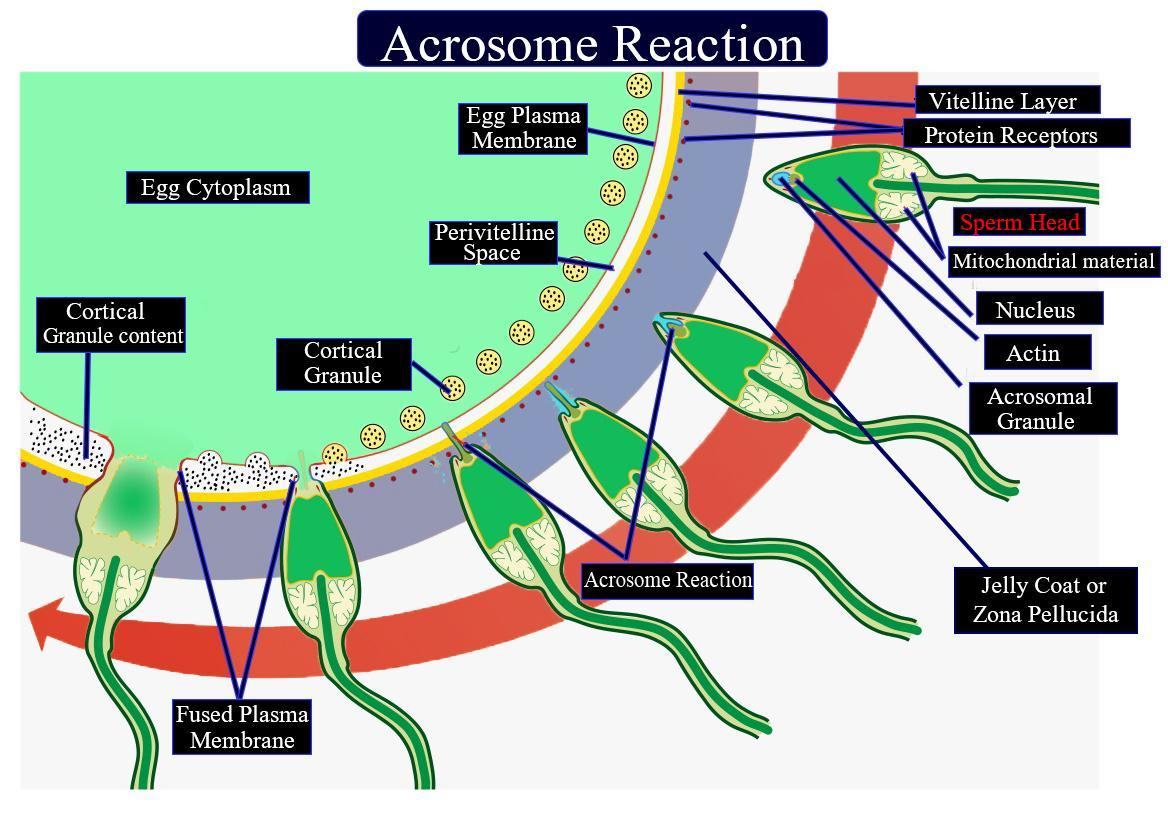
So, the correct answer is, ‘Formation of fertilization membrane.’
Additional Information:
- The fast block is electrical and is mediated by sodium ions during the egg membrane resting potential rises and sperm can no longer fuse with an egg.
- The slow block of polyspermy is physical and is mediated by calcium ions.
- Release of calcium ions propagates from the point of sperm entry, causing the cortical granules to fuse with the egg cell membrane.
- When once sperm penetrates the zona pellucida, the zona reaction occurs in which the zona pellucida is impermeable to other sperm.
- Mechanism of fertilization involves the following steps:
Step I: Capacitation of the sperms
Step II: First acrosomal reaction
Step III: Second acrosomal reaction
Step IV: Cortical and zona reaction
Step V: The nucleus of sperm enters the cytoplasm of the ovum
Step VI: Secondary oocyte completes second meiotic division
Step VII: The union between male and female pronuclei to form a zygote
Note:
- Multiple sperm fertilize the egg then the embryo inherits multiple parental centrioles which result in competition for an extra chromosome ultimately causing the zygote to die.
- The released contents of the granules cause the vitelline to rise and to harden into the fertilization envelope.
- As the embryo develops, membranes form two of these membranes are the amnion and the chorion to protect and nourish the embryo.
Complete step by step answer:
In mammals, blocks to polyspermy included the modification of zona protein by the contents of the cortical granules. Sperm can no longer bind to the zona. The fertilization of the ovum with only one sperm is termed as monospermy causes the fertilization membrane to prevent the entry of other sperm.
So, the correct answer is, ‘Formation of fertilization membrane.’
Additional Information:
- The fast block is electrical and is mediated by sodium ions during the egg membrane resting potential rises and sperm can no longer fuse with an egg.
- The slow block of polyspermy is physical and is mediated by calcium ions.
- Release of calcium ions propagates from the point of sperm entry, causing the cortical granules to fuse with the egg cell membrane.
- When once sperm penetrates the zona pellucida, the zona reaction occurs in which the zona pellucida is impermeable to other sperm.
- Mechanism of fertilization involves the following steps:
Step I: Capacitation of the sperms
Step II: First acrosomal reaction
Step III: Second acrosomal reaction
Step IV: Cortical and zona reaction
Step V: The nucleus of sperm enters the cytoplasm of the ovum
Step VI: Secondary oocyte completes second meiotic division
Step VII: The union between male and female pronuclei to form a zygote
Note:
- Multiple sperm fertilize the egg then the embryo inherits multiple parental centrioles which result in competition for an extra chromosome ultimately causing the zygote to die.
- The released contents of the granules cause the vitelline to rise and to harden into the fertilization envelope.
- As the embryo develops, membranes form two of these membranes are the amnion and the chorion to protect and nourish the embryo.
Recently Updated Pages
Master Class 12 Business Studies: Engaging Questions & Answers for Success

Master Class 12 Biology: Engaging Questions & Answers for Success
Master Class 12 Chemistry: Engaging Questions & Answers for Success
Class 12 Question and Answer - Your Ultimate Solutions Guide
Master Class 11 English: Engaging Questions & Answers for Success
Master Class 11 Social Science: Engaging Questions & Answers for Success
Trending doubts
Which are the Top 10 Largest Countries of the World?
Draw a labelled sketch of the human eye class 12 physics CBSE
Differentiate between homogeneous and heterogeneous class 12 chemistry CBSE
Why is the cell called the structural and functional class 12 biology CBSE
Draw ray diagrams each showing i myopic eye and ii class 12 physics CBSE
Which is the correct genotypic ratio of mendel dihybrid class 12 biology CBSE