




What is pollination? Mention any four features of wind-pollinated flowers.
Answer
 Verified
578.4k+ views
Hint: The goal of each living organism, including plants, is to make offspring for the subsequent generation. One of the ways in which plants can produce offspring is by making seeds. This seed can be made when female and male gametes get combined.
Complete answer:
Pollination is the process of transferring pollen grains from the male anther of a flower to the feminine stigma. Pollination is of two types: self-pollination and cross-pollination. Self-pollination takes place when the pollen from the anther is transferred on the stigma of an equivalent flower, or another flower on an equivalent plant. Cross-pollination on the other hand is referred to as the transfer of pollen from the anther of 1 flower to the stigma of another flower on a special individual of an equivalent species. Self-pollination occurs in flowers where both parts i.e stamen and carpel mature at an equivalent time, and are positioned so that the pollen can land on the flower’s stigma. This method of pollination doesn't require an investment from the plant to supply nectar and pollen as food for pollinators.
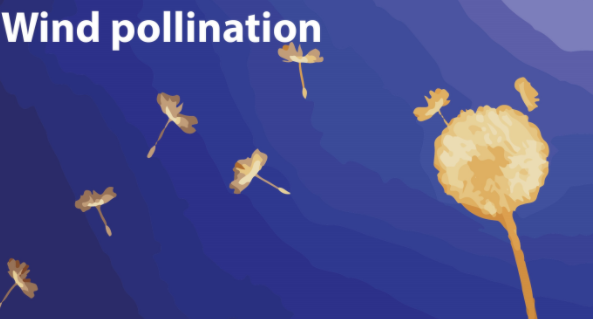
Anemophily or wind pollination is a type of pollination in which the pollen grain is transferred by the wind from the male to the female part.
Four features of wind-pollinated flowers are:-
- Large amounts of pollen are produced as many of them are lost in the air by wind.
- Pollens are light so that they can easily move by air.
-Stigma is feathery so that it can easily trap the pollen grain.
-Do not produce nectar and even flowers are not too bright.
Note: The flowers of those plants that undergo pollination by wind generally blooms early in the spring even before the leaves so that the leaves do not prevent the movement of the wind. The pollen is deposited on the feathery stigma which is exposed to the flower.
Complete answer:
Pollination is the process of transferring pollen grains from the male anther of a flower to the feminine stigma. Pollination is of two types: self-pollination and cross-pollination. Self-pollination takes place when the pollen from the anther is transferred on the stigma of an equivalent flower, or another flower on an equivalent plant. Cross-pollination on the other hand is referred to as the transfer of pollen from the anther of 1 flower to the stigma of another flower on a special individual of an equivalent species. Self-pollination occurs in flowers where both parts i.e stamen and carpel mature at an equivalent time, and are positioned so that the pollen can land on the flower’s stigma. This method of pollination doesn't require an investment from the plant to supply nectar and pollen as food for pollinators.
Anemophily or wind pollination is a type of pollination in which the pollen grain is transferred by the wind from the male to the female part.
Four features of wind-pollinated flowers are:-
- Large amounts of pollen are produced as many of them are lost in the air by wind.
- Pollens are light so that they can easily move by air.
-Stigma is feathery so that it can easily trap the pollen grain.
-Do not produce nectar and even flowers are not too bright.
Note: The flowers of those plants that undergo pollination by wind generally blooms early in the spring even before the leaves so that the leaves do not prevent the movement of the wind. The pollen is deposited on the feathery stigma which is exposed to the flower.
Recently Updated Pages
Master Class 12 Economics: Engaging Questions & Answers for Success

Master Class 12 Physics: Engaging Questions & Answers for Success
Master Class 12 English: Engaging Questions & Answers for Success
Master Class 12 Social Science: Engaging Questions & Answers for Success
Master Class 12 Maths: Engaging Questions & Answers for Success
Master Class 12 Business Studies: Engaging Questions & Answers for Success
Trending doubts
Which are the Top 10 Largest Countries of the World?
What are the major means of transport Explain each class 12 social science CBSE
Draw a labelled sketch of the human eye class 12 physics CBSE
Why cannot DNA pass through cell membranes class 12 biology CBSE
Differentiate between insitu conservation and exsitu class 12 biology CBSE
Draw a neat and well labeled diagram of TS of ovary class 12 biology CBSE