




Please explain how we can differentiate beta and alpha-D-fructopyranose from beta and alpha-L-fructofuranose? What is the difference in their ring structures?
Answer
 Verified
638.4k+ views
Hint: Beta and alpha structures differ by the position of –OH in the anomeric carbon.
- Pyranose is analogue to pyran and furanose is analogue to furan.
Complete step by step answer:
So let’s analyse the question given, here in the question, it is asked that we have to comment on the beta and alpha structures of D-fructopyranose and beta and alpha structures of L-fructofuranose.
- First we should know the difference between the alpha and the beta structures. Both the structures differ by the position of the hydroxyl group (-OH) present in the anomeric carbon.
If the –OH group is present pointing downwards the ring then the structure is called as alpha structure and if the structure is –OH is pointing upwards then the structure is a beta structure.
Now we have to know the difference between fructopyranose and fructofuranose.
Fructopyranose is a structure which is analogous to the cyclic structure called as pyran, which is a 6 carbon membered ring.
Fructofuranose is a structure which is analogous to the cyclic structure called furan which is a 5 membered ring.
The structures of pyran and furan are as follows:
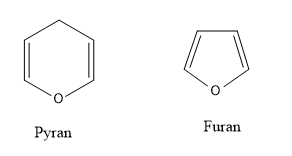
By gathering all these information let's draw the structure of alpha and beta structures of D-fructopyranose and alpha and beta structure of D-fructofuranose.
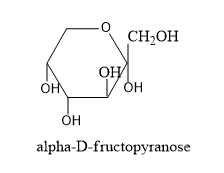
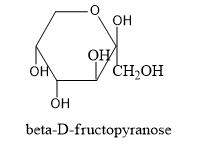
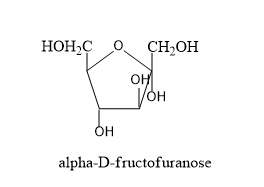
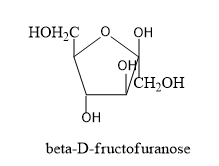
- Now we have to know the difference in structures of L isomers and D-isomers.
L-isomers are the structures which are mirror images of the D-isomers.
To draw the structures of the L-isomers we have to change the configuration of each carbon. We have to interchange the configuration of the groups. Those groups that are pointing upwards should be written downwards and vice versa.
Hence let’s trace the structure of L-fructofuranose by following the above said conditions.
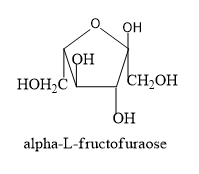
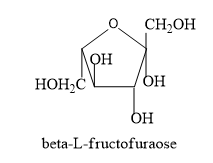
Note: In the D- isomers the –OH group is placed on the right side of the asymmetric carbon which is placed furthest from the carbonyl group whereas in the L-isomer the –OH group is placed on the left side.
- Pyranose is analogue to pyran and furanose is analogue to furan.
Complete step by step answer:
So let’s analyse the question given, here in the question, it is asked that we have to comment on the beta and alpha structures of D-fructopyranose and beta and alpha structures of L-fructofuranose.
- First we should know the difference between the alpha and the beta structures. Both the structures differ by the position of the hydroxyl group (-OH) present in the anomeric carbon.
If the –OH group is present pointing downwards the ring then the structure is called as alpha structure and if the structure is –OH is pointing upwards then the structure is a beta structure.
Now we have to know the difference between fructopyranose and fructofuranose.
Fructopyranose is a structure which is analogous to the cyclic structure called as pyran, which is a 6 carbon membered ring.
Fructofuranose is a structure which is analogous to the cyclic structure called furan which is a 5 membered ring.
The structures of pyran and furan are as follows:
By gathering all these information let's draw the structure of alpha and beta structures of D-fructopyranose and alpha and beta structure of D-fructofuranose.
- Now we have to know the difference in structures of L isomers and D-isomers.
L-isomers are the structures which are mirror images of the D-isomers.
To draw the structures of the L-isomers we have to change the configuration of each carbon. We have to interchange the configuration of the groups. Those groups that are pointing upwards should be written downwards and vice versa.
Hence let’s trace the structure of L-fructofuranose by following the above said conditions.
Note: In the D- isomers the –OH group is placed on the right side of the asymmetric carbon which is placed furthest from the carbonyl group whereas in the L-isomer the –OH group is placed on the left side.
Recently Updated Pages
Explain the structure of megasporangium class 12 biology CBSE

Why is chloroform kept in dark coloured bottles class 12 chemistry CBSE
Derive the balancing condition of a Wheatstone bri class 12 physics CBSE
Draw VI characteristics of a pn junction diode Explain class 12 physics CBSE
Is it possible to carry pride in ones language too class 12 english CBSE
In a population at Hardy Weinberg equilibrium the allele class 12 biology CBSE
Trending doubts
Draw a labelled sketch of the human eye class 12 physics CBSE
Which are the Top 10 Largest Countries of the World?
Draw ray diagrams each showing i myopic eye and ii class 12 physics CBSE
One megawatt is equal to how many units of electri class 12 physics CBSE
Which is the correct genotypic ratio of mendel dihybrid class 12 biology CBSE
Give 10 examples of unisexual and bisexual flowers