




Plants without well-differentiated stem, root and leaf are kept in
A. Thallophyta
B.Angiosperm
C. Pteridophyta
D. Gymnosperm
Answer
 Verified
654.3k+ views
Hint: Plants whose body is not differentiated into distinct roots, stems, leaves are called thallophytes and plants with distinct roots, stems and leaves are called Cormophytes. Algae are autotrophic organisms.
Complete step by step answer: Plants whose body is not differentiated into distinct roots, stems and leaves are called thallophytes. For example - Algae. They occur in a variety of other habitats like moist stones, soils and wood and are autotrophic in nature. They are simple plants.
a. Plants with distinct roots, stems and leaves are called Cormophytes. For example - Pteridophytes, gymnosperms and angiosperms.
b. Seedless plants that reproduce by spore are called cryptogams. For example - bryophytes and pteridophytes.
c. Seed plants or plants that reproduce by seeds are called phanerogams/spermatophytes. For example - gymnosperms and angiosperms.
So, the correct answer is option A.
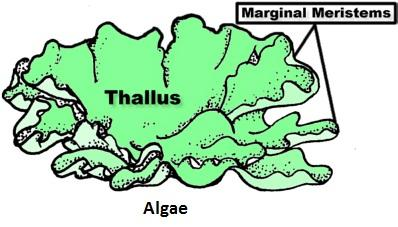
Note: Algae are chlorophyll bearing, simple, thalloid and autotrophic organisms. These are largely aquatic. Some may show a symbiotic association with fungi. Example lichens. Some algae are parasitic e.g. Cephaleuros (green algae) on tea leaves, Harveyella (red algae) on other red algae. The form and size of algae are highly variable. These are microscopic, unicellular, colonial and filamentous. Mechanical tissues and vascular tissues are absent however in some kelps trumpet hyphae are present. Thalli are covered with mucilage. Chloroplast lack grana but are associated with pyrenoids. Reproduction occurs by vegetative, asexual and sexual means.
Complete step by step answer: Plants whose body is not differentiated into distinct roots, stems and leaves are called thallophytes. For example - Algae. They occur in a variety of other habitats like moist stones, soils and wood and are autotrophic in nature. They are simple plants.
a. Plants with distinct roots, stems and leaves are called Cormophytes. For example - Pteridophytes, gymnosperms and angiosperms.
b. Seedless plants that reproduce by spore are called cryptogams. For example - bryophytes and pteridophytes.
c. Seed plants or plants that reproduce by seeds are called phanerogams/spermatophytes. For example - gymnosperms and angiosperms.
So, the correct answer is option A.
Note: Algae are chlorophyll bearing, simple, thalloid and autotrophic organisms. These are largely aquatic. Some may show a symbiotic association with fungi. Example lichens. Some algae are parasitic e.g. Cephaleuros (green algae) on tea leaves, Harveyella (red algae) on other red algae. The form and size of algae are highly variable. These are microscopic, unicellular, colonial and filamentous. Mechanical tissues and vascular tissues are absent however in some kelps trumpet hyphae are present. Thalli are covered with mucilage. Chloroplast lack grana but are associated with pyrenoids. Reproduction occurs by vegetative, asexual and sexual means.
Recently Updated Pages
Which will be the least stable resonating structure class 11 chemistry CBSE

How many 5 digit telephone numbers can be construc-class-11-maths-CBSE
How do you find the angle of the resultant vector class 11 physics CBSE
Draw labelled diagram of the following i Gram seed class 11 biology CBSE
1 Quintal is equal to a 110 kg b 10 kg c 100kg d 1000 class 11 physics CBSE
What is the need and importance of classification class 11 biology CBSE
Trending doubts
Find the value of the expression given below sin 30circ class 11 maths CBSE
One Metric ton is equal to kg A 10000 B 1000 C 100 class 11 physics CBSE
10 examples of friction in our daily life
Draw a diagram of a plant cell and label at least eight class 11 biology CBSE
Difference between physical and chemical change class 11 chemistry CBSE
Proton was discovered by A Thomson B Rutherford C Chadwick class 11 chemistry CBSE