




Plants are green due to the presence of
(a) Chloroplast
(b) Chromoplast
(c) Leucoplast
(d) All the above
Answer
 Verified
641.7k+ views
Hint: These organelles allow plants to use energy-rich molecules to absorb the energy of the Sun. Two membranes surround this organelle. Although they are much smaller, these organelles retain tiny, circular genomes that resemble those of cyanobacteria.
Complete answer:
- Like mitochondria, chloroplasts originally arose from an ancient symbiosis, when a photosynthetic prokaryote was engulfed by a nucleated cell.
- Chloroplasts, in fact, resemble modern cyanobacteria that remain similar to the cyanobacteria of three million years ago.
- The evolution of photosynthesis goes back much further, to the earliest cells that established the ability to absorb and use light energy to create molecules rich in energy.
- Photosynthetic cells began producing oxygen as these species gained the ability to split water molecules and use the electrons from these molecules, an occurrence that had drastic implications for the evolution of all living things on Earth.
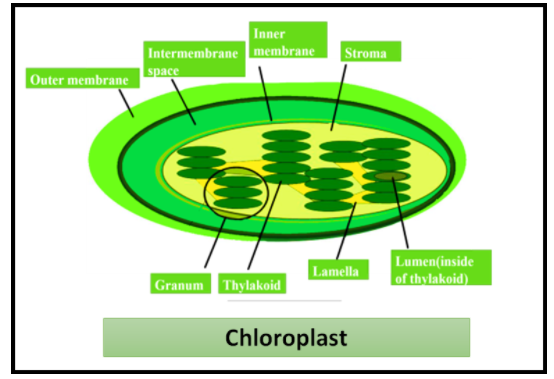
- The outer membrane is permeable to small organic molecules, whereas it is less permeable to the inner membrane and is covered with transport proteins.
- The innermost matrix of chloroplasts, called the stroma, includes metabolic enzymes and several copies of the chloroplast genome.
- Chloroplasts also have a third internal membrane called the thylakoid membrane, which is heavily folded and appears as stacks of flattened discs.
- Light- harvesting complexes include thylakoids, including pigments such as chlorophyll, as well as electron transport chains used for photosynthesis. The chlorophyll inside the chloroplast influences the green color of the leaves.
So, the correct answer is ‘(a) Chloroplast’.
Note:
- Leucoplast imparts white color.
- Chromoplast contains various colored pigments.
- Chromoplasts are specially located in flowers (petals) .
Complete answer:
- Like mitochondria, chloroplasts originally arose from an ancient symbiosis, when a photosynthetic prokaryote was engulfed by a nucleated cell.
- Chloroplasts, in fact, resemble modern cyanobacteria that remain similar to the cyanobacteria of three million years ago.
- The evolution of photosynthesis goes back much further, to the earliest cells that established the ability to absorb and use light energy to create molecules rich in energy.
- Photosynthetic cells began producing oxygen as these species gained the ability to split water molecules and use the electrons from these molecules, an occurrence that had drastic implications for the evolution of all living things on Earth.
- The outer membrane is permeable to small organic molecules, whereas it is less permeable to the inner membrane and is covered with transport proteins.
- The innermost matrix of chloroplasts, called the stroma, includes metabolic enzymes and several copies of the chloroplast genome.
- Chloroplasts also have a third internal membrane called the thylakoid membrane, which is heavily folded and appears as stacks of flattened discs.
- Light- harvesting complexes include thylakoids, including pigments such as chlorophyll, as well as electron transport chains used for photosynthesis. The chlorophyll inside the chloroplast influences the green color of the leaves.
So, the correct answer is ‘(a) Chloroplast’.
Note:
- Leucoplast imparts white color.
- Chromoplast contains various colored pigments.
- Chromoplasts are specially located in flowers (petals) .
Recently Updated Pages
If x a + bt + ct2 where x is in meters and t is in class 11 physics CBSE

A car covers the first half distance between two places class 11 physics CBSE
The resultant of two vectors overrightarrow P and overrightarrow class 11 physics CBSE
Find the value of cos 135 class 11 maths CBSE
A mass M is held in place by an applied force F and class 11 physics CBSE
A solution of glucose in water is labelled as 10 dfracwv class 11 chemistry CBSE
Trending doubts
One Metric ton is equal to kg A 10000 B 1000 C 100 class 11 physics CBSE
Find the value of the expression given below sin 30circ class 11 maths CBSE
What do you mean by retardation What is its SI uni class 11 physics CBSE
Draw a diagram of nephron and explain its structur class 11 biology CBSE
10 examples of friction in our daily life
Difference between physical and chemical change class 11 chemistry CBSE