




Plague is spread by
(a) Pediculus
(b) Cimex
(c) Aedes
(d) Xenopsylla
Answer
 Verified
604.2k+ views
Hint: It is a zoonotic disease with severe clinical presentations caused by the bacterium Yersinia pestis. The animal reservoir, the bacteria, and the vector in a given area are collectively called a plague natural focus. All human beings can become infected by being bitten by infected fleas which direct contact with infected fluids or tissue from a host inhalation of the respiratory droplets.
Complete step by step answer:
-Earlier it was named Pasteurella pestis consisting of a short, rod-shaped, gram-negative bacteria that causes the disease Bubonic plague.
- Basically, it is a disease of rodents (squirrels, rabbits, rats) that is transmitted to humans by a bite of Rat Flea/Xenopsylla. This will happen when the flea has fed on an infected rodent and it bites a human.
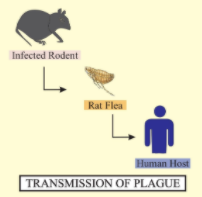
- It can also be spread by person-to-person contact through aerosol inhalation.
- So, Yersinia pestis is a causal agent of the Bubonic Plague), and it is transmitted by Rat Flea/Xenopsylla.
So, the correct answer is ‘ Xenopsylla’.
Additional information: Plague is divided into three main types:
1. Bubonic,
2. Septicemic
3. Pneumonic — depending on which part of your body is involved.
Bubonic plague
The bubonic plague is a very common type of disease. It's named after the swollen lymph nodes (buboes) that commonly create in the first week after you become contaminated.
Septicemic plague
Septicemic plague happens when plague microbes increase in your circulatory system.
Pneumonic plague
Pneumonic plague influences the lungs. It's the least variety of plague however the most dangerous in light of the fact that it very well can be spread from individual to individual by means of cough droplet.
Note: Known as the Black Death during medical eras, today plague happens in less than 5,000 individuals per year around the world. It very well may be fatal if not treated instantly with antibiotics. The most common type of plague brings about swollen and delicate lymph hubs called buboes in the crotch, armpits, or neck. The most extraordinary and deadliest type of plague influences the lungs, and it very well may be spread from individual to individual.
Complete step by step answer:
-Earlier it was named Pasteurella pestis consisting of a short, rod-shaped, gram-negative bacteria that causes the disease Bubonic plague.
- Basically, it is a disease of rodents (squirrels, rabbits, rats) that is transmitted to humans by a bite of Rat Flea/Xenopsylla. This will happen when the flea has fed on an infected rodent and it bites a human.
- It can also be spread by person-to-person contact through aerosol inhalation.
- So, Yersinia pestis is a causal agent of the Bubonic Plague), and it is transmitted by Rat Flea/Xenopsylla.
So, the correct answer is ‘ Xenopsylla’.
Additional information: Plague is divided into three main types:
1. Bubonic,
2. Septicemic
3. Pneumonic — depending on which part of your body is involved.
Bubonic plague
The bubonic plague is a very common type of disease. It's named after the swollen lymph nodes (buboes) that commonly create in the first week after you become contaminated.
Septicemic plague
Septicemic plague happens when plague microbes increase in your circulatory system.
Pneumonic plague
Pneumonic plague influences the lungs. It's the least variety of plague however the most dangerous in light of the fact that it very well can be spread from individual to individual by means of cough droplet.
Note: Known as the Black Death during medical eras, today plague happens in less than 5,000 individuals per year around the world. It very well may be fatal if not treated instantly with antibiotics. The most common type of plague brings about swollen and delicate lymph hubs called buboes in the crotch, armpits, or neck. The most extraordinary and deadliest type of plague influences the lungs, and it very well may be spread from individual to individual.
Recently Updated Pages
Master Class 12 Business Studies: Engaging Questions & Answers for Success

Master Class 12 Biology: Engaging Questions & Answers for Success
Master Class 12 Chemistry: Engaging Questions & Answers for Success
Class 12 Question and Answer - Your Ultimate Solutions Guide
Master Class 11 Social Science: Engaging Questions & Answers for Success
Master Class 11 English: Engaging Questions & Answers for Success
Trending doubts
Which is more stable and why class 12 chemistry CBSE
Which are the Top 10 Largest Countries of the World?
Draw a labelled sketch of the human eye class 12 physics CBSE
Differentiate between homogeneous and heterogeneous class 12 chemistry CBSE
What are the major means of transport Explain each class 12 social science CBSE
Sulphuric acid is known as the king of acids State class 12 chemistry CBSE