




Picric acid is a yellow coloured compound. Its chemical name is:
A.Trinitrobenzene
B.2,4,6-trinitrophenol
C.Trinitrotoluene
D.Trinitroaniline
Answer
 Verified
628.8k+ views
Hint:To answer this question, you should recall the IUPAC name of picric acid as well as its chemical and physical properties. It is an aromatic compound with three nitro groups and an alcohol group.
Complete step by step answer:
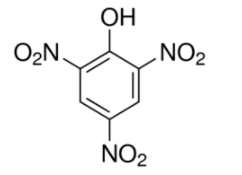
Trinitrophenol, also known as picric acid, wetted, with not less than \[10\% \] water by mass is a yellow mass of moist crystals or a slurry. Picric acid is a yellow coloured compound. Its chemical name is 2,4,6 -trinitrophenol. The structure can be drawn as:
Hence, the correct answer to this question is option B.
Additional Information:
- Picric acid is an explosive, but wetting lowers the risk of detonation. Dangerously explosive if allowed to dry out. The pure substance is denser than water and moderately soluble in water. Used in the synthesis of dyes, as a drug, to manufacture explosives and matches, to manufacture copper and to make coloured glass.
- Store tightly sealed (to protect from drying out) in a cool, ventilated place, away from acute fire hazards and easily oxidized materials. May be irritating to skin, and mucous membranes. It may be toxic by ingestion. The dry compound is a sensitive high explosive. The mixture with water is considered safe for storage, handling and shipping. Can be detonated with a number 8 electric blasting cap.
- The primary hazard is blast where the entire load explodes instantaneously and not from flying projectiles fragments. Can explode under prolonged exposure to heat.
Note:
You should know that Picric acid is a C-nitro compound comprising phenol having three nitro substituents at the 2-, 4- and 6-positions. It has a role as an explosive, an antiseptic drug and a fixative. It derives from a 1,3,5-trinitrobenzene and a phenol. It is the conjugate acid of a picrate anion.
Complete step by step answer:
Trinitrophenol, also known as picric acid, wetted, with not less than \[10\% \] water by mass is a yellow mass of moist crystals or a slurry. Picric acid is a yellow coloured compound. Its chemical name is 2,4,6 -trinitrophenol. The structure can be drawn as:
Hence, the correct answer to this question is option B.
Additional Information:
- Picric acid is an explosive, but wetting lowers the risk of detonation. Dangerously explosive if allowed to dry out. The pure substance is denser than water and moderately soluble in water. Used in the synthesis of dyes, as a drug, to manufacture explosives and matches, to manufacture copper and to make coloured glass.
- Store tightly sealed (to protect from drying out) in a cool, ventilated place, away from acute fire hazards and easily oxidized materials. May be irritating to skin, and mucous membranes. It may be toxic by ingestion. The dry compound is a sensitive high explosive. The mixture with water is considered safe for storage, handling and shipping. Can be detonated with a number 8 electric blasting cap.
- The primary hazard is blast where the entire load explodes instantaneously and not from flying projectiles fragments. Can explode under prolonged exposure to heat.
Note:
You should know that Picric acid is a C-nitro compound comprising phenol having three nitro substituents at the 2-, 4- and 6-positions. It has a role as an explosive, an antiseptic drug and a fixative. It derives from a 1,3,5-trinitrobenzene and a phenol. It is the conjugate acid of a picrate anion.
Recently Updated Pages
Explain the structure of megasporangium class 12 biology CBSE

Why is chloroform kept in dark coloured bottles class 12 chemistry CBSE
Derive the balancing condition of a Wheatstone bri class 12 physics CBSE
Draw VI characteristics of a pn junction diode Explain class 12 physics CBSE
Is it possible to carry pride in ones language too class 12 english CBSE
In a population at Hardy Weinberg equilibrium the allele class 12 biology CBSE
Trending doubts
Draw a labelled sketch of the human eye class 12 physics CBSE
Which are the Top 10 Largest Countries of the World?
Draw ray diagrams each showing i myopic eye and ii class 12 physics CBSE
Which is the correct genotypic ratio of mendel dihybrid class 12 biology CBSE
Differentiate between homogeneous and heterogeneous class 12 chemistry CBSE
Which animal never drinks water in its entire life class 12 biology CBSE