



How can I physically generate a square with two $\text{4x4}$ squares, three $\text{3x3}$ squares, four $\text{2x2}$ squares and $4$ $\text{1x1}$ squares?
Answer
 Verified
546.6k+ views
Hint: In this question we will first write the total area we have by using the area of the square formula which is $a={{s}^{2}}$ where $a$ is the area of the square and $s$ is the length of the side of the square. We will then find the total area which we have from all the given squares and then try to fit a square which can have all or some squares in it.
Complete step by step solution:
We have the squares given as two $\text{4x4}$ squares, three $\text{3x3}$ squares, four $\text{2x2}$ squares and four $\text{1x1}$ squares?
Now on using the formula of the area of a square and then multiplying it with the number of squares present, we will get the total area.
Therefore, the area is:
$\Rightarrow 2\times \left( 4\times 4 \right)=32$ units
$\Rightarrow 3\times \left( 3\times 3 \right)=27$ units
$\Rightarrow 4\times \left( 2\times 2 \right)=16$ units
$\Rightarrow 4\times \left( 1\times 1 \right)=4$ units
Now the total area is:
$\Rightarrow 32+27+16+4=79$ units.
Now we know that a square with the area of $79$ units cannot be made using the provided set of squares.
The greatest possible number which has an integer square root which is lesser than $79$ is a square with $64$ square units. Now a square of $64$ units has a length of $8$ units.
Now even though it is a perfect square, there exists no possible combination of squares such that they create another greater square.
The only square that can be created from the given sets of squares is a square of $49$ units which has a side of $7$ units. The square can be made up as:
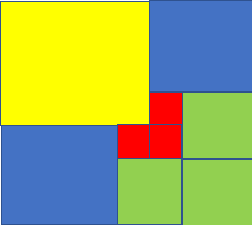
Where the yellow square represents the $\text{4x4}$ square, blue squares represent $\text{3x3}$ squares, green squares represent $\text{2x2}$ squares and red squares represent $\text{1x1}$ squares.
Note: It is to be remembered that we have not used some of the squares provided to us because upon inserting them, we would have not got a perfect square. It is to be noted that the area of the square is $49$ units therefore the area unused is $79-49=30$ units.
Complete step by step solution:
We have the squares given as two $\text{4x4}$ squares, three $\text{3x3}$ squares, four $\text{2x2}$ squares and four $\text{1x1}$ squares?
Now on using the formula of the area of a square and then multiplying it with the number of squares present, we will get the total area.
Therefore, the area is:
$\Rightarrow 2\times \left( 4\times 4 \right)=32$ units
$\Rightarrow 3\times \left( 3\times 3 \right)=27$ units
$\Rightarrow 4\times \left( 2\times 2 \right)=16$ units
$\Rightarrow 4\times \left( 1\times 1 \right)=4$ units
Now the total area is:
$\Rightarrow 32+27+16+4=79$ units.
Now we know that a square with the area of $79$ units cannot be made using the provided set of squares.
The greatest possible number which has an integer square root which is lesser than $79$ is a square with $64$ square units. Now a square of $64$ units has a length of $8$ units.
Now even though it is a perfect square, there exists no possible combination of squares such that they create another greater square.
The only square that can be created from the given sets of squares is a square of $49$ units which has a side of $7$ units. The square can be made up as:
Where the yellow square represents the $\text{4x4}$ square, blue squares represent $\text{3x3}$ squares, green squares represent $\text{2x2}$ squares and red squares represent $\text{1x1}$ squares.
Note: It is to be remembered that we have not used some of the squares provided to us because upon inserting them, we would have not got a perfect square. It is to be noted that the area of the square is $49$ units therefore the area unused is $79-49=30$ units.
Recently Updated Pages
Master Class 12 Economics: Engaging Questions & Answers for Success

Master Class 12 Physics: Engaging Questions & Answers for Success
Master Class 12 English: Engaging Questions & Answers for Success
Master Class 12 Social Science: Engaging Questions & Answers for Success
Master Class 12 Maths: Engaging Questions & Answers for Success
Master Class 12 Business Studies: Engaging Questions & Answers for Success
Trending doubts
Which are the Top 10 Largest Countries of the World?
What are the major means of transport Explain each class 12 social science CBSE
Draw a labelled sketch of the human eye class 12 physics CBSE
Why cannot DNA pass through cell membranes class 12 biology CBSE
Differentiate between insitu conservation and exsitu class 12 biology CBSE
Draw a neat and well labeled diagram of TS of ovary class 12 biology CBSE