




Phonoreceptors occurs in
A. Skin
B. Middle ear
C. Tympanum
D. Internal ear
Answer
 Verified
678.9k+ views
Hint: In this region, the cochlea is present which is an organ responsible for hearing and also maintains equilibrium.
Complete answer:
The organ of hearing is called a phonoreceptor. The inner part of the ear, as long as it is called the labyrinth of the ear, contains the organ of the senses of hearing and equilibrium.
Additional information
- The organ of hearing (phonoreceptor) in man is a pair of ears situated on the head.
- Apart from their auditory function, the eras are also the organs of balancing.
- The ear consists of three basic parts + the outer ear, middle ear, and the inner ear.
- The middle ear and the inner ear are the part of the ear that serves as a specific purpose in the task of detecting and interpreting sound.
- In most of the animals, the only visible part of the ear is the pinna which is the part of the outer ear.
- The tympanic cavity and the three bones of ossicles come under the middle part of the ear.
- The inner ear sits in the bony labyrinth and contains structures that are key to several senses.
- The semicircular canals enable balance and eye tracking when moving.
- The utricle and saccule enable balance when stationary.
- The cochlea enables hearing.
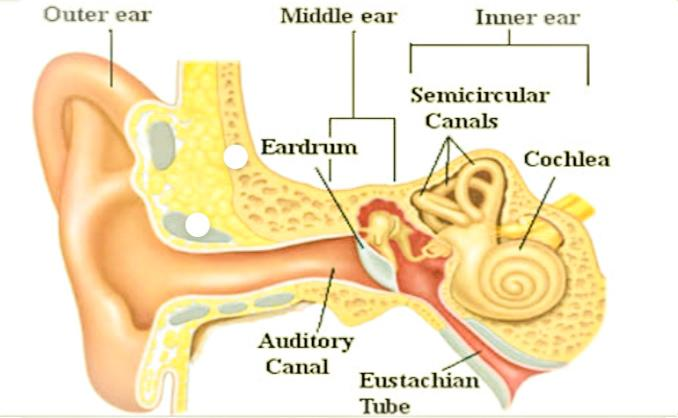
So, the correct answer is ‘Internal ear’.
Note: The name cochlea derives from an ancient Greek word ‘kokhlias', meaning ‘spiral, snail Shell’. The internal ear is the main sensory organ of hearing, it consists of the cochlea whose core component is the Organ of Corti. The structure of the cochlea is filled with the interstitial fluid which is present in the coiled chambers of the cochlear tube. In this fluid, the organ of Corti is found.
Complete answer:
The organ of hearing is called a phonoreceptor. The inner part of the ear, as long as it is called the labyrinth of the ear, contains the organ of the senses of hearing and equilibrium.
Additional information
- The organ of hearing (phonoreceptor) in man is a pair of ears situated on the head.
- Apart from their auditory function, the eras are also the organs of balancing.
- The ear consists of three basic parts + the outer ear, middle ear, and the inner ear.
- The middle ear and the inner ear are the part of the ear that serves as a specific purpose in the task of detecting and interpreting sound.
- In most of the animals, the only visible part of the ear is the pinna which is the part of the outer ear.
- The tympanic cavity and the three bones of ossicles come under the middle part of the ear.
- The inner ear sits in the bony labyrinth and contains structures that are key to several senses.
- The semicircular canals enable balance and eye tracking when moving.
- The utricle and saccule enable balance when stationary.
- The cochlea enables hearing.
So, the correct answer is ‘Internal ear’.
Note: The name cochlea derives from an ancient Greek word ‘kokhlias', meaning ‘spiral, snail Shell’. The internal ear is the main sensory organ of hearing, it consists of the cochlea whose core component is the Organ of Corti. The structure of the cochlea is filled with the interstitial fluid which is present in the coiled chambers of the cochlear tube. In this fluid, the organ of Corti is found.
Recently Updated Pages
Which will be the least stable resonating structure class 11 chemistry CBSE

How many 5 digit telephone numbers can be construc-class-11-maths-CBSE
How do you find the angle of the resultant vector class 11 physics CBSE
Draw labelled diagram of the following i Gram seed class 11 biology CBSE
1 Quintal is equal to a 110 kg b 10 kg c 100kg d 1000 class 11 physics CBSE
What is the need and importance of classification class 11 biology CBSE
Trending doubts
Find the value of the expression given below sin 30circ class 11 maths CBSE
One Metric ton is equal to kg A 10000 B 1000 C 100 class 11 physics CBSE
10 examples of friction in our daily life
Draw a diagram of a plant cell and label at least eight class 11 biology CBSE
Proton was discovered by A Thomson B Rutherford C Chadwick class 11 chemistry CBSE
10 examples of diffusion in everyday life