




Phloem parenchyma is absent in
(a) Dicot roots
(b) Dicot leaf
(c) Monocot stem
(d) Dicot stem
Answer
 Verified
612.9k+ views
Hint: Phloem parenchyma is composed of living parenchymatous cells. It stores food and organic materials and also helps in the transport of food material. These are absent in grass or grass-like plants whose seeds contain only one embryonic leaf.
Complete answer:
Phloem parenchyma are elongated cells that have tapering ends. They are cylindrical.
Phloem parenchyma is found in both primary and secondary phloem. It is a part of the phloem elements. These are found in dicot roots, leaves, and stems but are absent in monocot plants.
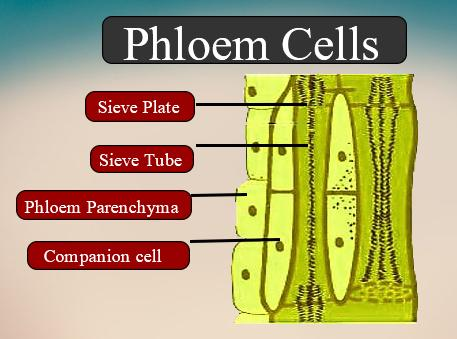
Additional Information: -Phloem is a living tissue that carries food materials, from the source to the sink. The phloem is made up of different elements. These are:
Sieve tube elements, phloem fibers, companion cells, and phloem parenchyma.
-Sieve tube elements are long thin-walled structures that lack nuclei in the mature state. These cells help in the food conduction.
-Companion cells are the specialized parenchymatous cells that are closely associated with sieve tube elements. They help in the maintenance of the pressure gradient in the sieve tube element.
Phloem fibers are the blast fibers that provide mechanical support.
-Phloem Parenchyma: These cells have dense cytoplasm and prominent nucleus. The cell walls are made up of cellulose and have pits. These elements store foods synthesized by the plants and also help to transport them to the various parts of the plants. These also contain organic materials like resins, tannins, mucilage, latex. These materials can be seen as an exudate.
So, the correct answer is, “Monocot stem.”
Note: -The pits present in the phloem parenchyma joins the adjacent cells to form a common connected wall. These form the plasmodesmata connection which is a microscopic channel through which the food and organic materials enter the Phloem.
-Xylem contains xylem parenchyma which is also a living tissue but is present in all vascular plants, unlike the phloem parenchyma.
Complete answer:
Phloem parenchyma are elongated cells that have tapering ends. They are cylindrical.
Phloem parenchyma is found in both primary and secondary phloem. It is a part of the phloem elements. These are found in dicot roots, leaves, and stems but are absent in monocot plants.
Additional Information: -Phloem is a living tissue that carries food materials, from the source to the sink. The phloem is made up of different elements. These are:
Sieve tube elements, phloem fibers, companion cells, and phloem parenchyma.
-Sieve tube elements are long thin-walled structures that lack nuclei in the mature state. These cells help in the food conduction.
-Companion cells are the specialized parenchymatous cells that are closely associated with sieve tube elements. They help in the maintenance of the pressure gradient in the sieve tube element.
Phloem fibers are the blast fibers that provide mechanical support.
-Phloem Parenchyma: These cells have dense cytoplasm and prominent nucleus. The cell walls are made up of cellulose and have pits. These elements store foods synthesized by the plants and also help to transport them to the various parts of the plants. These also contain organic materials like resins, tannins, mucilage, latex. These materials can be seen as an exudate.
So, the correct answer is, “Monocot stem.”
Note: -The pits present in the phloem parenchyma joins the adjacent cells to form a common connected wall. These form the plasmodesmata connection which is a microscopic channel through which the food and organic materials enter the Phloem.
-Xylem contains xylem parenchyma which is also a living tissue but is present in all vascular plants, unlike the phloem parenchyma.
Recently Updated Pages
Master Class 11 Social Science: Engaging Questions & Answers for Success

Master Class 11 English: Engaging Questions & Answers for Success
Master Class 11 Maths: Engaging Questions & Answers for Success
Master Class 11 Chemistry: Engaging Questions & Answers for Success
Master Class 11 Biology: Engaging Questions & Answers for Success
Master Class 11 Physics: Engaging Questions & Answers for Success
Trending doubts
Draw a diagram of a plant cell and label at least eight class 11 biology CBSE
Explain zero factorial class 11 maths CBSE
Difference between unicellular and multicellular o class 11 biology CBSE
Net gain of ATP in glycolysis a 6 b 2 c 4 d 8 class 11 biology CBSE
What organs are located on the left side of your body class 11 biology CBSE
How do I get the molar mass of urea class 11 chemistry CBSE