




\[{\text{Phenol }}\xrightarrow[{{\text{oxid}}}]{{{\text{Aerial}}}}{\text{Coloured product}}\] This is due to the formation of :
E.
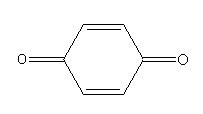
F.
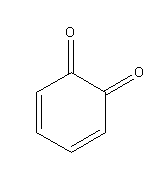
G.
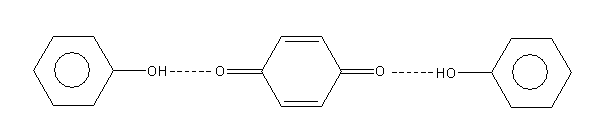
H. All
Answer
 Verified
630.6k+ views
Hint:The reaction given to us is aerial oxidation of phenol. Oxidation of phenol in presence of air gives the colour product. The oxygen in the air reacts with phenol and gives quinone products.
Complete step by step answer:On exposure to air phenol slowly oxidises and turns to the p-benzoquinone product. The colour of the p-benzoquinone product is pink.
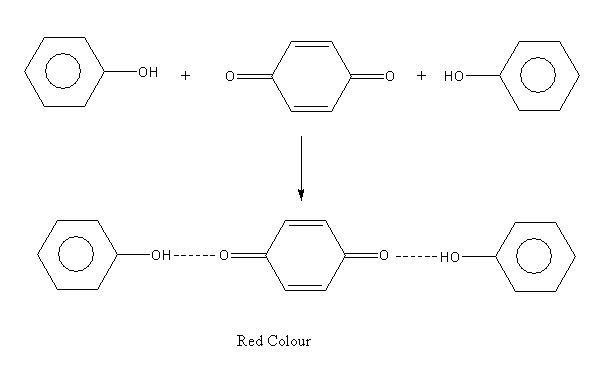
The oxidation reaction of phenol is as follows:
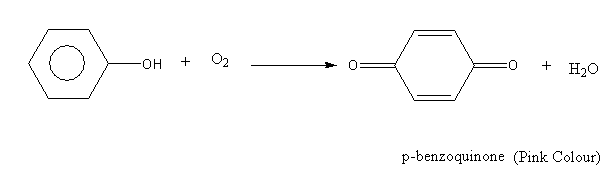
Here, phenol is aromatic while the p-benzoquinone is non-aromatic.
A p-benzoquinone form again reacts with a second molecule of phenol and gives the polymerized product of diphenoquinone which is red colour.
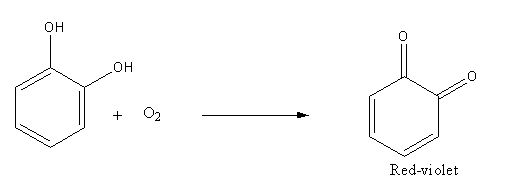
Oxidation of dihydroxybenzene (catechol) in presence of air produce 1,2-benzoquinone:
so (B) is the incorrect option.Thus, option (A) and (C) are the correct answer.
Additional Information:
Oxidation of phenol in the air gives colour compounds. When we store phenol in the air it turns to pink due to the formation of p-benzoquinone.
Catechol when stored in the air turns to red-violet due to the formation of 1, 2-benzoquinone.
Note: Oxidation is the addition of oxygen atoms. The phenol hydroxyl group is an electron-donating group that influences the nucleophilic character of phenol. Quinone's product is non-aromatic. In quinines carbonyl double bond is in conjugation with a double bond in the ring.
Complete step by step answer:On exposure to air phenol slowly oxidises and turns to the p-benzoquinone product. The colour of the p-benzoquinone product is pink.
The oxidation reaction of phenol is as follows:
Here, phenol is aromatic while the p-benzoquinone is non-aromatic.
A p-benzoquinone form again reacts with a second molecule of phenol and gives the polymerized product of diphenoquinone which is red colour.
Oxidation of dihydroxybenzene (catechol) in presence of air produce 1,2-benzoquinone:
so (B) is the incorrect option.Thus, option (A) and (C) are the correct answer.
Additional Information:
Oxidation of phenol in the air gives colour compounds. When we store phenol in the air it turns to pink due to the formation of p-benzoquinone.
Catechol when stored in the air turns to red-violet due to the formation of 1, 2-benzoquinone.
Note: Oxidation is the addition of oxygen atoms. The phenol hydroxyl group is an electron-donating group that influences the nucleophilic character of phenol. Quinone's product is non-aromatic. In quinines carbonyl double bond is in conjugation with a double bond in the ring.
Recently Updated Pages
Explain the structure of megasporangium class 12 biology CBSE

Why is chloroform kept in dark coloured bottles class 12 chemistry CBSE
Derive the balancing condition of a Wheatstone bri class 12 physics CBSE
Draw VI characteristics of a pn junction diode Explain class 12 physics CBSE
Is it possible to carry pride in ones language too class 12 english CBSE
In a population at Hardy Weinberg equilibrium the allele class 12 biology CBSE
Trending doubts
Draw a labelled sketch of the human eye class 12 physics CBSE
Which are the Top 10 Largest Countries of the World?
Draw ray diagrams each showing i myopic eye and ii class 12 physics CBSE
Which is the correct genotypic ratio of mendel dihybrid class 12 biology CBSE
Differentiate between homogeneous and heterogeneous class 12 chemistry CBSE
Give 10 examples of unisexual and bisexual flowers