




When phenol is treated with bromine water, the product formed is:
A. $o - {\rm{Bromo}}\;{\rm{phenol}}$
B. $p - {\rm{Bromo}}\;{\rm{phenol}}$
C. $m - {\rm{Bromo}}\;{\rm{phenol}}$
D. $2,4,6 - {\rm{Tribromo}}\;{\rm{phenol}}$
Answer
 Verified
642.9k+ views
Hint: We know that the reaction of phenol with halogen is commonly termed as halogenation reaction. The reaction of phenol with bromine water results in the formation of polyhalogen derivatives.
Complete step by step answer:
It is known to us that if we add bromine water to a solution of phenol. The discoloration of bromine water occurs and the formation of white precipitate takes place. The white precipitate is $2,4,6 - {\rm{Tribromo}}\;{\rm{phenol}}$. In this reaction, the polarity of phenol plays a very important role in the formation of electrophile. In the given case, ${\rm{B}}{{\rm{r}}^ + }$ acts as the electrophile. Basically, it is an electrophilic substitution reaction in which the replacement of hydrogen atom present on the ring of phenol takes place by bromine.
As the substitution is initiated by using an electrophile, the reaction is named as electrophilic substitution. Depending on the electrophile used, ortho, meta or para substitution takes place. The para substitution is favored the most as there will not be any steric hindrance. Electrophilic substitutions in lower temperature prefer para substituted product over ortho product.
The reaction of phenol with bromine water is shown below.
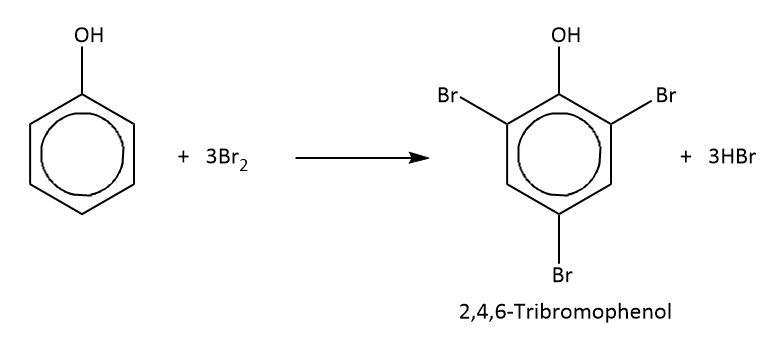
Hence, we can say that, when phenol is treated with bromine water, the product formed is $2,4,6 - {\rm{Tribromo}}\;{\rm{phenol}}$
Thus, the correct option is D.
Note:
As we know that, aromatic compounds undergo electrophilic substitution reactions where an electrophile with a positive charge attacks the ring. The substitution can take place in ortho, meta, or para positions in the ring.
Complete step by step answer:
It is known to us that if we add bromine water to a solution of phenol. The discoloration of bromine water occurs and the formation of white precipitate takes place. The white precipitate is $2,4,6 - {\rm{Tribromo}}\;{\rm{phenol}}$. In this reaction, the polarity of phenol plays a very important role in the formation of electrophile. In the given case, ${\rm{B}}{{\rm{r}}^ + }$ acts as the electrophile. Basically, it is an electrophilic substitution reaction in which the replacement of hydrogen atom present on the ring of phenol takes place by bromine.
As the substitution is initiated by using an electrophile, the reaction is named as electrophilic substitution. Depending on the electrophile used, ortho, meta or para substitution takes place. The para substitution is favored the most as there will not be any steric hindrance. Electrophilic substitutions in lower temperature prefer para substituted product over ortho product.
The reaction of phenol with bromine water is shown below.
Hence, we can say that, when phenol is treated with bromine water, the product formed is $2,4,6 - {\rm{Tribromo}}\;{\rm{phenol}}$
Thus, the correct option is D.
Note:
As we know that, aromatic compounds undergo electrophilic substitution reactions where an electrophile with a positive charge attacks the ring. The substitution can take place in ortho, meta, or para positions in the ring.
Recently Updated Pages
Onehalf of a convex lens is covered with a black paper class 12 physics CBSE

Differentiate between lanthanoids and actinoids class 12 chemistry CBSE
An object 5 cm in length is held 25 cm away from a class 12 physics CBSE
Name the following halides according to the IUPAC system class 12 chemistry CBSE
What is the Full Form of PVC, PET, HDPE, LDPE, PP and PS ?
An infinite ladder network of resistances is constructed class 12 physics CBSE
Trending doubts
Draw a labelled sketch of the human eye class 12 physics CBSE
Which are the Top 10 Largest Countries of the World?
Draw ray diagrams each showing i myopic eye and ii class 12 physics CBSE
Which is the correct genotypic ratio of mendel dihybrid class 12 biology CBSE
Differentiate between homogeneous and heterogeneous class 12 chemistry CBSE
Give 10 examples of unisexual and bisexual flowers