




Phenol can be converted into anisole by:
(A) $C{{H}_{2}}{{N}_{2}}$ / ether
(B) ${{(C{{H}_{3}})}_{2}}S{{O}_{4}}$ / $NaOH$
(C) $C{{H}_{3}}I$
(D) All of these
Answer
 Verified
608.7k+ views
Hint: An attempt to this question can be made by determining the action of the reagents mentioned in the options. Draw the expanded structure of the starting compound and the final product i.e. phenol and anisole. Now determine the reagent that can possibly give the desired product. Based on this you can answer the question.
Complete step by step answer:
We will draw the expanded structure of the starting compound and the final product i.e. phenol and anisole as suggested in the hint.
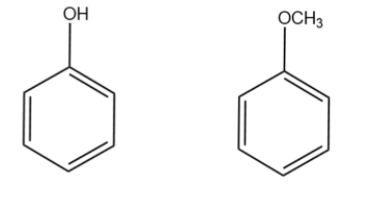
$\,\,\,Phenol\,\,\,\,\,\,\,\,\,\,\,\,\,\,\,\,\,\,Anisole$
We will determine the reaction of phenol with the reagents mentioned in the options.
(A) $C{{H}_{2}}{{N}_{2}}$ / ether
Diazomethane in the presence of ether converts alcohols into ethers. This is because the \[-C{{H}_{2}}\] group attaches to the alcohol group releasing molecular nitrogen. Thus, phenol when reacted with $C{{H}_{2}}{{N}_{2}}$ / ether produces the ether anisole.
(B) ${{(C{{H}_{3}})}_{2}}S{{O}_{4}}$ / $NaOH$
Dimethyl sulfate is a reagent whose behavior is similar to sulfuric acid. The only difference is instead of hydrogen ions the compound releases $C{{H}_{3}}^{+}$ ions in the solution. These ions, when reacted with phenol, form an ether. The ether is called anisole.
(C) $C{{H}_{3}}I$
Methyl iodide, like dimethyl sulfate, releases $C{{H}_{3}}^{+}$ ions in the solution. Thus $C{{H}_{3}}I$ also converts phenol into anisole.
From the above statements we can conclude that all the three reagents convert phenol into anisole.
Therefore, the correct answer is option (D) i.e. all of these.
Note: It is important to know that along with dimethyl sulfate we use sodium hydroxide to enhance the rate of the reaction.
Complete step by step answer:
We will draw the expanded structure of the starting compound and the final product i.e. phenol and anisole as suggested in the hint.
$\,\,\,Phenol\,\,\,\,\,\,\,\,\,\,\,\,\,\,\,\,\,\,Anisole$
We will determine the reaction of phenol with the reagents mentioned in the options.
(A) $C{{H}_{2}}{{N}_{2}}$ / ether
Diazomethane in the presence of ether converts alcohols into ethers. This is because the \[-C{{H}_{2}}\] group attaches to the alcohol group releasing molecular nitrogen. Thus, phenol when reacted with $C{{H}_{2}}{{N}_{2}}$ / ether produces the ether anisole.
(B) ${{(C{{H}_{3}})}_{2}}S{{O}_{4}}$ / $NaOH$
Dimethyl sulfate is a reagent whose behavior is similar to sulfuric acid. The only difference is instead of hydrogen ions the compound releases $C{{H}_{3}}^{+}$ ions in the solution. These ions, when reacted with phenol, form an ether. The ether is called anisole.
(C) $C{{H}_{3}}I$
Methyl iodide, like dimethyl sulfate, releases $C{{H}_{3}}^{+}$ ions in the solution. Thus $C{{H}_{3}}I$ also converts phenol into anisole.
From the above statements we can conclude that all the three reagents convert phenol into anisole.
Therefore, the correct answer is option (D) i.e. all of these.
Note: It is important to know that along with dimethyl sulfate we use sodium hydroxide to enhance the rate of the reaction.
Recently Updated Pages
Master Class 12 Business Studies: Engaging Questions & Answers for Success

Master Class 12 Chemistry: Engaging Questions & Answers for Success
Master Class 12 Biology: Engaging Questions & Answers for Success
Class 12 Question and Answer - Your Ultimate Solutions Guide
Master Class 11 English: Engaging Questions & Answers for Success
Master Class 11 Social Science: Engaging Questions & Answers for Success
Trending doubts
Which are the Top 10 Largest Countries of the World?
The total number of vertebrae in man is a30 b31 c32 class 12 biology CBSE
Draw a labelled sketch of the human eye class 12 physics CBSE
The number of cranial nerves in a frog is A 10 pairs class 12 biology CBSE
Differentiate between homogeneous and heterogeneous class 12 chemistry CBSE
Differentiate between Pyramid of energy and pyramid class 12 biology CBSE