




Phenol and ethanol are distinguished by the reaction with:
A) Red litmus paper
B) \[{\text{NaHC}}{{\text{O}}_{\text{3}}}\]
C) \[{\text{FeC}}{{\text{l}}_{\text{3}}}\]
D) \[{\text{NaOH}}\]
Answer
 Verified
558.3k+ views
Hint:Determine whether phenol and ethanol are acidic, basic or neutral in nature. Red litmus paper turns to blue in the basic medium. In presence of acid \[{\text{NaHC}}{{\text{O}}_{\text{3}}}\] dissociate and liberate \[{\text{C}}{{\text{O}}_{\text{2}}}\]gas. Write the reaction of phenol and ethanol with \[{\text{FeC}}{{\text{l}}_{\text{3}}}\] and \[{\text{NaOH}}\] and determine if there is any colour change.
Complete step-by-step answer:
The structure of phenol and ethanol are as follows:
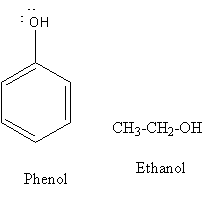
Now using chemical properties of phenol and alcohol we will decide the distinguishing test for phenol and ethanol.
A) Red litmus paper : Litmus paper is used to distinguish acid from the base. Red litmus paper turns to blue in basic medium while remaining unchanged in acidic medium. Phenol is acidic in nature while ethanol is a very weak acid. It is almost neutral. So red litmus paper will remain unchanged in both phenol and ethanol so it cannot be used to distinguish Phenol and ethanol. Thus, option (A) is an incorrect answer.
B)\[{\text{NaHC}}{{\text{O}}_{\text{3}}}\] : Sodium bicarbonate (\[{\text{NaHC}}{{\text{O}}_{\text{3}}}\]) is a weak base in presence of acid it dissociates into \[{\text{C}}{{\text{O}}_{\text{2}}}\]gas and water.
\[{\text{NaHC}}{{\text{O}}_{\text{3}}}{\text{ + H + }} \to {\text{C}}{{\text{O}}_{\text{2}}} + {{\text{H}}_{\text{2}}}{\text{O}}\]
Though phenol is acidic in nature it is very weak acid so it will not react with Sodium bicarbonate,\[{\text{NaHC}}{{\text{O}}_{\text{3}}}\].
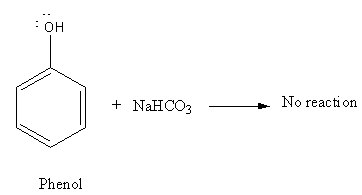
As ethanol is neutral in nature it will not react with Sodium bicarbonate,\[{\text{NaHC}}{{\text{O}}_{\text{3}}}\].
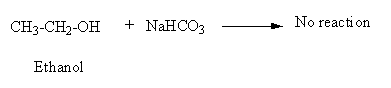
So, there will be no reaction of \[{\text{NaHC}}{{\text{O}}_{\text{3}}}\] with phenol and ethanol. Thus, option (B) is an incorrect answer.
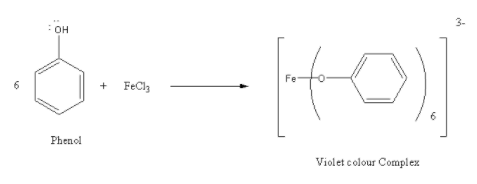
C) \[{\text{FeC}}{{\text{l}}_{\text{3}}}\] : Addition of \[{\text{FeC}}{{\text{l}}_{\text{3}}}\] in phenol gives a violet colour complex. While addition \[{\text{FeC}}{{\text{l}}_{\text{3}}}\] to phenol does not show any colour change. So, \[{\text{FeC}}{{\text{l}}_{\text{3}}}\] is used to distinguish phenol from ethanol. Thus, the correct option is (C) \[{\text{FeC}}{{\text{l}}_{\text{3}}}\].
D) \[{\text{NaOH}}\] : Sodium hydroxide,\[{\text{NaOH}}\] is a strong base so it reacts with acidic phenol and gives phenoxide. However, since ethanol is neutral in nature it does not react with \[{\text{NaOH}}\].
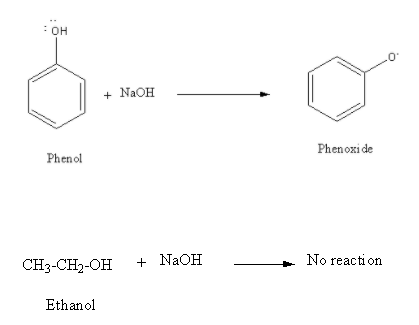
Though phenol reacts with \[{\text{NaOH}}\] but it does not show any colour change so \[{\text{NaOH}}\] can not be used to distinguish phenol from ethanol. Thus, option (D) is an incorrect answer.
Hence the correct answer is option ‘C’.
Note:To distinguish two different colourless species we have to carry out chemical reactions. We have to select the reagent that shows colour change after reacting with one species and remain unchanged after addition in another species. Litmus test can be used only if one species is acidic in nature and another species is basic in nature.
Complete step-by-step answer:
The structure of phenol and ethanol are as follows:
Now using chemical properties of phenol and alcohol we will decide the distinguishing test for phenol and ethanol.
A) Red litmus paper : Litmus paper is used to distinguish acid from the base. Red litmus paper turns to blue in basic medium while remaining unchanged in acidic medium. Phenol is acidic in nature while ethanol is a very weak acid. It is almost neutral. So red litmus paper will remain unchanged in both phenol and ethanol so it cannot be used to distinguish Phenol and ethanol. Thus, option (A) is an incorrect answer.
B)\[{\text{NaHC}}{{\text{O}}_{\text{3}}}\] : Sodium bicarbonate (\[{\text{NaHC}}{{\text{O}}_{\text{3}}}\]) is a weak base in presence of acid it dissociates into \[{\text{C}}{{\text{O}}_{\text{2}}}\]gas and water.
\[{\text{NaHC}}{{\text{O}}_{\text{3}}}{\text{ + H + }} \to {\text{C}}{{\text{O}}_{\text{2}}} + {{\text{H}}_{\text{2}}}{\text{O}}\]
Though phenol is acidic in nature it is very weak acid so it will not react with Sodium bicarbonate,\[{\text{NaHC}}{{\text{O}}_{\text{3}}}\].
As ethanol is neutral in nature it will not react with Sodium bicarbonate,\[{\text{NaHC}}{{\text{O}}_{\text{3}}}\].
So, there will be no reaction of \[{\text{NaHC}}{{\text{O}}_{\text{3}}}\] with phenol and ethanol. Thus, option (B) is an incorrect answer.
C) \[{\text{FeC}}{{\text{l}}_{\text{3}}}\] : Addition of \[{\text{FeC}}{{\text{l}}_{\text{3}}}\] in phenol gives a violet colour complex. While addition \[{\text{FeC}}{{\text{l}}_{\text{3}}}\] to phenol does not show any colour change. So, \[{\text{FeC}}{{\text{l}}_{\text{3}}}\] is used to distinguish phenol from ethanol. Thus, the correct option is (C) \[{\text{FeC}}{{\text{l}}_{\text{3}}}\].
D) \[{\text{NaOH}}\] : Sodium hydroxide,\[{\text{NaOH}}\] is a strong base so it reacts with acidic phenol and gives phenoxide. However, since ethanol is neutral in nature it does not react with \[{\text{NaOH}}\].
Though phenol reacts with \[{\text{NaOH}}\] but it does not show any colour change so \[{\text{NaOH}}\] can not be used to distinguish phenol from ethanol. Thus, option (D) is an incorrect answer.
Hence the correct answer is option ‘C’.
Note:To distinguish two different colourless species we have to carry out chemical reactions. We have to select the reagent that shows colour change after reacting with one species and remain unchanged after addition in another species. Litmus test can be used only if one species is acidic in nature and another species is basic in nature.
Recently Updated Pages
Master Class 12 Business Studies: Engaging Questions & Answers for Success

Master Class 12 Biology: Engaging Questions & Answers for Success
Master Class 12 Chemistry: Engaging Questions & Answers for Success
Class 12 Question and Answer - Your Ultimate Solutions Guide
Master Class 11 English: Engaging Questions & Answers for Success
Master Class 11 Social Science: Engaging Questions & Answers for Success
Trending doubts
Which are the Top 10 Largest Countries of the World?
Draw a labelled sketch of the human eye class 12 physics CBSE
Differentiate between homogeneous and heterogeneous class 12 chemistry CBSE
Why is the cell called the structural and functional class 12 biology CBSE
Draw ray diagrams each showing i myopic eye and ii class 12 physics CBSE
Which is the correct genotypic ratio of mendel dihybrid class 12 biology CBSE