




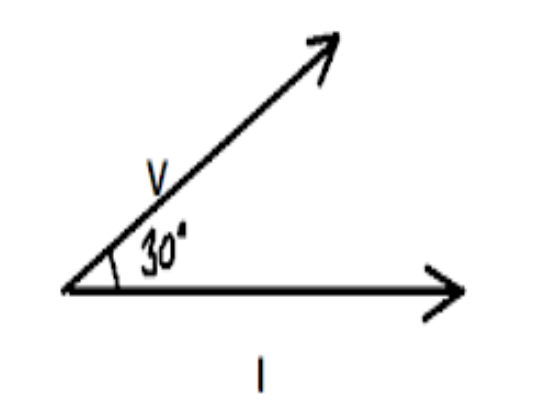
Phase diagram of series AC circuit is shown in the figure:
A) The circuit must be containing a resistor and capacitor only.
B) The circuit must be containing a resistor and inductor only.
C) The circuit must be containing a resistor, inductor and capacitor.
D) The circuit cannot have only a capacitor and inductor.
Answer
 Verified
574.5k+ views
Hint:To solve this question we have to analyze all the options given in the question. We have to understand the phasor diagram of all the conditions given in the question and go for the best-suited option as the answer.
Complete step by step answer:
In the question, a phase diagram of an AC series circuit is given. Here the voltage leads the current by $30^\circ $.
Let’s analyze all the situations in the option to find the answer.
-The circuit must be containing resistors and capacitors only.
In any circuit containing only capacitor and resistor, the current should lead by an angle of $\phi $. But here the voltage is leading with an angle of $30^\circ $. So this cannot be the answer.
Hence option (A) is incorrect.
-The circuit must be containing resistors and inductors only.
In any circuit containing only a resistor and inductor, the voltage should lead by an angle of $\phi $. Here the voltage is leading with an angle of $30^\circ $. But the question says it must be a circuit containing resistor and inductor only. But there can be other conditions where the same relation between current and voltage is seen. So it can be that circuit but we cannot say it for sure. So it can’t be the answer.
Hence option (B) is incorrect.
-The circuit must be containing resistor, inductor and capacitor
In any circuit containing resistor, capacitor and inductor, two cases can occur. When the inductive resistance is more than the capacitive resistance, the voltage leads by an angle of $\phi $ but the reverse happens when the capacitive resistance is more than the inductive resistance. So this can’t be the answer.
Hence option (C) is incorrect.
-The circuit cannot have only capacitor and inductor
Whenever only a capacitor or only inductor is present, the current leads the voltage with an angle of $90^\circ $or the voltage leads the current with an angle of $90^\circ $ respectively. But here the angle between them is $30^\circ $. Hence this is the correct option.
Hence option (D) is incorrect.
Note:While solving any question with an option containing must and should, we should be very careful before going for any answer. Before selecting an option, analyze all the conditions. Even an exception can make our answer wrong.
Complete step by step answer:
In the question, a phase diagram of an AC series circuit is given. Here the voltage leads the current by $30^\circ $.
Let’s analyze all the situations in the option to find the answer.
-The circuit must be containing resistors and capacitors only.
In any circuit containing only capacitor and resistor, the current should lead by an angle of $\phi $. But here the voltage is leading with an angle of $30^\circ $. So this cannot be the answer.
Hence option (A) is incorrect.
-The circuit must be containing resistors and inductors only.
In any circuit containing only a resistor and inductor, the voltage should lead by an angle of $\phi $. Here the voltage is leading with an angle of $30^\circ $. But the question says it must be a circuit containing resistor and inductor only. But there can be other conditions where the same relation between current and voltage is seen. So it can be that circuit but we cannot say it for sure. So it can’t be the answer.
Hence option (B) is incorrect.
-The circuit must be containing resistor, inductor and capacitor
In any circuit containing resistor, capacitor and inductor, two cases can occur. When the inductive resistance is more than the capacitive resistance, the voltage leads by an angle of $\phi $ but the reverse happens when the capacitive resistance is more than the inductive resistance. So this can’t be the answer.
Hence option (C) is incorrect.
-The circuit cannot have only capacitor and inductor
Whenever only a capacitor or only inductor is present, the current leads the voltage with an angle of $90^\circ $or the voltage leads the current with an angle of $90^\circ $ respectively. But here the angle between them is $30^\circ $. Hence this is the correct option.
Hence option (D) is incorrect.
Note:While solving any question with an option containing must and should, we should be very careful before going for any answer. Before selecting an option, analyze all the conditions. Even an exception can make our answer wrong.
Recently Updated Pages
Master Class 12 Economics: Engaging Questions & Answers for Success

Master Class 12 Physics: Engaging Questions & Answers for Success
Master Class 12 English: Engaging Questions & Answers for Success
Master Class 12 Social Science: Engaging Questions & Answers for Success
Master Class 12 Maths: Engaging Questions & Answers for Success
Master Class 12 Business Studies: Engaging Questions & Answers for Success
Trending doubts
Which are the Top 10 Largest Countries of the World?
What are the major means of transport Explain each class 12 social science CBSE
Draw a labelled sketch of the human eye class 12 physics CBSE
Why cannot DNA pass through cell membranes class 12 biology CBSE
Differentiate between insitu conservation and exsitu class 12 biology CBSE
Draw a neat and well labeled diagram of TS of ovary class 12 biology CBSE