




Periderm includes
(a) Phellem
(b) Phelloderm
(c) Phellogen
(d) Phellem, Phelloderm, and Phellogen
Answer
 Verified
580.8k+ views
Hint: It is a cylindrical tissue that covers the surfaces of stems and roots of perennial plants during early secondary growth; therefore it is not found in monocots and is bound to those gymnosperms and eudicots that show secondary development.
Complete answer
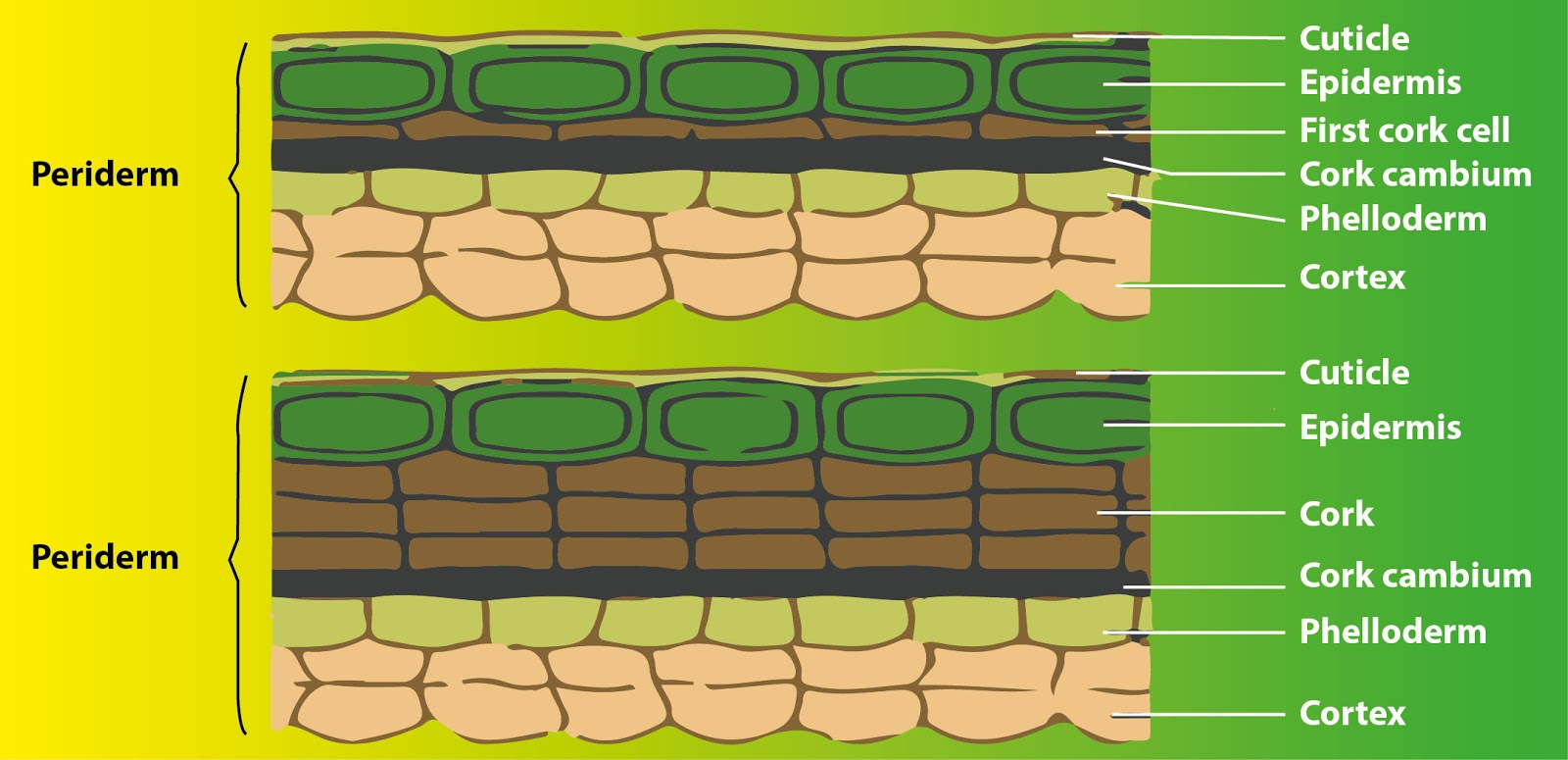
During development in the thickness of stems and establishment of gymnosperms and dicotyledons (i.e., secondary development) the periderm is the secondary defensive dermal tissue that replaces the epidermis. In contrast to the standard epidermis, the periderm might be a multilayered tissue framework, most of which generally establishes the cork or phellem, phellogen or cork cambium, and phelloderm.
Additional information
The term periderm etymologically means “about, around” (from the Greek peri) and “skin” (from the Greek derma). Along these lines, it largely relates to an external defensive layer. The term periderm is the external covering of specific plants, particularly woody plants in botany. It is the outermost layer of the bark made from cork cells, cork cambium, and phelloderm. The epidermis of the stems and woody plants will be replaced. It is more effective for preventing water loss and is more resistant to mechanical injuries. Due to this, the cork cells are situated at the outermost. These cells are dead cells impregnated with materials such as tannins and suberin. The cork cells originate from the cork cambium and it is the meristematic part of the periderm.
Aside from the cork cells, the cork cambium likewise gives new cells that structure the inward layer of the periderm, phelloderm.
So the correct answer is ‘Phellem, Phelloderm, and Phellogen’.
Note:
The term periderm is also used in embryology and zoology. In embryology, it relates to the farthest layer of specific embryos and fetuses at the 6th month gestational age. This layer, likewise called epitrichium, typically vanishes before birth. In zoology, another term for perisarc is the periderm, which is defined as the outer hard covering in the case of many hydroids.
Complete answer
During development in the thickness of stems and establishment of gymnosperms and dicotyledons (i.e., secondary development) the periderm is the secondary defensive dermal tissue that replaces the epidermis. In contrast to the standard epidermis, the periderm might be a multilayered tissue framework, most of which generally establishes the cork or phellem, phellogen or cork cambium, and phelloderm.
Additional information
The term periderm etymologically means “about, around” (from the Greek peri) and “skin” (from the Greek derma). Along these lines, it largely relates to an external defensive layer. The term periderm is the external covering of specific plants, particularly woody plants in botany. It is the outermost layer of the bark made from cork cells, cork cambium, and phelloderm. The epidermis of the stems and woody plants will be replaced. It is more effective for preventing water loss and is more resistant to mechanical injuries. Due to this, the cork cells are situated at the outermost. These cells are dead cells impregnated with materials such as tannins and suberin. The cork cells originate from the cork cambium and it is the meristematic part of the periderm.
Aside from the cork cells, the cork cambium likewise gives new cells that structure the inward layer of the periderm, phelloderm.
So the correct answer is ‘Phellem, Phelloderm, and Phellogen’.
Note:
The term periderm is also used in embryology and zoology. In embryology, it relates to the farthest layer of specific embryos and fetuses at the 6th month gestational age. This layer, likewise called epitrichium, typically vanishes before birth. In zoology, another term for perisarc is the periderm, which is defined as the outer hard covering in the case of many hydroids.
Recently Updated Pages
If x a + bt + ct2 where x is in meters and t is in class 11 physics CBSE

A car covers the first half distance between two places class 11 physics CBSE
The resultant of two vectors overrightarrow P and overrightarrow class 11 physics CBSE
Find the value of cos 135 class 11 maths CBSE
A mass M is held in place by an applied force F and class 11 physics CBSE
A solution of glucose in water is labelled as 10 dfracwv class 11 chemistry CBSE
Trending doubts
One Metric ton is equal to kg A 10000 B 1000 C 100 class 11 physics CBSE
Find the value of the expression given below sin 30circ class 11 maths CBSE
Draw a diagram of nephron and explain its structur class 11 biology CBSE
10 examples of friction in our daily life
Proton was discovered by A Thomson B Rutherford C Chadwick class 11 chemistry CBSE
Bond order ofO2 O2+ O2 and O22 is in order A O2 langle class 11 chemistry CBSE