



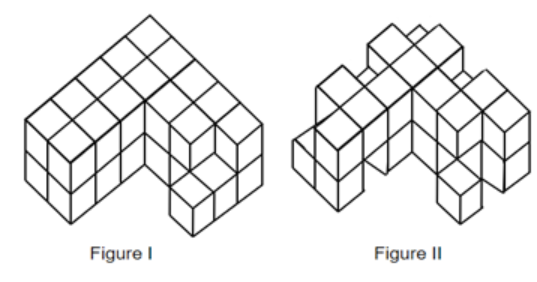
What percentages of cubes are removed from the figure (I) to get figure (II)?
\[\begin{align}
& A)18\dfrac{4}{5}\% \\
& B)27\dfrac{3}{11}\% \\
& C)18\dfrac{3}{4}\% \\
& D)21\dfrac{3}{7}\% \\
\end{align}\]
Answer
 Verified
579.6k+ views
Hint: First of all, we should understand the question. Now we will carefully observe both the figures and count the number of cubes present in each figure. Now it is clear we should find the percentage of cubes removed. So, let us find the difference of cubes in figure 1 and figure 2. Now let us divide this difference of cubes by the number of cubes in figure 1. So, we can find the percentage of cubes removed by using the formulae that
\[\text{Percentage of cubes removed from figure 1 to get figure =}\dfrac{number\text{ of cubes in figure 1- number of cubes in figure 2}}{number\text{ of cubes in figure 1}}\times 100\]We know that the percentage of a certain quantity can be represented by the symbol %.
Complete step-by-step solution:
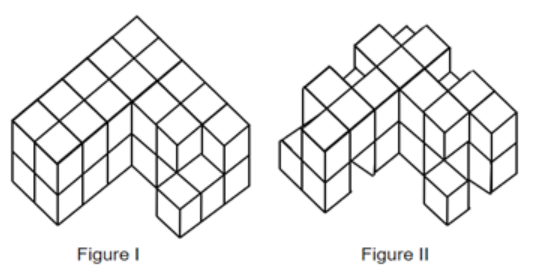
Now we will carefully observe both the figures and count the number of cubes present in each figure.
By carefully observing both the figures we can say that
The number of cubes present in figure (I) is 32 and the number of cubes present in figure (II) is 26.
We know that
\[\text{Percentage of cubes removed from figure 1 to get figure =}\dfrac{number\text{ of cubes in figure 1- number of cubes in figure 2}}{number\text{ of cubes in figure 1}}\times 100\]
So, let us find the difference between the number of cubes from figure 1 to figure 2.
\[\Rightarrow \text{ Number of cubes in figure 1- Number of cubes in figure 2}=32-26=6\]
\[\begin{align}
& \Rightarrow \text{Percentage of cubes removed from figure 1 to get figure 2=}\dfrac{6}{32}\times 100 \\
& \Rightarrow \text{Percentage of cubes removed from figure 1 to get figure }2=\dfrac{75}{4} \\
& \Rightarrow \text{Percentage of cubes removed from figure 1 to get figure }2=18\dfrac{3}{4} \\
\end{align}\]
We know that the percentage is represented by the symbol %. So, we can say that the percentage of cubes removed from figure (I) to get figure (II) is equal to $18\dfrac{3}{4}\%$.
Hence option C is correct.
Note: While counting the number of cubes we should be careful if we even miss a single cube the answer will completely vary from the actual answer. So, students should recheck more than one time whether they counted the number of cubes in a correct manner or not. If any counting mistake, it should be rectified by the student immediately to have a correct answer.
\[\text{Percentage of cubes removed from figure 1 to get figure =}\dfrac{number\text{ of cubes in figure 1- number of cubes in figure 2}}{number\text{ of cubes in figure 1}}\times 100\]We know that the percentage of a certain quantity can be represented by the symbol %.
Complete step-by-step solution:
Now we will carefully observe both the figures and count the number of cubes present in each figure.
By carefully observing both the figures we can say that
The number of cubes present in figure (I) is 32 and the number of cubes present in figure (II) is 26.
We know that
\[\text{Percentage of cubes removed from figure 1 to get figure =}\dfrac{number\text{ of cubes in figure 1- number of cubes in figure 2}}{number\text{ of cubes in figure 1}}\times 100\]
So, let us find the difference between the number of cubes from figure 1 to figure 2.
\[\Rightarrow \text{ Number of cubes in figure 1- Number of cubes in figure 2}=32-26=6\]
\[\begin{align}
& \Rightarrow \text{Percentage of cubes removed from figure 1 to get figure 2=}\dfrac{6}{32}\times 100 \\
& \Rightarrow \text{Percentage of cubes removed from figure 1 to get figure }2=\dfrac{75}{4} \\
& \Rightarrow \text{Percentage of cubes removed from figure 1 to get figure }2=18\dfrac{3}{4} \\
\end{align}\]
We know that the percentage is represented by the symbol %. So, we can say that the percentage of cubes removed from figure (I) to get figure (II) is equal to $18\dfrac{3}{4}\%$.
Hence option C is correct.
Note: While counting the number of cubes we should be careful if we even miss a single cube the answer will completely vary from the actual answer. So, students should recheck more than one time whether they counted the number of cubes in a correct manner or not. If any counting mistake, it should be rectified by the student immediately to have a correct answer.
Recently Updated Pages
Master Class 11 English: Engaging Questions & Answers for Success

Master Class 11 Maths: Engaging Questions & Answers for Success
Master Class 11 Biology: Engaging Questions & Answers for Success
Master Class 11 Social Science: Engaging Questions & Answers for Success
Master Class 11 Physics: Engaging Questions & Answers for Success
Master Class 11 Accountancy: Engaging Questions & Answers for Success
Trending doubts
Convert 40circ C to Fahrenheit A 104circ F B 107circ class 8 maths CBSE
When people say No pun intended what does that mea class 8 english CBSE
What are the methods of reducing friction. Explain
Write a short biography of Dr APJ Abdul Kalam under class 8 english CBSE
Explain the role of the opposition party in a demo class 8 social studies CBSE
Why did James Mill and Thomas Macaulay think that European class 8 social science CBSE