




Percentage weight of hydrogen in urea is:
A. 6.67%
B. 10%
C. 4%
D. 12.33%
Answer
 Verified
625.2k+ views
Hint: Solve this question by calculating the molecular weight of the compound using weights of the element. Then, divide the weight of the desired element by the molar mass of the compound to find weight of the compound in the element. Multiply it by 100 to find the percentage.
Complete step by step answer:
Urea, also known as carbamide, is a compound with molecular formula \[CO{{(N{{H}_{2}})}_{2}}\]. It is a highly soluble organic compound formed in the liver from ammonia produced as a result of deamination of amino acids. It is a major organic component of human urine and is the waste product of many living organisms.
The structural formula of urea is –
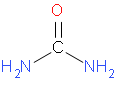
Let us start by calculating molar mass of urea.
= molar mass of carbon + molar mass of oxygen + (2 x molar mass of nitrogen) + (4 x molar mass of hydrogen)
= 12 g + 16 g + (2 x 14) g + (4 x 1) g
= 60 g.
% weight of element = \[\dfrac{\text{mass of element}}{\text{molar mass of compound}}\]x 100 %
% weight of hydrogen =\[\dfrac{\text{4}}{\text{60}}\] x 100 %
% weight of hydrogen = 6.67 %
Therefore, the answer is – option (a) – Percentage weight of hydrogen in urea is 6.67%.
Note: Percentage weights of other elements in urea are as follows –
Carbon
% weight = \[\dfrac{12}{\text{60}}\text{ }\]x 100 % = 19.99 %
Nitrogen
% weight = \[\dfrac{14}{\text{60}}\] x 100 % = 46.64 %
Oxygen
% weight = \[\dfrac{16}{\text{60}}\] x 100 % = 26.64 %
Complete step by step answer:
Urea, also known as carbamide, is a compound with molecular formula \[CO{{(N{{H}_{2}})}_{2}}\]. It is a highly soluble organic compound formed in the liver from ammonia produced as a result of deamination of amino acids. It is a major organic component of human urine and is the waste product of many living organisms.
The structural formula of urea is –
Let us start by calculating molar mass of urea.
= molar mass of carbon + molar mass of oxygen + (2 x molar mass of nitrogen) + (4 x molar mass of hydrogen)
= 12 g + 16 g + (2 x 14) g + (4 x 1) g
= 60 g.
% weight of element = \[\dfrac{\text{mass of element}}{\text{molar mass of compound}}\]x 100 %
% weight of hydrogen =\[\dfrac{\text{4}}{\text{60}}\] x 100 %
% weight of hydrogen = 6.67 %
Therefore, the answer is – option (a) – Percentage weight of hydrogen in urea is 6.67%.
Note: Percentage weights of other elements in urea are as follows –
Carbon
% weight = \[\dfrac{12}{\text{60}}\text{ }\]x 100 % = 19.99 %
Nitrogen
% weight = \[\dfrac{14}{\text{60}}\] x 100 % = 46.64 %
Oxygen
% weight = \[\dfrac{16}{\text{60}}\] x 100 % = 26.64 %
Recently Updated Pages
Master Class 12 Business Studies: Engaging Questions & Answers for Success

Master Class 12 Biology: Engaging Questions & Answers for Success
Master Class 12 Chemistry: Engaging Questions & Answers for Success
Class 12 Question and Answer - Your Ultimate Solutions Guide
Master Class 11 Social Science: Engaging Questions & Answers for Success
Master Class 11 English: Engaging Questions & Answers for Success
Trending doubts
Which is more stable and why class 12 chemistry CBSE
Which are the Top 10 Largest Countries of the World?
Draw a labelled sketch of the human eye class 12 physics CBSE
Differentiate between homogeneous and heterogeneous class 12 chemistry CBSE
What are the major means of transport Explain each class 12 social science CBSE
Sulphuric acid is known as the king of acids State class 12 chemistry CBSE