




What is the path followed by a moving body on which a constant force acts in a direction other than initial velocity (i.e. excluding parallel and antiparallel direction)?
(A). Straight lie
(B). Parabolic
(C). Circular
(D). Elliptical
Answer
 Verified
609.6k+ views
Hint: The motion of a body is the resultant of one or more forces acting on it. In a projectile motion, the body has motion in horizontal as well as vertical direction. Resolving the velocity into its components and applying equation of motion, we can determine the path followed by the body
Formula used:
$x=u\cos \theta t$
$s=ut+\dfrac{1}{2}a{{t}^{2}}$
Complete step-by-step solution:
According to Newton’s second law, a body undergoes acceleration when a force acts on it, therefore,
$F=ma$
Here, $F$ is the force acting on a body
$m$ is the mass of a body
$a$ is the acceleration of the body
In a projectile, the path followed by the body is given as
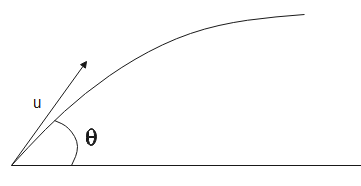
Here $u$ is the initial velocity of the body. The force acting on the body should not be parallel or anti-parallel, let $\phi $ be the angle between initial velocity and force, then, $\phi \ne 0$ or $\phi \ne {{180}^{o}}$
In a projectile no force is acting in the horizontal motion therefore, the horizontal velocity remains constant. In the vertical direction, the force of gravity acts on the body hence, the acceleration is constant. The FBD diagram of the body in projectile motion is
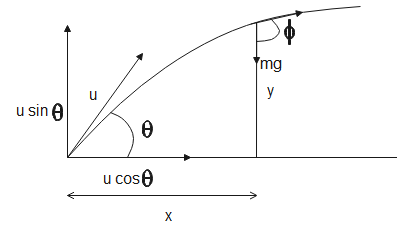
The force acting on the particle is $mg$ and acceleration in the vertical direction is equal to g.
Let x be the distance covered along the horizontal axis, then
$x=u\cos \theta t$ - (1)
Let y be the distance covered along the vertical axis. Applying equation of motion along vertical axis we get,
$s=ut+\dfrac{1}{2}a{{t}^{2}}$
Here, $s$ is the distance covered
$t$ is the time taken
$a$ is acceleration
Substituting given values in the above equation,
$y=u\sin \theta t-\dfrac{1}{2}g{{t}^{2}}$
Substituting $t$ from eq (1)
$\begin{align}
& y=u\sin \theta \dfrac{x}{u\cos \theta }-\dfrac{1}{2}g{{\left( \dfrac{x}{u\cos \theta } \right)}^{2}} \\
& \Rightarrow y=x\tan \theta -\dfrac{1}{2}g\dfrac{{{x}^{2}}}{{{u}^{2}}{{\cos }^{2}}\theta } \\
\end{align}$
The above equation represents the equation of a parabola.
Therefore, in projectile motion, the force acting on the body is not in the direction of initial velocity and the path followed is a parabola.
Hence, the correct option is (B).
Note:
Since the force is constant, acceleration is also constant. The velocity becomes zero at the highest point of the projectile and it is maximum at the lowest point. The velocity and force are not in the same direction at any point of the projectile. The force of gravity or mg is responsible for decelerating the body.
Formula used:
$x=u\cos \theta t$
$s=ut+\dfrac{1}{2}a{{t}^{2}}$
Complete step-by-step solution:
According to Newton’s second law, a body undergoes acceleration when a force acts on it, therefore,
$F=ma$
Here, $F$ is the force acting on a body
$m$ is the mass of a body
$a$ is the acceleration of the body
In a projectile, the path followed by the body is given as
Here $u$ is the initial velocity of the body. The force acting on the body should not be parallel or anti-parallel, let $\phi $ be the angle between initial velocity and force, then, $\phi \ne 0$ or $\phi \ne {{180}^{o}}$
In a projectile no force is acting in the horizontal motion therefore, the horizontal velocity remains constant. In the vertical direction, the force of gravity acts on the body hence, the acceleration is constant. The FBD diagram of the body in projectile motion is
The force acting on the particle is $mg$ and acceleration in the vertical direction is equal to g.
Let x be the distance covered along the horizontal axis, then
$x=u\cos \theta t$ - (1)
Let y be the distance covered along the vertical axis. Applying equation of motion along vertical axis we get,
$s=ut+\dfrac{1}{2}a{{t}^{2}}$
Here, $s$ is the distance covered
$t$ is the time taken
$a$ is acceleration
Substituting given values in the above equation,
$y=u\sin \theta t-\dfrac{1}{2}g{{t}^{2}}$
Substituting $t$ from eq (1)
$\begin{align}
& y=u\sin \theta \dfrac{x}{u\cos \theta }-\dfrac{1}{2}g{{\left( \dfrac{x}{u\cos \theta } \right)}^{2}} \\
& \Rightarrow y=x\tan \theta -\dfrac{1}{2}g\dfrac{{{x}^{2}}}{{{u}^{2}}{{\cos }^{2}}\theta } \\
\end{align}$
The above equation represents the equation of a parabola.
Therefore, in projectile motion, the force acting on the body is not in the direction of initial velocity and the path followed is a parabola.
Hence, the correct option is (B).
Note:
Since the force is constant, acceleration is also constant. The velocity becomes zero at the highest point of the projectile and it is maximum at the lowest point. The velocity and force are not in the same direction at any point of the projectile. The force of gravity or mg is responsible for decelerating the body.
Recently Updated Pages
Basicity of sulphurous acid and sulphuric acid are

Master Class 12 Economics: Engaging Questions & Answers for Success
Master Class 12 Biology: Engaging Questions & Answers for Success
Master Class 11 English: Engaging Questions & Answers for Success
Master Class 11 Physics: Engaging Questions & Answers for Success
Master Class 11 Computer Science: Engaging Questions & Answers for Success
Trending doubts
Draw a labelled sketch of the human eye class 12 physics CBSE
The chemical formula of tear gas is A CO Cl 2 B C 10 class 12 chemistry CBSE
Draw ray diagrams each showing i myopic eye and ii class 12 physics CBSE
Which are the Top 10 Largest Countries of the World?
Differentiate between homogeneous and heterogeneous class 12 chemistry CBSE
Which is the correct genotypic ratio of mendel dihybrid class 12 biology CBSE