




Oxidative phosphorylation of cytoplasmic ${\text{NADH}}\left( {{H^ + }} \right)$ takes place in
(A) Cytosol
(B) E.R
(C) Mitochondria
(D) Golgi bodies
Answer
 Verified
611.4k+ views
Hint: The oxidative phosphorylation of cytoplasmic ${\text{NADH}}\left( {{H^ + }} \right)$ is the process in the electron transport chain that takes place in the eukaryotes. In this electron transport mechanism, the electrons are transported from the electron donors to the electron acceptors by the process of redox reactions.
Complete Answer:
${\text{NADH}}\left( {{H^ + }} \right)$ Ions are released from the products of the glycolysis, fatty acid oxidation and the Krebs’s cycle process.
- These ions help to undergo oxidative phosphorylation to convert the ADP into ATP (Adenosine triphosphate).
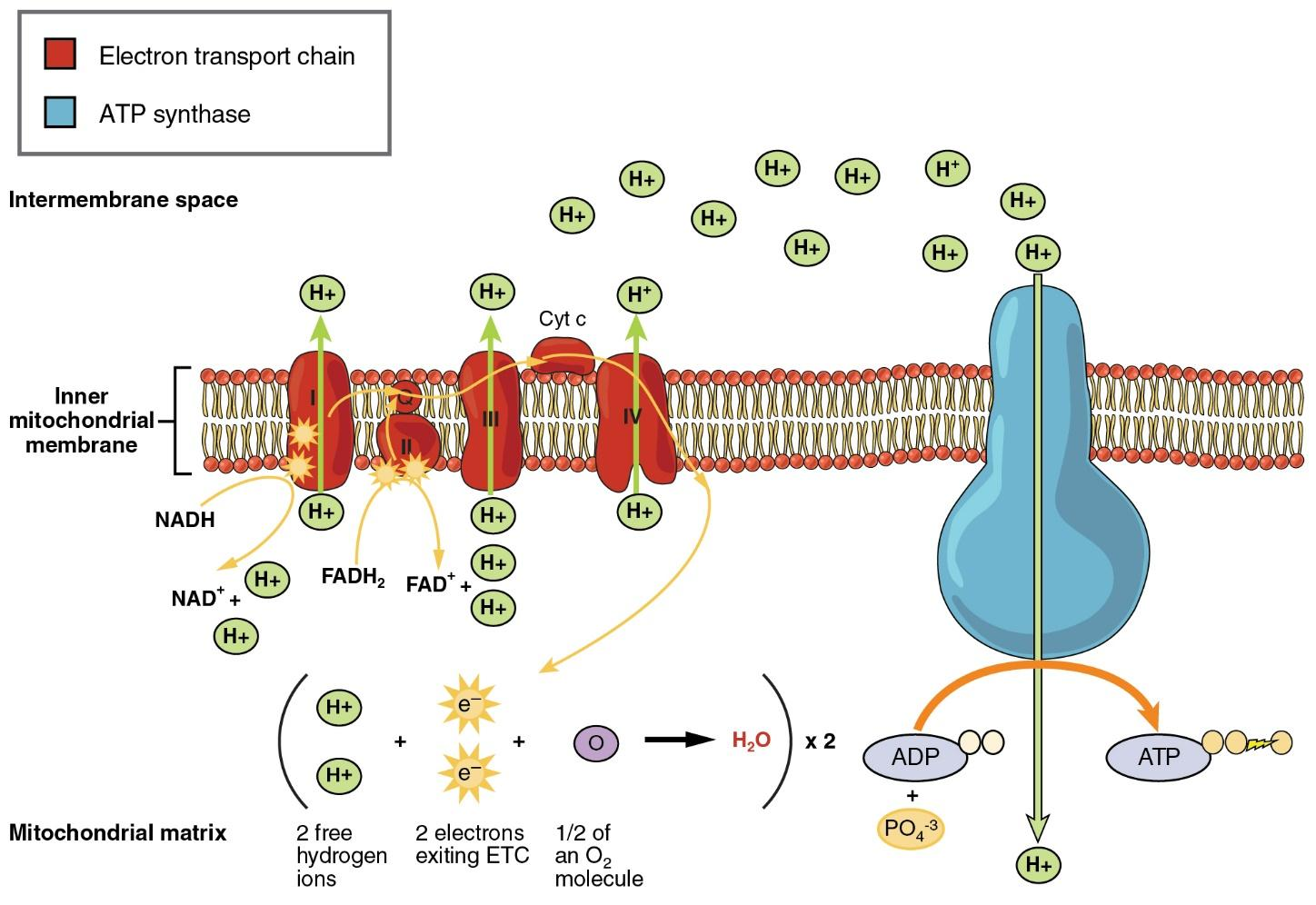
- The produced ATP synthase and electron transport assembly forms the integral part of the inner membrane of the mitochondria. This electron transport assembly helps in the catalyzation of the reactions of oxidation and reductions that take place simultaneously.
- In the electron transport chain, the electron donors pass the electron from them to the electronegative acceptor.
- The energy released in these transformations of electrons to oxygen helps to generate the proton gradient across the membrane of the mitochondria. This process pumps the proton to the inner membrane of the mitochondria.
- Hence phosphorylation of cytoplasmic ${\text{NADH}}\left( {{H^ + }} \right)$ takes place in mitochondria.
Thus, the option (C) is correct.
Note: In the plants, the electron transport chain is known to take place in the thylakoid membrane. Here not ${\text{NADH}}\left( {{H^ + }} \right)$ is involved, only the light energy is used to drive up the process of the redox reactions to convert ADP to the ATP.
Complete Answer:
${\text{NADH}}\left( {{H^ + }} \right)$ Ions are released from the products of the glycolysis, fatty acid oxidation and the Krebs’s cycle process.
- These ions help to undergo oxidative phosphorylation to convert the ADP into ATP (Adenosine triphosphate).
- The produced ATP synthase and electron transport assembly forms the integral part of the inner membrane of the mitochondria. This electron transport assembly helps in the catalyzation of the reactions of oxidation and reductions that take place simultaneously.
- In the electron transport chain, the electron donors pass the electron from them to the electronegative acceptor.
- The energy released in these transformations of electrons to oxygen helps to generate the proton gradient across the membrane of the mitochondria. This process pumps the proton to the inner membrane of the mitochondria.
- Hence phosphorylation of cytoplasmic ${\text{NADH}}\left( {{H^ + }} \right)$ takes place in mitochondria.
Thus, the option (C) is correct.
Note: In the plants, the electron transport chain is known to take place in the thylakoid membrane. Here not ${\text{NADH}}\left( {{H^ + }} \right)$ is involved, only the light energy is used to drive up the process of the redox reactions to convert ADP to the ATP.
Recently Updated Pages
Master Class 12 Business Studies: Engaging Questions & Answers for Success

Master Class 12 Biology: Engaging Questions & Answers for Success
Master Class 12 Chemistry: Engaging Questions & Answers for Success
Class 12 Question and Answer - Your Ultimate Solutions Guide
Master Class 11 Social Science: Engaging Questions & Answers for Success
Master Class 11 English: Engaging Questions & Answers for Success
Trending doubts
Which is more stable and why class 12 chemistry CBSE
Which are the Top 10 Largest Countries of the World?
Draw a labelled sketch of the human eye class 12 physics CBSE
Differentiate between homogeneous and heterogeneous class 12 chemistry CBSE
What are the major means of transport Explain each class 12 social science CBSE
Sulphuric acid is known as the king of acids State class 12 chemistry CBSE