




Outer layer of skin that frog casts off is composed of
(a) Simple squamous epithelium
(b) Tessellated epithelium
(c) Ciliated epithelium
(d) Cuboidal epithelium
Answer
 Verified
613.5k+ views
Hint: A layer of fat cells that are arranged in a single layer that helps the small particles and molecules to enter inside and its primary function is protection against harmful germs and substances and is the outermost layer.
Complete answer:
The outermost layer of the skin of the frog casts is composed of the simple squamous epithelium. It is sometimes also called Stratum corneum. It is made up of square- like flattened cells that are arranged in a single layer with the nucleus inside it. It acts as a protective covering of the body from the outside world.
- The cells of the squamous epithelium are attached to the basal membrane of the epithelium that may be two or three- layered.
- It is permeable to small particles and substances that provide nutrition to the cells.
- The particles passed through the epithelium by the process of diffusion and filtration.
- This type of epithelium is also found in the lining of the inner organs like alveoli, lungs, capillaries, etc.
- The layer of this epithelium appears like tiles, so it is also called pavement epithelium.
- The epithelium constitutes a layer of thin cells that are keratinized and appears horn- like.
- It is usually made up of dead cells that are cast off at the time of molting.
- This layer is composed of three main substances that include: ceramides, cholesterol, and fatty acids.
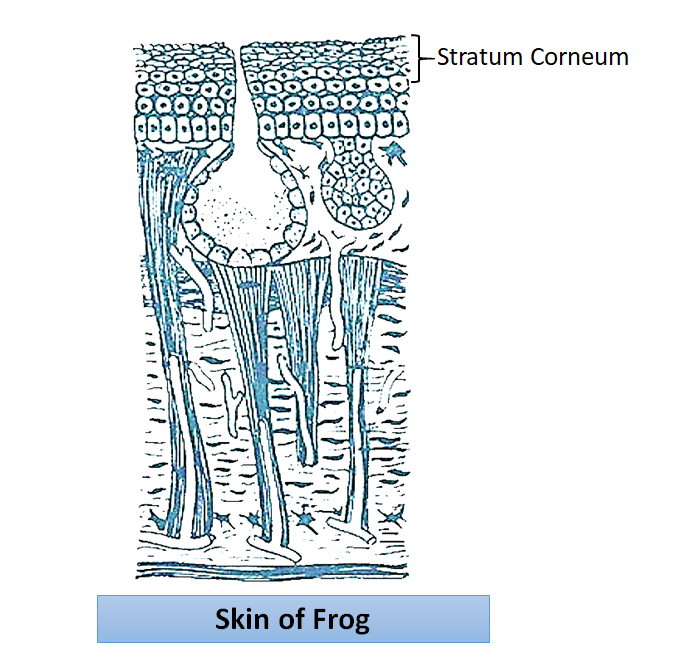
So, the correct answer is ‘Simple squamous epithelium’.
Note: The keratin present in the stratum corneum is responsible for providing the hydration to the skin and prevents the process of evaporation that leads to the loss of water from the skin making it dry. It helps the skin to remain at its position and stretches it back by absorbing water from the surroundings. This layer is permanent in frogs but during molting, it is shed off and is replaced by a more rigid layer composed of beta keratin.
Complete answer:
The outermost layer of the skin of the frog casts is composed of the simple squamous epithelium. It is sometimes also called Stratum corneum. It is made up of square- like flattened cells that are arranged in a single layer with the nucleus inside it. It acts as a protective covering of the body from the outside world.
- The cells of the squamous epithelium are attached to the basal membrane of the epithelium that may be two or three- layered.
- It is permeable to small particles and substances that provide nutrition to the cells.
- The particles passed through the epithelium by the process of diffusion and filtration.
- This type of epithelium is also found in the lining of the inner organs like alveoli, lungs, capillaries, etc.
- The layer of this epithelium appears like tiles, so it is also called pavement epithelium.
- The epithelium constitutes a layer of thin cells that are keratinized and appears horn- like.
- It is usually made up of dead cells that are cast off at the time of molting.
- This layer is composed of three main substances that include: ceramides, cholesterol, and fatty acids.
So, the correct answer is ‘Simple squamous epithelium’.
Note: The keratin present in the stratum corneum is responsible for providing the hydration to the skin and prevents the process of evaporation that leads to the loss of water from the skin making it dry. It helps the skin to remain at its position and stretches it back by absorbing water from the surroundings. This layer is permanent in frogs but during molting, it is shed off and is replaced by a more rigid layer composed of beta keratin.
Recently Updated Pages
Master Class 11 Social Science: Engaging Questions & Answers for Success

Master Class 11 English: Engaging Questions & Answers for Success
Master Class 11 Maths: Engaging Questions & Answers for Success
Master Class 11 Chemistry: Engaging Questions & Answers for Success
Master Class 11 Biology: Engaging Questions & Answers for Success
Master Class 11 Physics: Engaging Questions & Answers for Success
Trending doubts
Differentiate between an exothermic and an endothermic class 11 chemistry CBSE
There are 720 permutations of the digits 1 2 3 4 5 class 11 maths CBSE
Draw a diagram of a plant cell and label at least eight class 11 biology CBSE
1 Quintal is equal to a 110 kg b 10 kg c 100kg d 1000 class 11 physics CBSE
Which chemical is known as king of chemicals A H 2 class 11 chemistry CBSE
Draw a diagram of nephron and explain its structur class 11 biology CBSE