



Out of 100 students 50 fail in English and 30 in Maths. If 12 students fail in both English and Maths, then the number of students passing both the subjects is
(a) 26
(b) 28
(c) 30
(d) 32
Answer
 Verified
622.5k+ views
Hint: At first take down all the data given and represent it in the form of a Venn diagram then find what is asked in the question.
Complete step-by-step answer:
In the question we are told that out of 100 students 50 fail in English and 30 fail in Maths, now if 12 students fail in both subjects English and Maths, then we have to find the number of students who passed in both subjects.
So, let’s represent number of students who failed in English as n(E), number of students who failed in Maths as n(M) and number of students who failed in both subjects as $n\left( E\cap M \right)$
So, we can write it as,
$\begin{align}
& n\left( E \right)=50 \\
& n\left( M \right)=30 \\
& n\left( E\cap M \right)=12 \\
\end{align}$
So, we can say that n (E only) means students who failed only in English
So, n(E only) = 50 – 12 = 38
Also for maths we can say that n(M only) means students who only failed in Maths.
So, n(M only) = 30 – 12 = 18
Now we can represent it as in in Venn diagram,
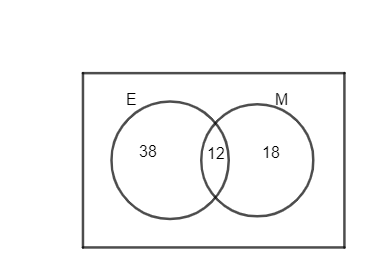
Hence the total number of students who failed is n(E only) + $n(E\cap M)$ + n(M only) which is equal to 38 + 12 + 18 which is 68.
Total students which were given was 100.So the remaining students are 100 – 68 = 32 which have passed in both subject
Hence the correct option is (d).
Note: Students generally get confused between A and only A, B and only B, C and only C. Actually, A means people can read only or A and B or A and C or A and B and C. The same goes for B and C also.
Complete step-by-step answer:
In the question we are told that out of 100 students 50 fail in English and 30 fail in Maths, now if 12 students fail in both subjects English and Maths, then we have to find the number of students who passed in both subjects.
So, let’s represent number of students who failed in English as n(E), number of students who failed in Maths as n(M) and number of students who failed in both subjects as $n\left( E\cap M \right)$
So, we can write it as,
$\begin{align}
& n\left( E \right)=50 \\
& n\left( M \right)=30 \\
& n\left( E\cap M \right)=12 \\
\end{align}$
So, we can say that n (E only) means students who failed only in English
So, n(E only) = 50 – 12 = 38
Also for maths we can say that n(M only) means students who only failed in Maths.
So, n(M only) = 30 – 12 = 18
Now we can represent it as in in Venn diagram,
Hence the total number of students who failed is n(E only) + $n(E\cap M)$ + n(M only) which is equal to 38 + 12 + 18 which is 68.
Total students which were given was 100.So the remaining students are 100 – 68 = 32 which have passed in both subject
Hence the correct option is (d).
Note: Students generally get confused between A and only A, B and only B, C and only C. Actually, A means people can read only or A and B or A and C or A and B and C. The same goes for B and C also.
Recently Updated Pages
Basicity of sulphurous acid and sulphuric acid are

Master Class 11 Business Studies: Engaging Questions & Answers for Success
Master Class 11 Computer Science: Engaging Questions & Answers for Success
Master Class 11 Economics: Engaging Questions & Answers for Success
Master Class 12 English: Engaging Questions & Answers for Success
Master Class 12 Social Science: Engaging Questions & Answers for Success
Trending doubts
What are gulf countries and why they are called Gulf class 8 social science CBSE
Name the states through which the Tropic of Cancer class 8 social science CBSE
What is BLO What is the full form of BLO class 8 social science CBSE
Citizens of India can vote at the age of A 18 years class 8 social science CBSE
Advantages and disadvantages of science
The pH of the gastric juices released during digestion class 8 biology CBSE