




What is the origin of replication? State its function.
Answer
 Verified
575.7k+ views
Hint: The genetic material is passed on to the next generation by duplication of DNA by semiconservative replication prior to cell division. This ensures that the daughter cells receive a full complement of chromosomes. Origin of replication is also known as Ori.
Complete answer:
Genetic engineering is a branch of biology that deals with altering the chemistry of genetic material of DNA and RNA to be introduced up into host organisms. It thus changes up the phenotype of the organism of the host. Genetic engineering includes creation of recombinant DNA, use of gene cloning and gene transfer, overcome this limitation and allow us to isolate and introduce only one set of desirable genes without introducing undesirable genes into the target organism.
Most likely, the DNA pieces would not be able to multiply itself in the progeny cells of the organism. But when it gets integrated into the genome of the recipient, it may multiply and be inherited along the host DNA. This is because the alien piece of the DNA has become part of the chromosome which has the ability to replicate. In a chromosome there is a specific DNA sequence called the "origin of replication"which is mainly responsible for the initiating replication.
Therefore, for the multiplication of an alien piece of DNA in an organism it needs to be a part of a chromosome which has a specific sequence which is called "origin of replication". Thus, an alien DNA is linked with the origin of replication, so that this alien piece of DNA can replicate and multiply itself in the host organisms. This can be called cloning or making multiple identical copies of any template DNA.
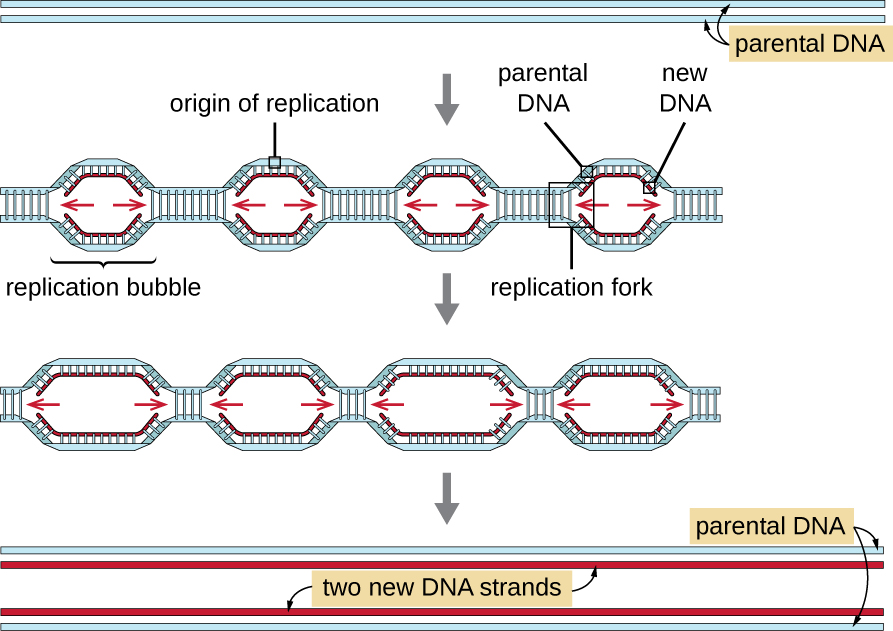
FUNCTION- Ori is mainly the place where the DNA replication begins, enabling a plasmid to reproduce so as to survive within the cells.
Note: Gregor Mendel worked on the inheritance of traits in pea plants suggesting that specific "factors'' are responsible for transferring organismal traits between generations. It was the start of the discovery whereas the isolation of DNA polymerases, the enzymes that catalyze the synthesis of new DNA strands was done by Kornberg and his colleagues from the bacteria E.coli.
Complete answer:
Genetic engineering is a branch of biology that deals with altering the chemistry of genetic material of DNA and RNA to be introduced up into host organisms. It thus changes up the phenotype of the organism of the host. Genetic engineering includes creation of recombinant DNA, use of gene cloning and gene transfer, overcome this limitation and allow us to isolate and introduce only one set of desirable genes without introducing undesirable genes into the target organism.
Most likely, the DNA pieces would not be able to multiply itself in the progeny cells of the organism. But when it gets integrated into the genome of the recipient, it may multiply and be inherited along the host DNA. This is because the alien piece of the DNA has become part of the chromosome which has the ability to replicate. In a chromosome there is a specific DNA sequence called the "origin of replication"which is mainly responsible for the initiating replication.
Therefore, for the multiplication of an alien piece of DNA in an organism it needs to be a part of a chromosome which has a specific sequence which is called "origin of replication". Thus, an alien DNA is linked with the origin of replication, so that this alien piece of DNA can replicate and multiply itself in the host organisms. This can be called cloning or making multiple identical copies of any template DNA.
FUNCTION- Ori is mainly the place where the DNA replication begins, enabling a plasmid to reproduce so as to survive within the cells.
Note: Gregor Mendel worked on the inheritance of traits in pea plants suggesting that specific "factors'' are responsible for transferring organismal traits between generations. It was the start of the discovery whereas the isolation of DNA polymerases, the enzymes that catalyze the synthesis of new DNA strands was done by Kornberg and his colleagues from the bacteria E.coli.
Recently Updated Pages
Which will be the least stable resonating structure class 11 chemistry CBSE

How many 5 digit telephone numbers can be construc-class-11-maths-CBSE
How do you find the angle of the resultant vector class 11 physics CBSE
Draw labelled diagram of the following i Gram seed class 11 biology CBSE
1 Quintal is equal to a 110 kg b 10 kg c 100kg d 1000 class 11 physics CBSE
What is the need and importance of classification class 11 biology CBSE
Trending doubts
Find the value of the expression given below sin 30circ class 11 maths CBSE
One Metric ton is equal to kg A 10000 B 1000 C 100 class 11 physics CBSE
Draw a diagram of nephron and explain its structur class 11 biology CBSE
10 examples of friction in our daily life
Draw a diagram of a plant cell and label at least eight class 11 biology CBSE
Difference Between Prokaryotic Cells and Eukaryotic Cells