




What is the organic molecule that stores the most energy called, and what is its structure \[?\]
Answer
 Verified
558.6k+ views
Hint: First we know what an organic compound is. Then write the name of the organic molecule that stores most energy, and writes its general structure.
Complete step by step answer:
A compound is a substance that consists of two or more elements. A compound has a unique composition that is always the same. The smallest particle of a compound is called a molecule.
An organic molecule is a molecule normally found in living systems. Organic molecules are usually composed of carbon atoms in rings or long chains, to which are attached to other atoms of such elements as hydrogen, oxygen, and nitrogen. Some examples of organic molecules are Carbohydrates - Carbohydrates consist only of carbon, hydrogen, and oxygen. They include starches and sugars and play an important role in our daily lives.
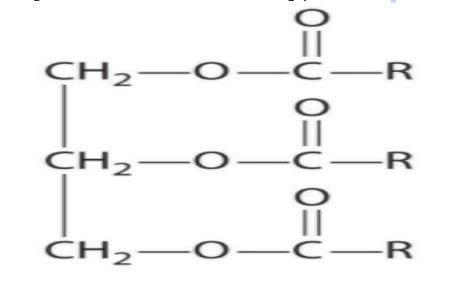
The organic molecules that store the most energy are called fats or triglycerides. The animal body uses carbohydrates (glycogen) for medium-term energy storage and fats or triglycerides (lipids) for long-term energy storage. Carbohydrates store about \[16\] kJ/g, while fats store about \[39\] kJ/g. Triglycerides are esters formed from glycerol and three fatty acids. The three fatty acids are usually different, but most common triglycerides contain \[16\], \[18\], or \[20\] carbon atoms.
The general structure of fats or triglycerides is
Note:
Note that fats store more than twice as much energy as glycogen. Among the various types of organic compounds, four major categories are found in all living things are carbohydrates, lipids, proteins, and nucleic acids.
Complete step by step answer:
A compound is a substance that consists of two or more elements. A compound has a unique composition that is always the same. The smallest particle of a compound is called a molecule.
An organic molecule is a molecule normally found in living systems. Organic molecules are usually composed of carbon atoms in rings or long chains, to which are attached to other atoms of such elements as hydrogen, oxygen, and nitrogen. Some examples of organic molecules are Carbohydrates - Carbohydrates consist only of carbon, hydrogen, and oxygen. They include starches and sugars and play an important role in our daily lives.
The organic molecules that store the most energy are called fats or triglycerides. The animal body uses carbohydrates (glycogen) for medium-term energy storage and fats or triglycerides (lipids) for long-term energy storage. Carbohydrates store about \[16\] kJ/g, while fats store about \[39\] kJ/g. Triglycerides are esters formed from glycerol and three fatty acids. The three fatty acids are usually different, but most common triglycerides contain \[16\], \[18\], or \[20\] carbon atoms.
The general structure of fats or triglycerides is
Note:
Note that fats store more than twice as much energy as glycogen. Among the various types of organic compounds, four major categories are found in all living things are carbohydrates, lipids, proteins, and nucleic acids.
Recently Updated Pages
Master Class 12 Economics: Engaging Questions & Answers for Success

Master Class 12 English: Engaging Questions & Answers for Success
Master Class 12 Social Science: Engaging Questions & Answers for Success
Master Class 12 Maths: Engaging Questions & Answers for Success
Master Class 12 Physics: Engaging Questions & Answers for Success
Master Class 9 General Knowledge: Engaging Questions & Answers for Success
Trending doubts
Which are the Top 10 Largest Countries of the World?
Draw a labelled sketch of the human eye class 12 physics CBSE
Differentiate between homogeneous and heterogeneous class 12 chemistry CBSE
Sulphuric acid is known as the king of acids State class 12 chemistry CBSE
Why is the cell called the structural and functional class 12 biology CBSE
Draw ray diagrams each showing i myopic eye and ii class 12 physics CBSE