




Ordinary light incident on a glass slab at the polarizing angle suffers a deviation of $22^\circ $. Find the value of the angle of refraction.
A) $74^\circ $
B) $22^\circ $
C) $90^\circ $
D) $34^\circ $
Answer
 Verified
591.6k+ views
Hint:The incident ordinary light will undergo refraction and reflection at the surface of the glass slab. The given deviation angle is the difference between the incident angle and the refracted angle. Here it is mentioned that the light is incident at the polarising angle. This suggests that the reflected light ray and the refracted light ray are perpendicular to each other.
Complete step by step answer.
Step 1: Sketch a figure of the light incident on the glass slab.
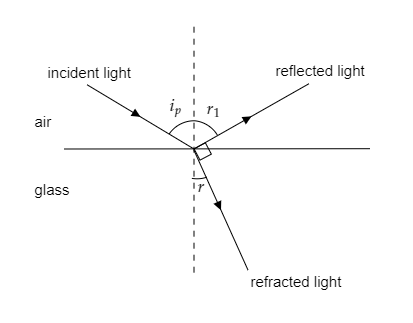
In the above figure, the dotted line represents the normal to the surface.
The angle of incidence is given to be the polarising angle so we have $i = {i_p}$ .
The angle of reflection is denoted by ${r_1}$ and the angle of refraction is denoted by $r$ in the figure.
The angle of deviation is given to be $\delta = {i_p} - r = 22^\circ $ ------- (1).
Since $i = {i_p}$, the angle between the reflected ray and the refracted ray will be $90^\circ $ .
From the above figure, we have $r + {r_1} + 90^\circ = 180^\circ $
$ \Rightarrow r + {r_1} = 90^\circ $
The above expression can also be expressed as $r + {i_p} = 90^\circ $ ------- (2).
Step 2: Using equation (1) and (2) obtain the value of the angle of refraction.
Equation (1) is given as $\delta = {i_p} - r = 22^\circ $ and equation (2) is given as $r + {i_p} = 90^\circ $ .
Subtracting left-hand side and right-hand side of equation (1) from that of equation (2) we get, $r + {i_p} - \left( {{i_p} - r} \right) = 90^\circ - 22^\circ $
$ \Rightarrow 2r = 68^\circ $ or $r = \dfrac{{68^\circ }}{2} = 34^\circ $
$\therefore $ the value of the angle of refraction is obtained to be $r = 34^\circ $ .
So the correct option is D.
Note:A part of the incident ordinary light will undergo refraction as it enters from a rarer medium (air) to a denser medium (glass) and a part of it will undergo reflection at the surface of the glass slab. The laws of reflection suggest that the angle of incidence and the angle of reflection are equal. So we replace the angle of reflection ${r_1}$ by the angle of incidence ${i_p}$ to obtain equation (2).
Complete step by step answer.
Step 1: Sketch a figure of the light incident on the glass slab.
In the above figure, the dotted line represents the normal to the surface.
The angle of incidence is given to be the polarising angle so we have $i = {i_p}$ .
The angle of reflection is denoted by ${r_1}$ and the angle of refraction is denoted by $r$ in the figure.
The angle of deviation is given to be $\delta = {i_p} - r = 22^\circ $ ------- (1).
Since $i = {i_p}$, the angle between the reflected ray and the refracted ray will be $90^\circ $ .
From the above figure, we have $r + {r_1} + 90^\circ = 180^\circ $
$ \Rightarrow r + {r_1} = 90^\circ $
The above expression can also be expressed as $r + {i_p} = 90^\circ $ ------- (2).
Step 2: Using equation (1) and (2) obtain the value of the angle of refraction.
Equation (1) is given as $\delta = {i_p} - r = 22^\circ $ and equation (2) is given as $r + {i_p} = 90^\circ $ .
Subtracting left-hand side and right-hand side of equation (1) from that of equation (2) we get, $r + {i_p} - \left( {{i_p} - r} \right) = 90^\circ - 22^\circ $
$ \Rightarrow 2r = 68^\circ $ or $r = \dfrac{{68^\circ }}{2} = 34^\circ $
$\therefore $ the value of the angle of refraction is obtained to be $r = 34^\circ $ .
So the correct option is D.
Note:A part of the incident ordinary light will undergo refraction as it enters from a rarer medium (air) to a denser medium (glass) and a part of it will undergo reflection at the surface of the glass slab. The laws of reflection suggest that the angle of incidence and the angle of reflection are equal. So we replace the angle of reflection ${r_1}$ by the angle of incidence ${i_p}$ to obtain equation (2).
Recently Updated Pages
Master Class 12 Social Science: Engaging Questions & Answers for Success

Master Class 12 Physics: Engaging Questions & Answers for Success
Master Class 12 Maths: Engaging Questions & Answers for Success
Master Class 12 Economics: Engaging Questions & Answers for Success
Master Class 12 Chemistry: Engaging Questions & Answers for Success
Master Class 12 Business Studies: Engaging Questions & Answers for Success
Trending doubts
Which are the Top 10 Largest Countries of the World?
Draw a labelled sketch of the human eye class 12 physics CBSE
Explain the structure of megasporangium class 12 biology CBSE
What are the major means of transport Explain each class 12 social science CBSE
How many chromosomes are found in human ovum a 46 b class 12 biology CBSE
The diagram of the section of a maize grain is given class 12 biology CBSE