




Only poisonous mammal is
A. Ornithorhynchus
B. Echidna
C. Guinea pig
D. Snake
Answer
 Verified
592.5k+ views
Hint: Mammals that produce poison or venom are categorized as a venomous mammal. It is a class of poison producing organisms that use poison to kill or disable prey, or to defend themselves with some additional functions. A semi-aquatic egg-laying mammal found in Australia is the only poisonous mammal from the above options.
Complete answer: Mammals are a large group of animals that are vertebrates and are characterized by the presence of mammary glands in females. Very few of the mammals are poison producing and these are characterized as Venomous mammals. These mammals produce poison to disable or kill their prey. Most of the venomous or poisonous mammals produce venom for their protection. Platypus or Ornithorhynchus is a poisonous mammal that is a semi-aquatic animal that is found in eastern regions of Australia. It is an egg-laying mammal. They sense their prey through electrolocation. It is one of the few poison producing mammals. The male Platypus has a spur which is an outgrowth of bone under a sheath of the horn. It is present on the hindfoot and is capable of secreting venom that can cause severe pain to humans. Unlike other poisonous mammals that produce venom to protect themselves, the Platypus uses it for mating purposes. The males use their poison for the competition of mates only. The poison has no significant role in protection.
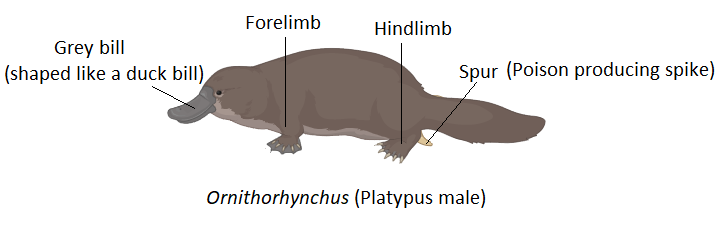
The Ornithorhynchus and Echidna both belong to order monotreme, but only Platypus is poison producing. Guinea pig is a rodent species. They are used extensively as test animals. These are not poisonous. Snake is a reptile. Although several snake species are poisonous, they are not mammals.
Therefore, the correct answer is option A.
Note: The poison produced by male spurs is also effective in the protection of the Platypus. The poison functions as a defence against pathogenic bacteria as it lyses them. The poison can kill small animals like dogs. It is not lethal to humans but painful enough to cause suffering. The poison can cause oedema development around the affected area.
Complete answer: Mammals are a large group of animals that are vertebrates and are characterized by the presence of mammary glands in females. Very few of the mammals are poison producing and these are characterized as Venomous mammals. These mammals produce poison to disable or kill their prey. Most of the venomous or poisonous mammals produce venom for their protection. Platypus or Ornithorhynchus is a poisonous mammal that is a semi-aquatic animal that is found in eastern regions of Australia. It is an egg-laying mammal. They sense their prey through electrolocation. It is one of the few poison producing mammals. The male Platypus has a spur which is an outgrowth of bone under a sheath of the horn. It is present on the hindfoot and is capable of secreting venom that can cause severe pain to humans. Unlike other poisonous mammals that produce venom to protect themselves, the Platypus uses it for mating purposes. The males use their poison for the competition of mates only. The poison has no significant role in protection.
The Ornithorhynchus and Echidna both belong to order monotreme, but only Platypus is poison producing. Guinea pig is a rodent species. They are used extensively as test animals. These are not poisonous. Snake is a reptile. Although several snake species are poisonous, they are not mammals.
Therefore, the correct answer is option A.
Note: The poison produced by male spurs is also effective in the protection of the Platypus. The poison functions as a defence against pathogenic bacteria as it lyses them. The poison can kill small animals like dogs. It is not lethal to humans but painful enough to cause suffering. The poison can cause oedema development around the affected area.
Recently Updated Pages
Master Class 11 English: Engaging Questions & Answers for Success

Master Class 11 Maths: Engaging Questions & Answers for Success
Class 11 Question and Answer - Your Ultimate Solutions Guide
Master Class 11 Biology: Engaging Questions & Answers for Success
Master Class 11 Physics: Engaging Questions & Answers for Success
Master Class 11 Accountancy: Engaging Questions & Answers for Success
Trending doubts
Differentiate between an exothermic and an endothermic class 11 chemistry CBSE
One Metric ton is equal to kg A 10000 B 1000 C 100 class 11 physics CBSE
Difference Between Prokaryotic Cells and Eukaryotic Cells
There are 720 permutations of the digits 1 2 3 4 5 class 11 maths CBSE
Draw a diagram of a plant cell and label at least eight class 11 biology CBSE
1 Quintal is equal to a 110 kg b 10 kg c 100kg d 1000 class 11 physics CBSE